
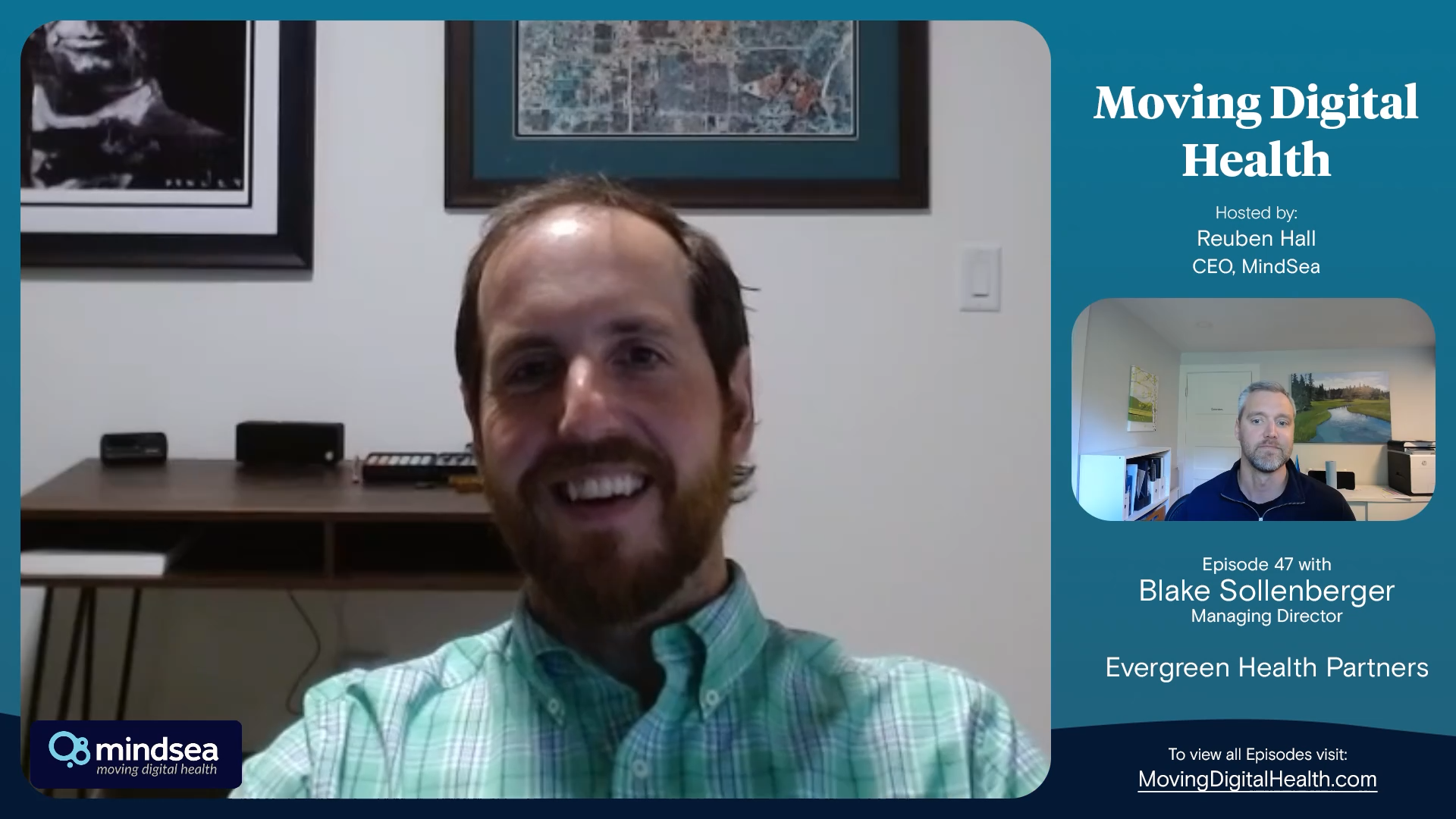
Health systems keep buying AI to clean up revenue cycle problems that better registration and training would have prevented. Blake Sollenberger has watched it happen from every seat in the building.
Blake is Managing Director at Evergreen Healthcare Partners, a consulting firm advising provider organizations on revenue cycle transformation and IT strategy. He spent four years at Epic implementing its hospital and professional billing applications. He then led revenue cycle operations as Assistant Vice President at the University of Texas Medical Branch. Before the current AI boom, he served as head of product at a machine learning company focused on clinical RCM technology.
In this episode of Moving Digital Health, Blake tells MindSea CEO Reuben Hall why the same upstream problems have driven denials for 20 years. He also covers what cautious buyers should ask AI vendors who promise to automate the cleanup. Along the way, he shares a daily standup practice that builds a 60-page operating manual in three months without a consultant in sight.
“Today in the AI era, and every day going forward, is the worst day you’re going to have interacting with technology, because each day it’s getting better.”
— Blake Sollenberger
Topics Covered in Episode 47 of Moving Digital Health (Blake Sollenberger):
- How did you end up working in healthcare revenue cycle? (00:52)
- How did moving from IT into operations change your systems thinking? (04:52)
- How did machine learning product work shape your skepticism about AI? (10:05)
- What upstream root causes should health systems fix before automating? (14:33)
- What does Evergreen Healthcare Partners do? (18:28)
- Why do organizations jump to AI before reducing variation in manual workflows? (21:53)
- What happens when best practices keep changing? (26:34)
- What mistakes do health systems make when weighing Epic against niche vendors? (28:33)
- How do you bridge the gap between IT and operations? (33:17)
- What do smart questions from cautious AI buyers sound like? (36:08)
- How does legacy revenue cycle tech complicate AI agent deployment? (38:51)
- Are providers adopting technology to counter payer gamesmanship? (40:51)
- What prep work should operators own before bringing in a consultant? (46:38)
Find Moving Digital Health on Apple Podcasts and Spotify, and subscribe to the MindSea newsletter to be notified about future episodes.
Read Transcript:
Reuben Hall (00:01)
Welcome to Moving Digital Health, a podcast series from MindSea. I’m your host, Reuben Hall, CEO of MindSea. Each week we sit down with leaders and innovators in healthcare to hear their personal stories and explore how they’re moving digital health forward.
Today, I’m joined by Blake Sollenberger, Managing Director at Evergreen Healthcare Partners. Blake brings a rare 360-degree view to healthcare transformation, having worked inside hospital and health system operations, Epic implementations, and as head of product at a machine learning company before the AI boom hit. Today, he advises health systems on what it actually takes to transform revenue cycle management without falling for the hype. Blake, welcome to the show.
Blake Sollenberger (00:44)
Hey, thank you Reuben.
How did you end up working in healthcare revenue cycle?
Blake lost his tax associate job in the 2008 financial crisis and applied to Epic without knowing its role in healthcare. Four years of billing implementations there led to a revenue cycle leadership role at UTMB and, eventually, consulting and product work.
Reuben Hall (00:45)
You have a wide range of roles in healthcare. Maybe you could walk me through your career and how you ended up where you are.
Blake Sollenberger (00:52)
Yeah. I ended up in healthcare a little bit by accident. I had originally gone to receive my college degree in accounting, and I was working at a global accounting firm as a young tax associate, and pretty quickly realized I wasn’t very good at that job. It was around 2008 to 2010, when I was graduating and started working there, and as we all know, there was a large financial crisis rocking America back then.
So through closing of branches and tightening the belts, the accounting firm that I had worked for looked at their underperforming young tax associate and said, Blake, it’s been fun, but we’re going to give you an opportunity to spread your wings elsewhere. And so I did what any young Madison-based professional would do when they find themselves unexpectedly unemployed.
I applied to this really magical-looking campus called Epic, not totally knowing the impact that they had in healthcare and all of the prestigious organizations that were using it for their electronic medical records. So I ended up working at Epic for about four years, and it was such an incredible exposure into healthcare as well as technology. The pace and the variety of work was exciting, and there were all these young professionals who were eager and soaking up knowledge like sponges.
It was just a very exciting place to work. Through that experience, I was able to implement Resolute Hospital Billing and Professional Billing, the financial applications that Epic sells as part of their enterprise suite. I was implementing that in all sorts of healthcare organizations across the nation, started to build some relationships with folks both in IT and operations, and then eventually I was extended an offer to work as an Assistant VP of revenue cycle at an academic medical center in the South, the University of Texas Medical Branch, or UTMB.
What was really amazing about that point in my career was that when I worked at Epic, I had all sorts of user readiness and operationalization methodologies that I’d either developed or had been implementing to help organizations deploy hospital and professional billing effectively to their staff members. So I had a touchpoint into operations in my time at Epic.
But one of the things I learned really quickly was how little I actually knew about operations from a day-to-day standpoint. And yet I had a very supportive leader who understood that my strengths were in understanding the IT system that was enabling our staff. She was very instrumental in growing me, in rounding out my experience to also oversee certain operational functions, as well as some shared service functions like analytics, training, and a PMO.
So I really got a good roundabout view of healthcare operations and the supporting services within it, and that kind of shaped the rest of my career in consulting and product.
How did moving from IT into operations change your systems thinking?
Blake learned how little Epic configuration work reveals about day-to-day operations. IT teams skip fundamentals like user personas and change management, then defend designs that break down in the exact conditions they exist to handle.
Reuben Hall (04:24)
That’s a wide variety of experience. And you mentioned the idea of working on both sides of the help desk ticket. How did that move from IT into hospital operations inform you about systems thinking that a lot of leaders miss from the high level?
Blake Sollenberger (04:52)
Well, first of all, it gave me a whole new appreciation for that old Mark Twain quote: it’s not what you don’t know that gets you in trouble, it’s what you know for sure that just ain’t so. And I think that really applied to my transition from IT into operations. You think you have a sense of what you’re getting into just through the configurations that you’ve done in your career to support staff and operations, but you realize how much you’re only scratching the surface when you start to deal with the day-to-day pain points and the wind changes that payer reimbursement throws at you.
When I was working at Epic, we had this concept of the model system. It’s now called the Foundation System. Basically, this was a preconfigured Epic environment based on Epic’s early adopters’ best practices. But a common pitfall of systems thinking for a lot of IT leaders is that we ignore, or never learned, some really important concepts that are centered around the user.
Take, for example, user personas. This is a concept in product management. Take user adoption, an important concept in change management. We’re so busy, from IT analysts up to leaders, falling in love with our own design that we forget about the user, and we’re often unwilling to destroy our masterpiece in pursuit of that end user’s dilemma.
I like to talk about this with an analogy. Think about the umbrella. It’s received some minor innovations over the decades, right? Ergonomic grips, telescoping handles. But it’s essentially still the same functionality an umbrella has always been. It’s that same design that flips inside out whenever a strong gust of wind exposes the end user to the elements.
So in essence, it’s built to break down in the exact environment and circumstances that it was meant to protect you from. If we extend that problematic thinking to a lot of IT leaders thinking about destroying their masterpiece and saying, this is good enough, and I shouldn’t even say we, I can say for myself: I’ve deployed features or implemented functionality, and I’ve seen it break down in some of the toughest circumstances that it was built for.
It’s in those moments, through the experience I’ve gained both as an operator and in product development, that I need to ask myself: did I understand the user persona and their use case? Like truly understand it, going back to that product management concept? Was my socialization of the change consistent? Was it repeatable? Was it predictable? Was it adequately enveloped into the existing user role? That’s change management. If it didn’t satisfy either or both of those fully, then I need to be willing to destroy my masterpiece and build a better umbrella.
Reuben Hall (07:43)
Yeah, we see it a lot at MindSea too. Over the years we’re often building net new products, so starting with nothing and building a vision, whether it’s a digital health intervention or some type of software. We really preach the approach of testing your assumptions first about how this product is going to work, doing user testing early, doing user research and getting feedback.
But there is this archetype of the strong leader with a strong vision. They know what they want, and it’s hard to steer them off that course. Without those checks and balances of involving the end user in the product, it’s really hard to get it right until you launch. And then you realize how you missed, and it’s a lot more expensive to fix things at that point than it is earlier in the process.
Blake Sollenberger (08:53)
Yeah, absolutely. IT leaders can fall victim to systems thinking, and they can fall victim to falling in love with their own masterpiece. But you’re absolutely right. Just as dangerous to a product development lifecycle as a developer who’s unwilling to walk a day in the shoes of the end user is the wrong executive champion within operations who has an idea already in mind of what they want.
When we think about customers, they really need to own the problem and be able to articulate it effectively. But you need to allow those IT developers, those analysts, to be able to own the solution.
How did machine learning product work shape your skepticism about AI?
Focus and precision determine outcomes, and vendors claiming excellence across dozens of use cases can rarely sustain either. Blake compares it to a restaurant with 100 menu items: the kitchen can’t cook all of them well.
Reuben Hall (09:36)
100%. So about five years ago, well before ChatGPT changed the conversation, you made the jump to head of product at a machine learning company that was focused on clinical RCM tech. Back then it was all about model precision, not large language models. How did that experience shape your skepticism or worldview around AI in healthcare?
Blake Sollenberger (10:05)
What it taught me was that focus and precision matter. If we’re blue collar about our focus, if we’re fanatical about our precision, then we’re going to achieve optimal patient outcomes. Or in the case of financial RCM tech, we’re going to raise that financial ROI. In many ways the stakes may be different, but machine learning product development and healthcare both require focus and precision to achieve those optimal outcomes.
So when you ask me about my skepticism: focus and precision are hard things to do at scale and across an organization’s culture. They’re even harder to sustain. If you’ve ever gone to one of those restaurants with 100 items on the menu, well, even before you’ve ordered something you already know there’s no way they can cook both a pot roast and a tortellini beautifully.
It’s the same concept in evaluating AI claims, because many of them have very grandiose claims across many different use cases. To presume that they’re able to focus on precision and sustain it across all these use cases and all these products in their portfolio, it’s virtually impossible, just as much as it’s impossible to maintain 100 quality items on a menu.
So I’m pragmatically skeptical. But I do still fall in love with technology deep down in my heart, so I guess I’m a bit of a tortured soul in that regard. The good news is, with LLMs and agentic AI, it’s accelerating the development iterations that are going on right now. It’s accelerated the growth curve of AI technology’s capabilities, and we’re seeing it get faster every day.
And so the good news is, this means today in the AI era, and every day going forward, is the worst day you’re going to have interacting with technology, because each day it’s getting better. So I’d say my skepticism is lightening up due to the era we’re in now with LLMs and agentic AI, and the proliferation of all these base technologies that underpin a lot of these specialized products.
But because of my time in product management at a machine learning company, my discernment is stronger. Scrutinizing the claims, and evaluating the vendor’s competency to really press and understand whether they have focus and precision, is what’s truly going to matter, because that DNA is going to get into the product itself. If they’re unfocused or they’re trying to do too much, that’s going to matter versus competitors who weren’t trying to stretch themselves too thin and were maybe doing it more effectively.
Reuben Hall (12:56)
Right. You see the large language models seem to just add more and more use cases, and this idea that, well, that model is so great it can do anything, right? But really, that generalist Swiss Army knife model is great at a lot of things, but for specific things, more specialized, focused tools can do a better job.
Blake Sollenberger (13:28)
Yeah, absolutely.
Reuben Hall (13:29)
I also think, to your point about precision, there’s the idea of asking the same question to an LLM but getting slightly different outputs every time. Even though those outputs are still high quality, it’s not the exact same output. So the concern of repeatability and precision in the outputs comes up there as well.
Blake Sollenberger (13:58)
Yeah, for sure.
What upstream root causes should health systems fix before automating?
The same ones from 20 years ago, starting with incomplete registration and missing prior authorizations. Blake argues real-time eligibility data already answers most front-desk questions, but organizations never wire it into discrete EMR fields.
Reuben Hall (13:59)
There’s a great quote you share from a VP of revenue cycle that you worked with before: building bots without cleaning up the process first is like fishing bodies out of the river. You get great at retrieval, but nobody asks why there are bodies in the river. So when you walk into a health system today, what are the upstream root causes you’re trying to segment out, rather than just papering over them?
Blake Sollenberger (14:33)
Unfortunately, it’s some of the same things we’ve always been trying to solve for. It’s funny, I was just talking with a colleague recently. He jumped back into healthcare consulting, revenue cycle consulting specifically, after being away for about a decade. After his first couple months on the job, I checked in with him, asked how he was doing, and he chuckled. He said, man, we’re still trying to solve the same problems we were when I left revenue cycle.
And that’s true. Much of the upstream fixes that reverberate into the back-end claim cycle and throughput, it’s still proper patient registration. It’s defensible and specific documentation. It’s completed prior authorizations. Maybe the difference from 20 or 30 years ago to now is the sheer volume of procedures requiring prior auth, or new product types, marketplace plans, Advantage plans in the coverage ecosystem that patients have to be registered under. Or maybe it’s more complex patient out-of-pocket minimums that make insurance verification, and patient service reps’ solicitation of patient deductibles, coinsurance, and co-pays, all of that more difficult. But we still didn’t solve it with real-time eligibility, real-time authorization, or those HL7 standards that everybody’s been implementing and optimizing over the last decades. We still have the problem, right?
What I’ve seen is that people are trying to automate waste on the back end with AI and automation. Using registration as one of the key upstream challenges: the back end is trying to just keep their head above water, when the real magic is going all the way with implementing your RTE and RTA configuration.
Even before you do some of those more interesting and sexy things like AI and automation on the back end, it’s really just doing good plumbing work: connecting your RTE responses from payers back into discrete fields that you can file into Epic or your EMR. It’s shoring up your coverage filing order logic. The payer is sending you those service-level auth requirements. It’s sending you the patient out-of-pocket details. But it’s not filing anywhere in the EMR. It’s just sending the message back.
And instead we ask those gatekeepers of our revenue cycle, those patient service reps at the front desk who turn over every six months, who managers are competing to staff with JCPenney and QuikTrip, these people who don’t understand healthcare, to interpret these electronic messages and enter them manually. Because we all installed the bare minimum RTE features and we put up this big mission accomplished banner, like we solved our registration denials. And we didn’t. We need to focus on the functional competency and training budgets.
I know it’s not as sexy as AI, and it’s not a transformative statement I just made, but it is a fact. These are staff members who really have no exposure to healthcare. What’s the responsibility of the insurer? What’s the responsibility of the patient? What am I coming in for that’s actually going to be covered according to the RTE response? These are complex things that staff have to interpret. The information is there, and yet we’re not discretely filing it to clean up some of these things and get more accurate registration early. So instead, we’re just putting more bodies in the river that we’re asking AI and automation to clean up later.
What does Evergreen Healthcare Partners do?
Evergreen is a nine-year-old consulting firm that began in Epic-focused IT staffing and now offers strategic services across revenue cycle, IT planning and assessment, clinical optimization, and ERP. Its consultants pair operational and IT experience, which Blake credits for the firm’s top KLAS scores.
Reuben Hall (18:18)
You hit on some key points there, Blake. I think that would be a good time to stop and learn a little bit more about Evergreen Healthcare Partners and what your role is there.
Blake Sollenberger (18:28)
Yeah, absolutely. Evergreen Healthcare Partners, we just celebrated our ninth year. We started with our humble beginnings in Epic-focused IT staffing and consulting. Over the years, we’ve developed a strategic services wing within Evergreen that includes pillars like revenue cycle, IT planning and assessment, clinical optimization, ERP, and Workday. We’ve done a lot of good work rooted in solving business problems, leveraging technology to enable those improvements.
But it’s not so much focused on the hours that a consultant works. It’s focused on solving the problem. So we’ve done a lot more deliverables-focused work, we’ve done a little bit of at-risk work, and we’re growing every day with a lot of incredible recruitment to help organizational leaders, both on the operations and the IT side, solve some of their more complex problems with some really elegant methodology and repeatable services.
One of the things that I’ve appreciated in my navigation of my career, from product to ops to IT to consulting, is that when you have a mind that’s on both the operational and IT side of a help desk ticket, you can see the picture more clearly and understand where the best place to solve a problem is. What’s fascinating is we have so many people like that at Evergreen that it’s really humbling. It’s incredible to work with these people day in and day out.
So it’s really a reward to be here. The culture is incredible, and we feel that every day working with our clients, and it shows in our KLAS scores, which are top in a lot of key categories. The evidence is there that taking care of your clients, taking care of your consultants first, everything else works out on its own. We’re really client focused here. We’re fanatical about outcomes, and we’re blue collar about the work to get there.
Why do organizations jump to AI before reducing variation in manual workflows?
Because reducing variation in humans is a lot tougher than turning on a product, Blake says. His fix costs 15 minutes a day: standups where every front-end supervisor delivers the same bite-sized SOP refresher to all patient-facing staff. Three months of those tips becomes a 60-page operating manual.
Reuben Hall (20:43)
There are some parallels to my experience at MindSea, and a similar kind of client and service focus. Before I took over as CEO, I was working as the director of product, and before that on the user experience and design side. One of the things I was always asking myself throughout the day was to put on a fresh set of eyes, put yourself in the user’s shoes, whether it’s the end user who’s using that software product or the client that you’re working with, and see things from all those different perspectives. Like you say, seeing the problem from different perspectives as well.
So you often quote a CFO who said you have to be effective before you can be efficient. Why do so many health systems jump straight to wanting the silver bullet, more with less via AI bots, before they’ve actually reduced the variation in their manual workflows?
Blake Sollenberger (21:53)
It’s really simple. It’s because reducing variation in humans is a lot tougher than turning on a product. But if you’re an operations manager or director listening to this, I promise you it’s worth it. Don’t just publish new standard operating procedures or new tip sheets out on SharePoint. You’ve got to socialize them, and it’s easier than you think.
Let’s extend that previous example I was talking about with registration and RTE for just a minute. I’m going to give your healthcare operators that are listening a takeaway that they can implement on their own, without consultants, in the next couple of weeks. And it’s going to pay off over the next couple of months really quickly, both in their metrics and in their reduced variation.
So here it is. Require and verify that every front-end supervisor you have that oversees patient-facing front desk workers who are collecting registration information conducts 15-minute standups with those staff every morning. In that 15 minutes, include a bite-sized tip sheet or an SOP refresher. These daily tips are on an ongoing calendar, where every day there’s a new bite-sized tip about how to perform their role more effectively, or a reminder about a standard operating procedure. That way, every person in that organization who interacts with a patient and asks for an insurance card has all heard the same expectation, the same way, on the same day, regardless of whether you’re centralized or decentralized, regardless of who their supervisor is.
That’s going to pay dividends, because you are setting a repeated, consistent, and predictable expectation about standardized work, and it’s built into the culture on a daily basis at every standup. And to do that, the day prior, supervisors should all be on their own 15-minute huddle. This could be with a learning specialist or with a manager who’s feeding them the next day’s tip sheets. This trains the trainer in a drip fashion, so the supervisors are knowledgeable before it’s spoken to the staff the next day.
And then voila, in three months, even if you’re starting from no documentation or woefully thin documentation, by simply implementing this, you’re going to have a 60-page operating manual for your staff at the end of those working days. It’s role focused. It supports new employee training and continuing education. And it’s not just click-focused IT training manuals on how to click through your EMR, how to click through Epic, without truly understanding your functional competency, what it means to do your role, like correctly setting a filing order on a dual-enrolled Medicaid patient.
Unfortunately, what I’ve seen way too often is that operational departments have abdicated the training responsibility for new employees and continuing education to the pre-baked IT manuals that their IT teams get from Epic. So yeah, staff are learning how to use Epic, but they’re not really understanding their role. Just by ingraining this in a daily 15-minute standup, which isn’t a big time investment, and which actually sets the proper expectations for the full day, it’s going to pay dividends so quickly. You’re going to have all the better documentation for it, and consistent standards. And again, this doesn’t require the pain of pulling reporting lines into a centralized shop. It can be done in any environment.
What happens when best practices keep changing?
Staff never get the chance to excel, which usually signals too many simultaneous product implementations or heavy leadership turnover. Blake’s rule: a standardized process beats an unstable best practice.
Reuben Hall (25:24)
I love that example of a practical operational takeaway. Sometimes it’s easy to talk about things at the high level and in ideal scenarios, but to get down to the details of practical tips that people can take away, I love that.
One thing I will challenge you on, though: I think that idea of involving best practice in those daily standups and updates is excellent. What about when the process itself is constantly changing? What I’m seeing is that with technology and new tools and new workflows, people in those operational roles have a hard time keeping up, because what is considered a best practice is changing so quickly.
Blake Sollenberger (26:34)
I think it’s the reason for the mantra: effective, then efficient. If the state of change is so rapid that it’s making previous best practices outdated before you’ve cycled through a full user role’s expectations in a 60-day period, then you’re not letting your own staff’s nervous system reset. That means you’re probably taking on too many product implementations all at once. Or it means you’re probably showing symptoms of heavy leadership turnover, where everybody new is trying to place their stamp on the organization early and demonstrate their ability.
Those are the things you need to reflect on as an organization. If we are constantly changing the manual as we’re deploying it, then we’re not really giving our staff the opportunity to excel. Even if it’s not best practice, if it’s at least standardized, you’ve made the win.
What mistakes do health systems make when weighing Epic against niche vendors?
Buyers demand ROI proof from the third-party vendor but never from the unimplemented Epic feature competing with it. If the specialized product’s return outweighs the technical debt it adds, Blake says let it into the ecosystem.
Reuben Hall (27:37)
It’s a great point that even though technology is changing so fast, people can only adapt their day-to-day at a human pace. We can’t expect them to always be learning new things without any break, without any opportunity to develop a solid routine and become experts at that workflow.
You mentioned Epic and your time there. It’s everywhere in hospital revenue cycles. What are the big mistakes that health systems make when deciding whether to extend Epic’s native RCM tools versus plugging into niche third-party solutions?
Blake Sollenberger (28:33)
I think the biggest mistake organizations make is asking the third-party vendor that’s trying to enter the organization, either through a pilot or an enterprise deal, to prove their ROI, but not asking the same of the competing Epic feature that already exists but isn’t yet implemented. I know adding third-party vendors increases technical debt, and Epic just offers a competing feature for free. But does that feature compete on return? That’s the question. Epic is an enterprise system. It’s very feature rich and it does a lot of things well, but it may not always be best of breed on any given feature.
If the deficit in return between that third-party vendor and Epic is made up by the reduced technical debt, then go with Epic. But Epic has to satisfy so many use cases and users across many applications, versus the specialized third-party product that’s niche and focused on that specific problem. If the reduced technical debt doesn’t make up for the difference in ROI, then we need to be open to allowing some of these specialized products and services into our ecosystem.
Because once upon a time, and it wasn’t even that long ago, a couple decades, revenue cycle departments had their own IT staff for all of their revenue cycle-specific products. When enterprise Epic was purchased by these organizations, everyone was centralized into IT from all these disparate departments. Those IT analysts who were supporting the users, all the people who maintained and implemented those systems, started to lose their functional competency over time, because now they were centralized in IT, not embedded in the department they serve.
Meanwhile, on the inverse end, users who had functional competency but were switching over to a new system, and this isn’t going from an Android to an iPhone, this is going from one legacy EMR like Cerner to Epic, they lose technical competency immediately on day one, while the IT staff lose functional competency over time. But anyone in revenue cycle operations who went through that big market change of IT centralization and was able to hold on to their SQL report writer, or hold on to a configuration specialist and get them certified in Epic, or a trainer in Epic, those people know what I’m talking about when I emphasize how important it is to embed your IT, training, and analytics folks into your revenue cycle.
It’s funny, given that a lot of our clients and partners at Evergreen are IT leaders. I know many of my colleagues who are CIOs are probably cursing me for saying that. But think about it: we have clinical informatics, staffed with physician informaticists and nurse informaticists, and they’re all licensed. They’re functionally and technically competent. They have both sides in their competency. They’re building those edge features, building out the clinical content and the personalization for physicians that IT has offloaded to the informatics department.
Ask any Epic ambulatory certified resource or any inpatient certified resource how invaluable their partnership with clinical informatics is. They’re all going to tell you it’s aces. But talk to the billing IT analyst and ask them where their business informatics team is. It doesn’t exist. There’s no home for functional knowledge and content build. Just as we have clinical informatics as a funded department at healthcare organizations, we need a similar concept for revenue cycle. Otherwise, we’re going to continue in this push and pull of, should we just go with Epic, or do we need to outsource to a vendor, because they have the competency that we gave away out of our budget into a centralized IT team, and then lost all that knowledge with it.
How do you bridge the gap between IT and operations?
Evergreen staffs consultants who hold both operational and IT fluency, a combination Blake compares to recruiting Blue Man Group: drummers who act are hard to find. Epic-era centralization stripped that dual competency out of most health systems.
Reuben Hall (32:57)
In your role at Evergreen, is that something you get involved in, analyzing a health system’s roles and departments, and potentially advising changes or reorganization there?
Blake Sollenberger (33:17)
Oh, all the time. Not necessarily reorganization. When it comes to a concept like business informatics, there are a couple of leaders in healthcare who have recognized this similar need on the administrative side, where it’s already been solved on the clinical side with informatics. I’m hopeful that catches hold over time, because it would be a benefit.
But for the organizations that are lean, or who are safety net and don’t really have the margins to support that, going back to why I love working at Evergreen: one of the things we really help with, having that dual operational and IT experience in most of our strategic services team members, is being able to be that bridge and liaison between IT and operations. We take complex business requirements and distill them down into salient terms, so operations can understand what they’re requesting and what the implications of an IT solution might be, and then translate that for an IT team who needs to understand those business requirements as specifications. We’re just really good at translating.
Maybe this is a bit silly, but I always like to think about the people I work with as blue men. I don’t know if you’re familiar with Blue Man Group, right? It’s the Broadway show. The thing about that is, how do you recruit a blue man? Do you get a drummer that knows how to act, or do you get an actor and teach them how to drum? It’s hard to find somebody who’s both a drummer and an actor.
In the healthcare revenue cycle, and probably in a lot of functions within healthcare, having somebody who understands both operations and IT at a really down-to-the-ground level is really rare. I think we’ve collected a lot of those gems here at Evergreen, and we’re deploying them every day out to our clients, developing repeatable methodology, and getting better at it every day. That’s one of the promises we make at Evergreen: we understand not just how to make a PowerPoint about fixing the problem. We can actually translate from being an advisor to rolling up our sleeves and executing.
Reuben Hall (35:44)
Yeah, sounds like a group of unicorns, essentially.
Blake Sollenberger (35:48)
Yeah, for sure.
What do smart questions from cautious AI buyers sound like?
Make the vendor shadow your most experienced biller for a week, then ask how they will co-own change management and staff adoption with your managers. Blake says the current market feels like dating after divorce: buyers are still interested but asking better questions.
Reuben Hall (35:49)
So you’ve described the current AI market in revenue cycle management as dating after divorce. Health systems are still interested, but they’ve been burned by overpromising and underdelivering. What do the smart questions from cautious buyers sound like?
Blake Sollenberger (36:08)
Over the last decade, there have been plenty of AI and automation companies that have crashed and burned, selling health systems on some pretty grand claims across a lot of ambitious use cases. A lot of health systems believed in the promise, got it through IT procurement, made the investment, and got burned.
So right now, understandably, for healthcare organizations evaluating AI products for purchase and implementation, it is a bit like dating after divorce. We’re all a little bit wiser now. We’re all a little bit more hesitant, and we’re asking better questions before we go falling in love again with the next AI or automation vendor.
If you’re considering an AI vendor promise, there are a couple of things you can do to help sift the signal from the noise. One of them is, make them come out and shadow Betty the biller for a week. She’s been doing this for 30 years and she knows how to do it. This is the user persona.
Next, ask them: together, and when I say together, I mean both you the vendor and us, operations and our managers, how do we work together to manage the change for staff and ensure widespread adoption once implemented? A lot of product vendors are lean. Maybe they’ve got a couple of proof points, or they’re in beta and not fully to market, or they’ve only got an MVP. One of the things that’s going to be harder for them to manage on their own is the actual user adoption and change management itself. They can implement the software, but if nobody’s using it, you didn’t get the uptake you were looking for.
Even if it’s a newer startup, you can assess for competency and excellence. There are a lot of people doing really great work at a lot of really interesting companies. It’s just identifying which ones are the right partners. And you have to stress test them by making them come out and shadow folks, making sure they really understand your problems and can articulate them effectively, what the solution is, and how best to get your staff to adopt it.
How does legacy revenue cycle tech complicate AI agent deployment?
Rigid specs and flat files still break transactions, but Blake believes AI agents on both ends of an exchange will soon turn good-enough data into filable transactions. Intelligence keeps getting better at handling imperfect data sets without manual cleansing. Paul Wareham covered the FHIR and HL7 tradeoffs behind this in his guide to integrating a custom patient app with your EHR.
Reuben Hall (38:26)
On the clinical side of digital health, we talk a lot about modern APIs and HL7 FHIR standards. But on the revenue cycle side, there are still a lot of flat files and nightly batch updates. How does that legacy tech foundation complicate the deployment of AI agents?
Blake Sollenberger (38:51)
We talked about it a little bit already with HL7 standards, but also extending to APIs, I think we’re approaching a point in technology where precise, discrete, and formatted data exchange is going to get easier. I don’t think it’s there yet, but I think we’re right at the precipice of it. Rigid specs that would break an entire incoming transaction from posting in one system, that’s soon going to give way to one system’s AI agent giving maybe almost perfect, maybe good enough data out, and the receiving system’s AI agent will be capable of doing additional ETL, additional data transformation and updates, to effectively file that transaction into their system.
The amazing thing that I think we’re all going to witness pretty soon is that historically, good artificial intelligence has required precision in data. But more and more, intelligence is getting better at handling larger and imperfect data sets without all the data cleansing that’s historically been very necessary, manual, and dependent upon consistent user input.
Are providers adopting technology to counter payer gamesmanship?
Health systems are deploying underpayment detection and denial pattern surveillance to catch takebacks and silent downgrades at scale. Blake reframes the fight as contract compliance, which moves it from revenue cycle to managed care and legal.
Reuben Hall (40:07)
I’ve seen that as well, where all of a sudden, instead of being so focused on getting that perfect data, it’s the AI that’s helping to massage the data into the usable format, essentially building a more flexible system.
The payer landscape has gotten increasingly complex. It’s no longer just straightforward denials. There are subtle takebacks, balance forwarding, and downgraded payments. Are health systems adopting technology to counteract that kind of automated gamesmanship?
Blake Sollenberger (40:51)
The payers’ whole premise is to hold on to premiums. Even if I try to assume best intentions, that they’re not just holding the money for money’s sake, they’re trying to elicit value from the providers while the providers are trying to maximize reimbursement. In the meantime, AR continues to climb while cash is only trickling in the door.
We’re getting to such a complex and really adversarial time in payer-provider collaboration in our healthcare system. A lot of that has resulted in payers heavily investing in AI technology to withhold payment so they can make that yield on the float. But health systems too, they’re starting to understand what’s happening, and they’re feeling the pinch of it. They’ve acted, because you can’t simply do nothing. So now they’re investing in technology to defend themselves, deploying sophisticated contract analytics platforms, AI-driven underpayment detection, denial pattern surveillance, and any automation that can identify some of those things you talked about, like balance forwarding, silent reimbursement downgrades, and takebacks. That would have been nearly impossible to detect at scale a few years ago, before AI.
But I think we need to be careful not to treat this primarily as a revenue cycle problem or just an IT problem. Yes, technology is helping the organization find the issue faster, but technology isn’t and won’t solve the issue itself. What’s really happening is that many of these tactics the payers are deploying represent a failure of contractual compliance. These are contractually agreed-to reimbursement dispute pathways that aren’t being taken. If a payer is systematically forwarding these balances or automating payment reductions that weren’t contemplated in the contractual agreement, then that’s not simply an accounts receivable challenge. It’s a deviation from the negotiated terms of the contract.
What we’re already seeing is health systems starting to shift the conversation from how do we recover these dollars, to why are we even allowing these noncompliant reimbursement behaviors to continue in the first place. So it’s not just revenue cycle anymore. Managed care departments are now using technology to generate evidence, quantify the impact, and identify the patterns. Then they’re taking these findings back to the contract, back to the payer, back to legal, and they’re having more informed executive contract conversations.
Reuben Hall (43:34)
And so it’s up to the regulators to enforce the payers’ responsibilities and, like you said, make them live up to their end of the bargain.
Blake Sollenberger (43:44)
There have been some attempts to do that recently, and a lot of them have been more focused on the patient-facing portion specifically, around things like price transparency legislation and the No Surprises Act. There are some states that have taken price transparency a step further, and there are some states where governments are getting more involved, at least on the Medicaid and CHIP programs. Minnesota and Maryland come to mind as really forward-thinking ones.
But I wouldn’t say there’s anything from a regulator standpoint that has teeth, beyond CMS and arbiters and pathways to make these complaints, especially for Advantage payers that aren’t adhering to Medicare guidelines. That still requires dispute resolution. That still requires evidence gathering. Even if it’s not a denial, it’s still a withholding, and it’s a denial by any other name. When a payer does what they’re doing, knowing it’s probably a breach, they’ll still spend the time going through dispute resolution, because it holds on to the money.
As long as the relationship is that the payer is giving and the provider is extracting the cash, the payer is always going to be in that position of leverage, because they can simply hold on to the money. So really getting to better agreed-to terms upfront, involving revenue cycle much sooner in renegotiations or net new managed payer relationships, getting those agreed-to terms into your contracts, and then treating any bad behavior as a contractual breach, those are the things that put more teeth behind it and are going to make a payer more sensitive to obstructing and obfuscating payment.
What prep work should operators own before bringing in a consultant?
Shore up your SOPs and get managers walking the floor before discovery starts. Blake also tells executives to evaluate which leaders blame IT for every operational problem, because those leaders will block adoption no matter the solution.
Reuben Hall (45:47)
It’s an interesting battleground. Those relationships have been around for a long time between the hospital system, the payer, and the patient, but now with AI, it’s leveled up the complexity of the push and pull in that system.
You have an analogy that consulting partners are like house cleaners, but the client still has to tidy up before they show up. For the digital health founders, product leaders, and operators listening to the show, people that want to transform their operations and improve efficiency, what’s the prep work they must own internally before bringing in an external advisor?
Blake Sollenberger (46:38)
If you’re an operator and you’re looking to transform your operations, maybe you’re even considering using a consultant, the things you should be doing to tidy up before they help you clean up: you’ve got to collect and shore up your SOPs. Are they outdated? You’ve got to evaluate your current state. That’s workflows, systems, training materials.
Yes, the vendor can and will do that too, but I can’t tell you how many times I’ve shadowed end users the week after I’ve interviewed their managers as part of discovery, and what the managers believe is happening versus what’s happening on the floor and in the cubicles couldn’t be any more different. You have to understand your business before the consultant does, because the consultant is going to own explaining the solution and implementing it for you. But the operators need to be able to effectively describe the problem. Maybe not fully quantify it or pinpoint it exactly, but be able to speak to the pain points their staff is seeing every day.
So make sure your managers are more intentional about walkabouts with staff, so they’re always understanding what’s actually happening on the floor. Do account sampling, not just for QA, but for your own familiarity. Expect that your staff provide you examples of problems, so you’re not always chasing boogeymen.
Lastly, from a personnel standpoint: if I’m an economic buyer at a healthcare organization, a key executive, I have to evaluate the leaders on my team before the consultants arrive, because there are going to be some potential obstructions if we’re trying to enact meaningful change. Ask yourself, who’s on my leadership team? How many times are they telling me every problem they’re facing is an IT problem? It’s never an operational problem, it’s always an IT problem. Can they never give you the quantified answers, or know what their metrics truly are, because they’re claiming the analytics team still hasn’t built that perfect report for them? Do they resist change? These are all huge red flags.
Even when that perfect report doesn’t exist, or that perfect system isn’t filing the right accounts to you, you can still sample 20 accounts to get an idea of the nature of the problem, even if you can’t quantify it. Leaders have to expect that managers are aware of their business and the problems facing them, regardless of how deficient their IT solutions are. That can’t be an excuse. It’s kind of like what my old basketball coach used to say: hey, if you’re running back on defense and you can’t find your man, just guard somebody, right? The answer isn’t to just stand there. Mark up a man and follow him until you can find your man. It may not be the most effective thing, but at least you’re productive.
Because when you have those folks who are always saying their problems would be solved if IT would get better, or I would know my metrics better if analytics could just build the right report, or every time you propose a solution they’re playing devil’s advocate repeatedly, that’s a sign that they don’t truly understand the business they oversee, and they lack the skills to execute. You’ve got to get them functional coaching immediately. Otherwise, they will inhibit organizational change and user adoption in their area, no matter what solution you implement. Those would be some of the things I would recommend, both as part of onboarding a consultant and preferably even before.
Reuben Hall (49:55)
And I love the line: you just can’t blame IT for all your problems, right?
Blake Sollenberger (50:00)
Right. It’s convenient to do, but not always effective.
Reuben Hall (50:04)
All right. Well, thank you so much for joining me on the podcast today, Blake.
Blake Sollenberger (50:07)
Yeah, absolutely. Thank you, Reuben.
Reuben Hall (50:09)
And thanks to everyone for listening to the Moving Digital Health podcast. If you enjoyed this conversation, please go to MovingDigitalHealth.com to subscribe to the MindSea newsletter and be notified about future episodes.