EMR integration services to connect your healthcare app to your clinical systems
Turn disconnected healthcare data into a connected experience for your clinicians and patients. MindSea designs the EMR and EHR integration layer that lets your healthcare app exchange data with the clinical systems your team already uses, with interoperability standards like FHIR and HL7 built in from the start.
Custom mobile and web apps across digital health categories like chronic disease management and behavioral health, designed to integrate with your EMR from the start.
Video visit platforms with patient scheduling and billing that sync with your EMR, so a telemedicine visit shows up in your EMR the same way an in-person visit would.
Discover clinical and technical requirements through structured workshops with clinical and compliance stakeholders to map your EMR and EHR environment
2
Compliance by Design
Design integration architecture around your specific systems with FHIR/HL7 standards and regulatory compliance built in from the start.
3
Security Standards Development
Build and test secure, standards-based integration layers across environments
4
Deployment & Support
Launch, monitor, and support continuous improvement post-deployment
In Practice
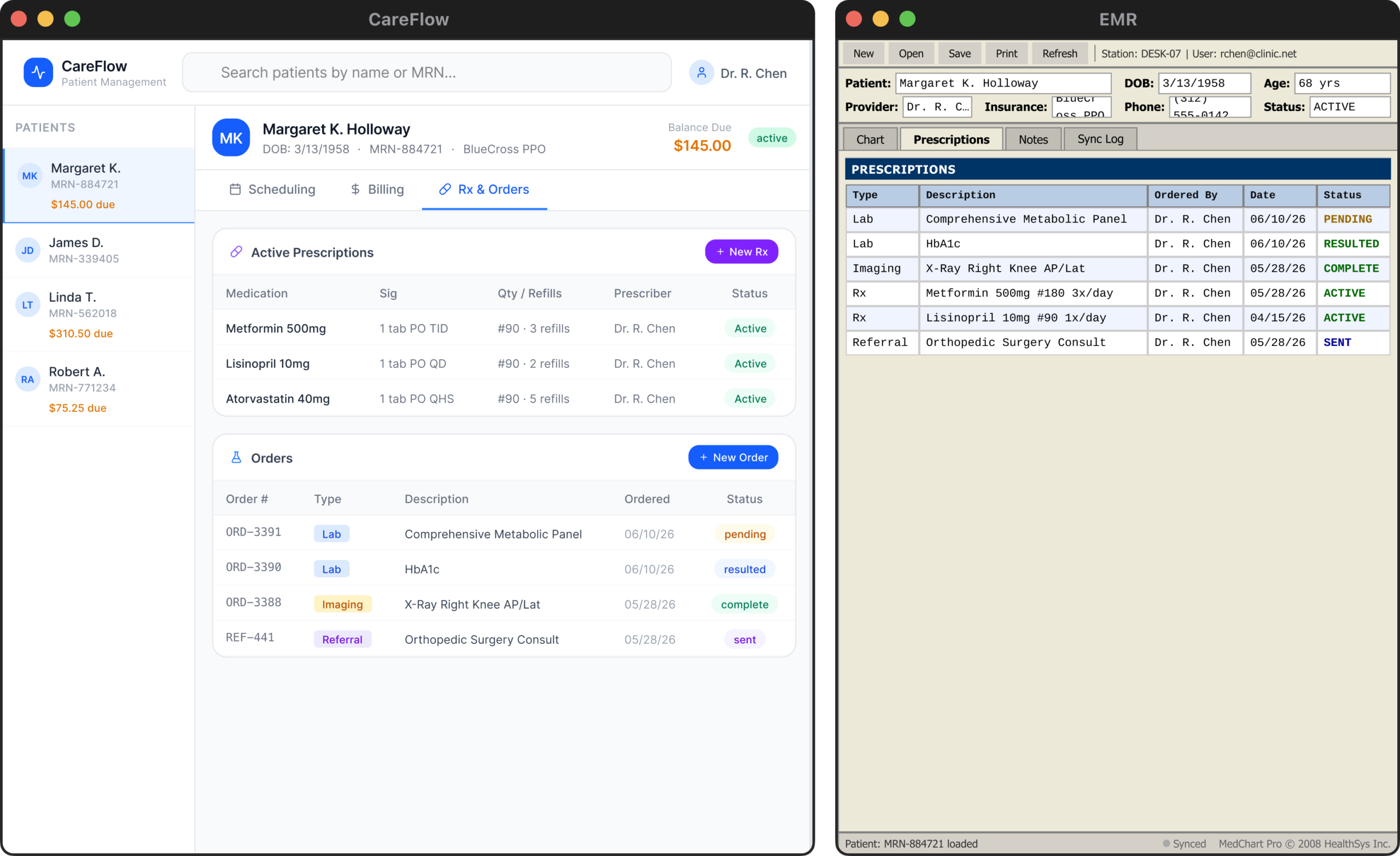
What an EMR-integrated app looks like in practice
An EMR-integrated app pushes patient activity, billing codes, and appointment changes back into the clinical record automatically, so care teams work from one source of truth instead of stitching systems together.
What our clients say about us
18 years
serving clients with reliable apps
10 million+
lives impacted
250+
successful projects delivered
“The company’s best quality is their ability to ‘really’ listen and transition the client’s thoughts into an executable plan… The scope of work included creating a HIPAA compliant platform for the basis of our telehealth company partnership, fully integrated seamlessly into the patient engagement and marketing platforms.””
–Rachel Boryachinskiy, CEO Development & Operations, Healthcare Deciphered
If you want to build EMR and EHR integrations that connect clinical systems, improve data flow, and support better-informed care across care teams, book a call with Alex Ferrari, VP Partnerships
How does EMR and EHR integration support day-to-day clinical workflows?
It ensures patient information flows directly into the systems clinicians already use, reducing duplicate data entry and improving access to accurate, up-to-date records during care delivery.
Does integration disrupt existing systems or workflows?
Integrations are designed to fit into existing environments with minimal disruption. Careful planning and testing, along with a phased rollout, help maintain continuity while improving system performance.
Can integration help improve patient outcomes?
Yes, it can. Connected systems can give clinicians a more complete view of patient data, supporting faster decisions, better coordination, and more consistent follow-up care.
How is patient data kept secure and compliant during integration?
Security is built into every layer, with encryption, access controls, and audit trails aligned to healthcare regulations such as HIPAA and clinical governance standards. Read our comprehensive guide on building HIPAA-compliant apps.
How long does an EMR or EHR integration project typically take?
Timelines vary based on complexity, systems involved, and compliance requirements. Most projects move through defined phases to ensure safe, reliable deployment without rushing critical steps.
Partner with us to improve how EMR and EHR systems support care delivery across your organization