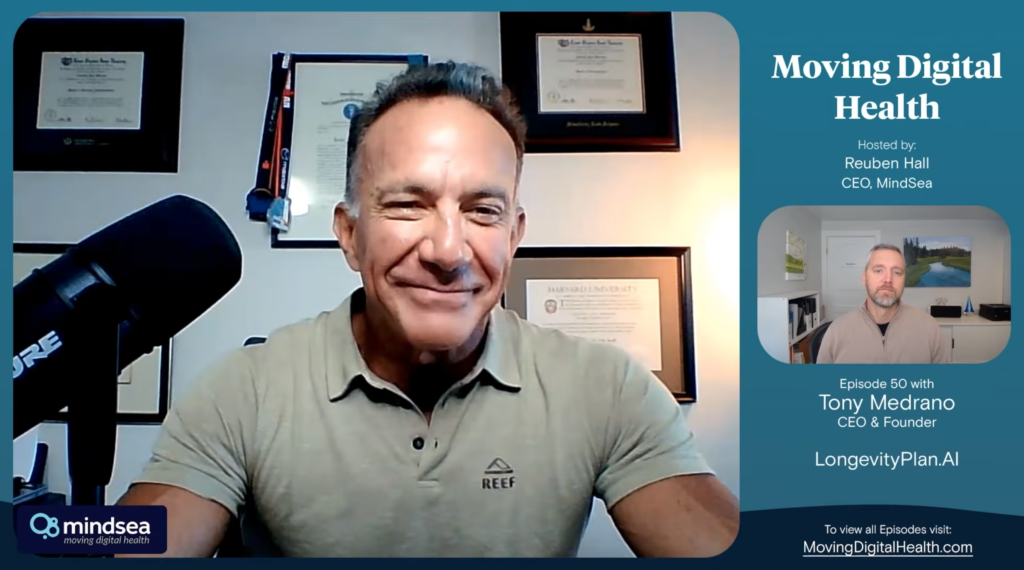

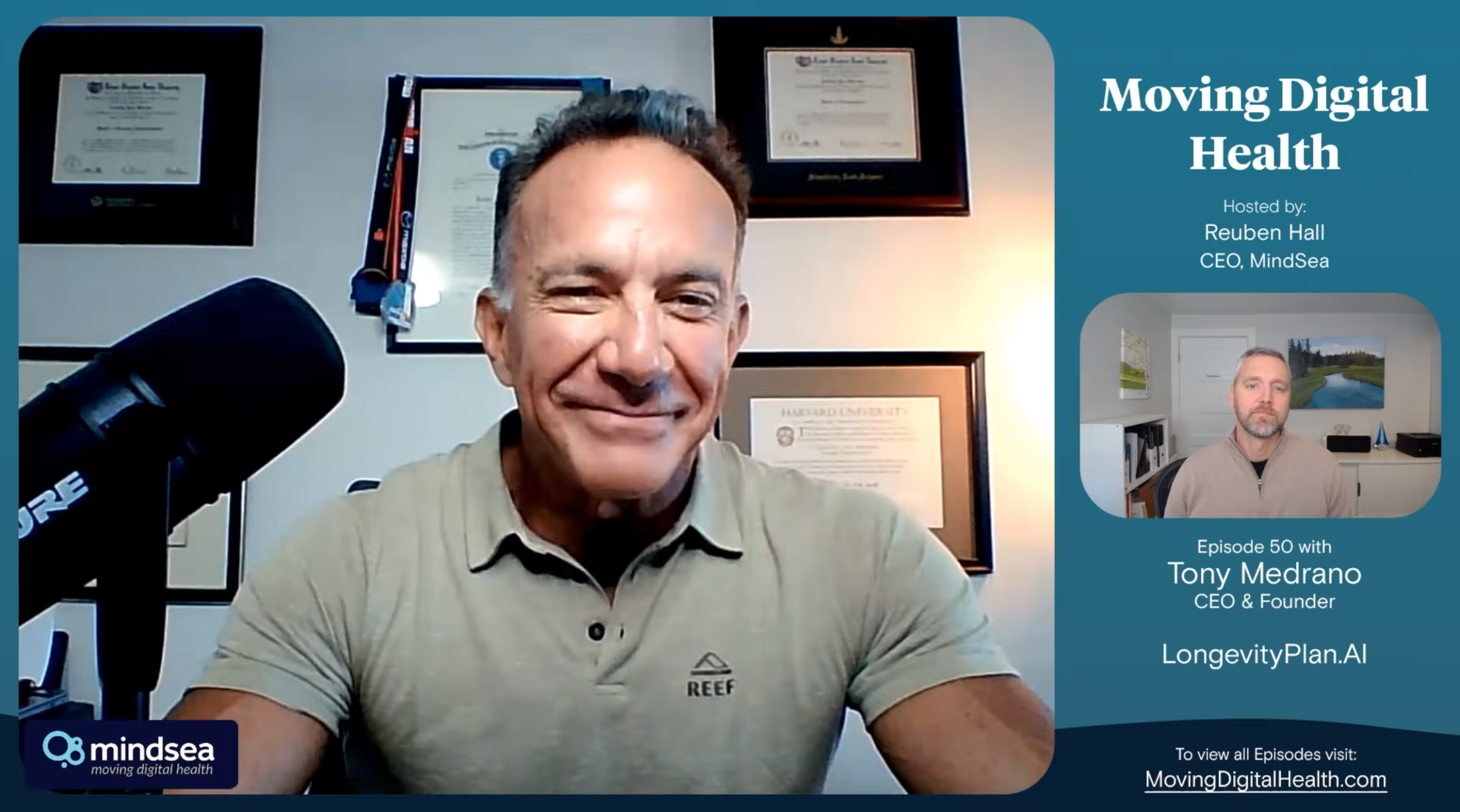
With Tony Medrano of LongevityPlan.ai
LongevityPlan.ai builds a health digital twin for each user from the goals they set and the data they upload. Tony Medrano, the company’s CEO and co-founder, describes it as an algorithmic model of one person. It gets more precise with every lab panel or wearable reading a user adds. In this episode of Moving Digital Health, Reuben Hall sits down with Tony to talk about building health tools around individual data.
Mainstream wearables tend to score users against population averages. Tony’s twin tailors its guidance to the goal a user sets, from muscle growth to fat loss. He also names VO2 max and body fat percentage as the two numbers most worth tracking. Both are getting easier to measure at home.
For anyone building a health app around personal data, Tony gets into how he handles wearable data overload. He also explains why he thinks fun keeps users engaged longer than precision does. Along the way, he shares how a cycling accident six weeks before his first Ironman shaped his view of recovery.
“What we try to do is a more custom solution. We rely on the individual’s data, not on averages, and we ask for more data. The digital twin is only as good as the individual who makes it, so the more data provided by the individual, the better.”
Tony Medrano, CEO and co-founder, LongevityPlan.ai
Topics Covered in Episode 50 of Moving Digital Health (Tony Medrano):
- What did a cycling accident before his first Ironman teach Tony about recovery? (00:54)
- How reliable are biological age and metabolic age measurements? (05:10)
- How does a founder’s own experience inform who a health product serves? (10:00)
- How can a health platform separate evidence-based peptides from hype? (11:57)
- What is a health digital twin, and where did the concept come from? (14:12)
- How does a digital twin turn user goals and uploaded data into recommendations? (16:39)
- How do you solve data overload when an app ingests wearable data? (19:14)
- What do elite athletes understand about recovery that executives often skip? (21:51)
- How can AI help users act before fatigue and burnout set in? (23:35)
- How do you design a health app people keep using for years? (26:09)
- Which health metrics will move from the lab into daily routines? (28:28)
- How does a founder balance building a startup with his own training? (32:29)
Find Moving Digital Health on Apple Podcasts and Spotify, and subscribe to the MindSea newsletter to be notified about future episodes.
Read Transcript:
Reuben Hall (00:01): Welcome to Moving Digital Health, a podcast series from MindSea. I’m your host, Reuben Hall, CEO of MindSea. Each week we sit down with leaders and innovators in healthcare to hear their personal stories and explore how they’re moving digital health forward. Today I’m joined by Tony Medrano, CEO and co-founder of LongevityPlan.ai. Tony is a three-time AI startup CEO with two successful exits, a former U.S. Navy officer, and a Stanford JD/MBA who has spent over a decade building AI and molecular diagnostic ventures. His company uses proprietary digital twin technology and peptide performance to deliver personalized longevity recommendations to everyone from the US Olympic team to the NBA, the NFL, and NASA. Tony, welcome to the show.
Tony Medrano (00:49): Thanks for having me, Reuben. Excited to be here.
What did a cycling accident before his first Ironman teach Tony about recovery?
Tony was hit by a car at 48, six weeks before his first Ironman, and suffered a third-degree shoulder separation. A sports injury specialist recommended no surgery and a strength test two weeks later. Tony finished the race swimming sidestroke with one and a half arms and riding 112 miles in a single gear. He has since completed two more Ironman races and is training for his fourth.
Reuben Hall (00:54): So Tony, at age 48, while training for your very first Ironman, you were hit by a car. Most people in that situation would reconsider extreme endurance sports, but you went on to complete three full Ironmans and are training for your fourth. How did that recovery journey alter your perspective?
Tony Medrano (01:13): It was life-changing, really. The accident was serious. I separated my right shoulder, a third-degree separation. My collarbone is no longer connected to my shoulder blade in the back. But frankly, it gave me more resolve to complete the Ironman. I was six weeks away. I was cycling, of course, and cycling is extremely dangerous. Cars are not paying attention all the time. I was going about 20 miles an hour and was effectively T-boned by a car that pulled out right in front of me. I went head over heels over the car, upside down on the bicycle, and landed on the hard ground. Luckily, I didn’t break anything.
I went straight to a recognized expert in sports injury who luckily lived close enough for me to drive to. The first question I asked him was, “Can I complete my Ironman in six weeks?” He kind of looked at me, but he said, “Maybe. I’ve seen this injury before. You’re pretty strong. Come back in two weeks, we’ll do a strength test, and we’ll see if you can do it.” He recommended no surgery. We’ve got an orthopedic surgeon on our board at LongevityPlan.ai, and he says this injury can go 50-50 either way, surgery or no surgery. As long as you maintain the strength in the arm, it can work, even though it rattles around a bit and looks a little awkward. Cyclists and hockey players will be familiar with the separated shoulder injury.
But I love obstacles, and that obstacle gave me more motivation to see if I could hack my way through the Ironman. I swam with one arm. I ended up having to cycle in one gear because I couldn’t reach the gears on the triathlon bike unless I stopped and got off. But I finished. I completed the swim in time, completed the cycle in time, and ran the marathon mostly like this, to keep my shoulder locked in, because it was pretty inflamed by that point. But I loved it. I had some obstacles, I overcame them, and then I signed up for two more Ironmans and finished those as well. I signed up for my fourth in November of this year, which I’m training for right now.
Reuben Hall (03:39): Okay, you’ve got to explain swimming with one arm. I’m trying to picture that in my head, and I just don’t know how you could have done that. How long is the swim in an Ironman?
Tony Medrano (03:49): It’s a 2.4-mile swim in the ocean. Luckily, because I was in the military, I learned how to swim sidestroke, which is a great open-water, long-distance stroke. It is slow, though. You’re basically swimming sideways. It’s not made for speed, and I’m the only one I’ve ever seen swim that way out of the many thousands of competitors in the Ironman. But I practiced during those six weeks to get my speed up. It’s a very comfortable stroke. My head was above water, so I could breathe pretty well, had good oxygen consumption, and felt very relaxed. The struggle was the time. I was swimming sideways with one and a half arms. The other one was doing a little mini doggy paddle because I couldn’t get it up. But I made it. I was in the bottom 10 percent of the swim and the bottom 10 percent of the bike, and made up some time in the run, but the important part was making the cutoff times and finishing the 140-mile race. The bike is 112 miles, which takes me almost eight hours, so it’s a long event.
How reliable are biological age and metabolic age measurements?
Reuben cites Tony’s numbers: 55 chronologically, 41 metabolically, and 28 biologically. Tony compares biological age to an engine’s horsepower and metabolic age to how well that engine runs. He acknowledges the science behind both is still loosely defined. He tracks body composition at home with the Hume Body Pod, and for precision he points to VO2 max and body fat percentage.
Reuben Hall (05:10): Well, it’s definitely impressive. By the numbers we have, you’re 55 chronologically, 41 metabolically, and 28 biologically. For clinicians and health tech leaders who hear terms like biological age and kind of scoff, how do you define that scientifically, and how is it actually measured through the LongevityPlan.ai platform?
Tony Medrano (05:40): I wrote a research paper on this recently, and the science is not well defined. I use the Hume Body Pod analyzer as really a home DEXA scan. It’s 98 percent accurate to a DEXA scan. You stand on it barefoot and hold on to a ski-rope-looking thing that comes out of the scale, and it runs an electric current through your body to assess your health. It gets your body fat, your muscle density, and all kinds of other readings, like bone health and water. That’s the best estimate.
Clinicians are right. Biological age is a measurement of how your system is built, kind of like the horsepower on an engine in a car. It tells you a little bit about what’s possible. Metabolic age is really a number that represents how well the engine’s running. A good engine can be not kept up as well. Rather than the precision of the measurements, the important part for me was that my engine’s solid and it’s being taken care of. I think that’s the main message. Frankly, I’m in better shape than 99 percent of 28-year-olds out there. I’m doing four hours of cardio a day. I don’t think many 28-year-olds are. So I feel comfortable with that assessment. But it’s not precise the way a VO2 max or a body fat percentage would be, which I think are two very important indicators of metabolic health and overall fitness.
Reuben Hall (07:35): And more importantly, how old do you feel?
Tony Medrano (07:41): I’m in the best shape of my life, and that’s quantitative. I started running Ironman triathlons when I was 48. Through my twenties, thirties, and forties, I was in grad school at Stanford, I was a naval officer, and I was a CEO and startup entrepreneur in Silicon Valley. All things that are pretty hard on health. So my health was like a lot of tech executives out there, kind of mediocre. I could do better. I ran one marathon in my thirties, and I tried to hit the gym once in a while, but I’d sometimes go years without the gym because work was so hard. I think a lot of people can identify with that. A lot of my friends from Stanford, Harvard, and Silicon Valley used to be in shape, but they just don’t have time anymore. Their cortisol’s up, and they lose sight of it. It’s hard to do with a family as well.
So I’m feeling great in all respects. I wake up before my alarm clock, and my alarm’s set at 4 a.m. because I like to get in a couple hours of cardio before work every day. I wake up happy, energized, and excited for my workout and my work. It’s unbelievable. I love it.
Reuben Hall (08:53): Excellent. Like you said, with parents, I often laugh about driving kids to basketball and hockey and swimming, sitting there doing nothing while the kids are in fantastic shape, and the parents feel like crap at the end of the day.
Tony Medrano (09:10): Exactly. Driving around, preparing meals, washing clothes, sitting at our desks all day long like most business folks do, it’s tough. I try to do as much work as possible from the gym and from the stationary bike. It’s possible to answer emails between sets and on a stationary bike, and you’ve got to fit it in if you want to do what I do, which is train for Ironman triathlons and run a fitness AI and peptide business. Health is important to me for business as well as personally. So I’ve found ways to work it in, where I’m sweaty for a long time throughout the day, and I sometimes jump on Zoom calls in my post-workout gear. That’s part of my brand.
How does a founder’s own experience inform who a health product serves?
Before Silicon Valley, Tony served as head firefighter on a Navy destroyer and taught high school, after growing up in a blue-collar neighborhood. He credits those roles with helping him understand how people try to get healthier around jobs and families. His own injuries, including a torn meniscus from military service and 40 pounds gained after the cycling accident, inform how he thinks about LongevityPlan.ai’s users.
Reuben Hall (10:00): You’ve also commanded emergency response teams on Navy destroyers, taught high school in Harlem, and spent five years lecturing at Stanford Business School. How do you bring all that experience from those distinct worlds into the leadership of your company?
Tony Medrano (10:22): I love different experiences. Being a naval officer between undergrad and grad school, where I was head firefighter on a destroyer, is super hands-on. I grew up in a blue-collar neighborhood doing real things, working the night shift in fast food through high school so I could have a car. Things that real people do. And teaching high school. There are a lot of teachers out there. I identify with people who are hands-on, doing real jobs. That’s different from a lot of folks in Silicon Valley. They might be great engineers, but they might be a little sheltered or not have those experiences.
Instead of focusing on one area of my career, I’ve wanted diverse experiences, and now I bring those to bear on how I solve problems for people and businesses with LongevityPlan.ai. With the peptides we offer, I’ve been injured multiple times. I tore my meniscus in military service, and I got injured when I was hit by a car training for a triathlon. I put on 40 pounds because of my injuries and had to struggle through taking it off, because I’m not a small guy. I’m a lot leaner now because of peptides. I identify with people’s use cases and what they’re doing in daily life to get in better shape, and in better mental shape for business as well. I love the unique experiences that life can offer.
How can a health platform separate evidence-based peptides from hype?
Tony argues that peptides vary too widely to judge as a single category. Some, like tesamorelin, have held FDA approval for more than a decade, while others have promising animal data and little human evidence. LongevityPlan.ai focuses on peptides with long clinical or prescribing track records. Tony also writes one or two research articles a week to help users read past the headlines.
Reuben Hall (11:57): You mentioned peptides, which are having a big moment right now. But the market is kind of muddy, with equal parts cutting-edge science and unverified claims and hype. How do you navigate that and use data to move peptides out of the fringe and into evidence-based performance?
Tony Medrano (12:20): We’re extremely evidence-based. My career has been Silicon Valley software, molecular diagnostics, and artificial intelligence. We’re talking math and science at the highest levels. Peptides are all different. Some have been through rigorous clinical trials and have been used in millions of people. So when anybody says all peptides are bad, or they’re all this or all that, they don’t know what they’re talking about. Each peptide is very different. Where there’s a long clinical track record, or a record of them being prescribed by doctors and used for decades, like in the sports community, there’s really strong evidence, and we focus on those.
I write one or two science articles about clinical research on peptides every week to try to bring clarity. What I’ve seen is that a lot of folks read a headline and just repeat it. They don’t bother to read the clinical studies. They’re not in PubMed. They don’t understand the difference between tesamorelin, which has been FDA approved for more than a decade for visceral fat reduction, and some of the more esoteric peptides that maybe have great data in lab rats, but not yet in humans. Then there are other folks who are self-interested, like folks in Big Pharma. They can’t patent a peptide, so they can’t make any money off of it, and therefore they disparage it and say there’s no clinical data. Well, like Gary Brecka said, there’s no clinical data on parachutes either, but we know they work.
What is a health digital twin, and where did the concept come from?
Tony traces digital twins to the 1970s, when NASA and nuclear power plants modeled complex systems on the ground. In 2020, he saw the NFL use digital twins of its players to catch injuries through gait analysis. LongevityPlan.ai adapted the idea into a lower-cost software-as-a-service (SaaS) version for everyday athletes. Users connect wearable data and upload lab, DEXA, VO2 max, and genetic results. The twin comes free for 12 months with a peptide purchase.
Reuben Hall (14:12): That’s a good metaphor. What about the digital twin? Tell us how that works. What does it look like when applied to human biology, and in a plan for bringing peptides into LongevityPlan.ai?
Tony Medrano (14:34): The digital twin concept is not new. It came about in the 1970s with NASA and nuclear power plants, where they were modeling complex industrial systems. I think many of us saw it in Apollo 13, where they had a twin of the Apollo craft on Earth so they could model complex scenarios with it instead of trying things out in space in real time, which is dangerous and costly. So digital versions of complex industrial systems have been around for a long time.
When I worked for the NFL in 2020, I found that they had made digital twins of all of their players to prevent injury and optimize performance, to do things like prevent stress fractures and catch potential injuries through gait analysis before they happened, so they could keep players in the game longer. Effectively, longevity and performance. I loved that idea, and I wanted to democratize it and make it more available to us regular, part-time weekend athletes who also want to prevent injury and optimize performance but don’t have the money the NFL does, or the same urgency.
So we took that concept and made a lower-cost, simplified SaaS model of a digital twin that people could use. The twin’s not an avatar. It’s a representation of an individual through algorithms. Once a user buys a peptide, they get a free 12-month subscription to the digital twin, where they can connect their wearable data and upload their lab reports, their DEXA scan, their VO2 max test, and a genetic test, all things that we offer, and build a digital representation of themselves so they can biohack themselves digitally, which is cheaper and safer than doing it physically in real time.
How does a digital twin turn user goals and uploaded data into recommendations?
Users start by setting a goal, such as muscle growth, injury reduction, longevity, or fat loss, then upload whatever data they have. Tony recommends quarterly lab snapshots and says the genetic test indicates which peptides are likely to work for a given user. Users can then ask the twin questions, like whether to take a rest day, and it might suggest raising a sleep concern with their clinician. Tony describes it as an educational tool for idea generation and says it doesn’t give medical advice.
Reuben Hall (16:39): How does the model simulate how a specific body will react to lifestyle changes or different therapies? Can you really just twist the dials, play out a few years, and see how things go?
Tony Medrano (16:58): Exactly. It’s a work in progress, and it is an educational tool. Obviously, we’re not providing medical advice. I’m not a doctor. So it’s all for educational purposes, to facilitate the engagement of individuals with their own health.
There are two important parts. First, the individual inputs their goals. What do they want to achieve? Is it muscle growth? Reduction in injury? Longevity? Fat loss? Then, with those goals, they upload as much data as they have. It’s not perfect, but it gets more perfect the more data people give it. A genetic test is relevant for how peptides will work for them, and that’s a test we offer through a partner. It gives a great foundation for everything. Through that test, we’ll know which peptides will work best for them and which won’t, so they can save some money.
Their blood work and lab tests are very important for athletes to understand and upload. Monthly or maybe yearly works, but quarterly is what I’d recommend, as a snapshot of how their body’s performing based on their supplements, diet, health, and exercise. Those are the key factors. Then the individual can upload their peptide protocols. How many peptides are they taking? How many supplements? What are their workout schedules like?
All of that information feeds the digital twin, and then you can ask the digital twin questions. “Should I take Sunday off? I’m feeling kind of tired.” The digital twin can make some recommendations and say, “Maybe you should ask your clinician about your sleep. It doesn’t seem like you’re sleeping as much as you should, based on your wearable information.” Things like that. It gets really precise from an idea-generation standpoint. So it’s a great companion to a normal plan, because plans change.
How do you solve data overload when an app ingests wearable data?
Tony sees mainstream wearables as built for everyone, scoring users against population averages that rarely fit an endurance athlete in his fifties. LongevityPlan.ai relies on each user’s own data and tailors outputs to the stated goal, so someone training for endurance gets endurance-relevant answers. The company built its product for proactive users willing to do the research and invest in their own health.
Reuben Hall (19:14): With all the data you’re ingesting from wearables and testing, how do you solve the signal-to-noise or data overload problem of giving too much information?
Tony Medrano (19:30): There’s a ton of information out there. One of the ways we solve it is, frankly, by not trying to be everything to everybody. Right now I’m wearing Google’s Fitbit Air, but I also use Whoop, and I’ve used Oura. Frankly, they’re trying to be everything to everybody. They give ratios based on averages of people. What we try to do is a more custom solution. We rely on the individual’s data, not on averages, and we ask for more data. The digital twin is only as good as the individual who makes it, so the more data provided by the individual, the better.
That especially relates to goals. When somebody says, “My goal is endurance,” we can craft the answers in the digital twin to give them endurance-related outputs, not general health outputs like a lot of the wearables give, which may not be relevant. I know this from my own wearable data. It’s not designed for endurance athletes doing Ironmans with a lean toward a bodybuilding weights regimen. It doesn’t compute. They’re looking for an average 55-year-old who might be struggling in some areas that I’m not. Ours is designed for people who have real goals and want to achieve something, people who are taking action about their health.
Reuben Hall (21:02): So it’s really designed for a pretty proactive user who’s going to be very involved in the process.
Tony Medrano (21:09): Exactly. Somebody who’s willing and interested to do the research on peptides, for example, because there’s a lot of scientific data out there, and a lot of noise, just like you said. Someone who’s willing to do the work to find the signals, and then willing to invest the time and money in their health to do the right things for them. It’s not for a person who’s just casually interested in their health or who wants to take a pill and get better. It’s more for the biohacker, the fitness optimizer, the business person who wants to treat their health like a business problem, jump into it, solve the problems, and increase their longevity through action, not through passive behavior, hoping their doctor will fix it for them.
What do elite athletes understand about recovery that executives often skip?
Tony has watched elite athletes treat recovery like a job, from sleep to nervous system and mental recovery. Executives, especially in Silicon Valley, tend to push hard mentally until their health breaks down. He suggests sleep as the easiest place to start because it’s measurable. For people who sit all day, plain cardio can double as mental recovery.
Reuben Hall (21:51): You’ve worked on many different tech solutions over the years, working with the NFL, NBA, Olympic teams, and NASA. What’s the common thread in how elite athletes approach performance versus a high-stress executive?
Tony Medrano (22:17): Great question. One of the biggest things I noticed was the focus on recovery. Not only injury recovery, but catching things before that, and rest and recovery after intense workouts. Their level of intensity is extreme, and then they focus on recovery like it’s a job. Mental recovery, nervous system recovery, all those things are relevant.
Business executives, frankly, especially in Silicon Valley, don’t. They run hard mentally and emotionally until they break down, often until their health deteriorates. Sleep is an easy thing to focus on, because you can at least get the numbers. But there are other types of recovery: psychological recovery, having real peace and tranquility in downtime, sleep, rest, or meditation. And for them, physical recovery may include more exercise than they’re normally getting, because they need something to get their mental health and their brains recovered from all of the work. That could just be plain old cardio.
How can AI help users act before fatigue and burnout set in?
Tony believes people already trust large language models (LLMs) to answer forward-looking questions. He sees AI as a way to predict fatigue before it shows up. He describes executives approaching health like a long-term investment, motivated by the gap between 80-year-olds who stay active and those who struggle. In his words, “It’s like investing in a portfolio of their own health.”
Reuben Hall (23:35): Healthcare has traditionally been very reactive, treating disease after symptoms appear. In that high-performance mindset, for executives or athletes, waiting for symptoms means you’re already behind the ball. How does predictive peptide performance, for example, help them get ahead of fatigue or burnout before it happens?
Tony Medrano (24:09): This is a great use case for artificial intelligence. Not only does it know all of the information in the clinical studies out there, but it learns as people give it more information. I think everybody recognizes that ChatGPT, for example, is great at predicting things. An LLM is a great tool for asking questions, and it has access to more information than a clinician does, for sure. It’s effectively infinite. So people trust an LLM’s predictive nature, and that trust is important, because with it, people want to ask it questions and are more willing to believe it. And it’s not as biased as, say, an individual who might have certain experiences, or maybe a political agenda to say something is good or bad. So people are investing more time communicating with AI to ask it forward-looking questions.
Business executives are great at delayed gratification. They’ve done this their whole lives, investing in their academic and business endeavors to win later. They’re starting to do that with health more now. They’re starting to biohack because they know it’s important. They’ve seen the difference between 80-year-olds like Harrison Ford, who are still starring in action movies, and the 80-year-olds they know who are barely making it, and some of the 50-year-olds who are barely making it. There’s a bifurcation in individual performance, and smart executives see that coming and want to act on it in their 40s. Now that there are tools available that they can invest in, it’s a business problem to them. It’s like investing in a portfolio of their own health.
How do you design a health app people keep using for years?
Reuben names the 60-to-90-day drop-off in patient engagement that often follows a wearable purchase. Tony’s answer is to make the experience fun before making it precise, since enjoyment is what brings people back. He describes his own data fatigue, which leads him to skip heart rate zone tracking and go trail running. He recommends an 80-20 approach that focuses on the few habits behind most results.
Reuben Hall (26:09): One of the biggest hurdles in digital health is long-term adherence, sticking with the plan and following through. People buy wearables and think buying things is the solution to the problem, but then you see the drop-off after 60 or 90 days. How do you design the experience so people stick with it and are bought into the process for years?
Tony Medrano (26:44): Absolutely, super important. The first thing about any fitness regimen is to make it fun. Over-optimizing things before you get results can be overwhelming. Personally, I have what I’d call wearable or data fatigue. I tend not to use as many gadgets as other people. Some people like buying things and discarding them, or using them. Everybody’s a little different. I personally like doing simple things that are big levers and make the biggest difference.
I don’t precisely monitor my zone 2, zone 3, zone 4 cardio. I like to go trail running in the mountains and on the beach to enjoy nature, breathe clean air, and have my feet in the sand. That’s personal, but it makes it fun for me. Is there a drop-off in performance? Well, yes, if you compare me to an Olympic athlete who is using a stopwatch for everything in their life, but that’s their full-time job, and they’re an elite performer. I’m somebody who wants to perform at my best and still have a great life mentally and psychologically.
So my advice is the 80-20 rule. Do the 20 percent of things that give you 80 percent of the results, and make it fun. Fun is the most important thing, because that brings you back. Like I said earlier, I’m waking up before my alarm clock not because of the precise regimen I’m going to do, but because I anticipate fun in my workout. That’s lasting for years.
Which health metrics will move from the lab into daily routines?
Tony names VO2 max and body fat percentage as the two metrics most likely to become routine, calling both highly actionable. LongevityPlan.ai has started working with VO2 Health, which Tony says estimates VO2 max from an at-home blood draw using proprietary, patented methods. He tracks body fat daily on a roughly $200 Hume Body Pod. A DEXA scan costs about $100 and takes time out of the workday.
Reuben Hall (28:28): Looking out over the next five to ten years, what’s one health metric or diagnostic that’s rare and expensive today, but valuable, that you think will become part of everyone’s daily routine?
Tony Medrano (28:49): Great question. I think there are two metrics that are really important, and they’re becoming easier to get. I’ll give you perfect examples. VO2 max is commonly regarded as the number one predictor of longevity, but until maybe this month, it was harder to get. You’d normally have to go to a physical location, put a mask on, run on a treadmill or ride a stationary bike, and have a computer assess your VO2 max. VO2 max is the amount of oxygen you can consume. It’s your lung capacity, effectively. That’s a pain.
We just started working with a company called VO2 Health that enables a VO2 max test via a home blood draw. It’s a simple five-minute patch you stick on your shoulder. It takes blood into a little vial, and you mail it back to them. I just did it two weeks ago. It was the easiest process, not painful at all. I didn’t even feel the blood draw, and it’s going to give me my VO2 max. I’ll actually know that number for my cardiovascular health, the number one driver of longevity, which before only a very small percentage of people got. This really democratizes VO2 max.
The second metric is body fat percentage. I think people shy away from this because it may have some sensitive implications, but the diabetes and obesity epidemics are just out of control, and people are dying every day because of them. Now body fat percentage can finally be measured at home via the Hume Body Pod, the $200 fancy scale that runs an electric current through your body and calculates it on a daily basis.
Those are the two numbers I watch. I’m looking forward to watching my VO2 max, maybe on a monthly basis, with the blood draw, because the Whoop is not accurate whatsoever. They’re just guessing at it via population averages, and they’re wildly off. But the body fat percentage via the Hume Body Pod is 98 percent accurate to a DEXA scan. Before, you’d have to make an appointment and pay $100 or so to get a DEXA scan. An executive can’t take a couple of hours out of their day to do that regularly. It’s a pain. Do it at home on a slightly more expensive scale, and it’s effectively free every day.
Those are the two most important metrics to overall health, both on the optimization side and on the prevention of serious metabolic diseases that kill people. With those two, I think you’re focusing on the right things. There’s a bunch of noise thrown off by wearables that may be fun and engaging for people, but it’s not actionable. VO2 max and body fat percentage are insanely actionable.
Reuben Hall (31:56): How do you get VO2 max from a blood draw?
Tony Medrano (32:00): Good question. One, it’s proprietary. Two, it’s done by VO2 Health. A group of Yale med school graduates figured it out and have some patented technology on it. They’re actually working with some of the world’s leading triathletes, so I trust them and their science. I won’t even try to explain how they calculate it.
How does a founder balance building a startup with his own training?
Tony trains four to six hours a day while running the company, answering email between sets and from a stationary bike. He treats his own regimen as part of the product, testing peptides on himself during injury recovery and sharing his body fat numbers publicly.
Reuben Hall (32:29): Fair enough. Jumping back to your own regimen and daily experience: you’re managing your peptide protocol, tracking your wearable and lab data, taking blood draws, training for your Ironman, and running your AI startup. Taking care of your health can feel like a second full-time job. As a CEO, how do you personally manage the time commitment for the business and your own health?
Tony Medrano (33:07): Great question. I’m working harder than I ever have in my life at 55, both as a CEO and separately as an athlete. Four or five, sometimes six hours a day of workouts, and then being a startup CEO of an AI company and a peptide company. So I’m on 24/7, but I’m combining both. I do a lot of work from the gym and a lot from a stationary bike.
The work is related, meaning I’m being healthy and providing an example to people of how to be healthy, how to test, and how to biohack. I’m living what I’m selling. I’m using peptides and doing the research on peptides so I can communicate how they work, and then I’m testing them on myself when I get injured to see if they help my recovery. I’m broadcasting my body fat percentage because I’m using a GLP-1 to help reduce it, so I can be healthier and it won’t impact my knees as much when I run. I have a torn meniscus from military service that BPC-157 helped repair, but I don’t want to put on extra weight, because I’ve got to run 10 or 20 miles a day sometimes.
Reuben Hall (34:27): Well, it’s very inspiring, Tony. I feel like I might get up a little earlier tomorrow, but probably not at 4 a.m. I appreciate your perspective and hearing about LongevityPlan.ai. It’s great to have you on the podcast today.
Tony Medrano (34:45): It was great to be here, Reuben. Really, thanks.
Reuben Hall (34:49): And thanks to everyone who’s listening to the Moving Digital Health podcast. If you enjoyed the conversation, please go to MovingDigitalHealth.com to subscribe to the MindSea newsletter and be notified about future episodes.