
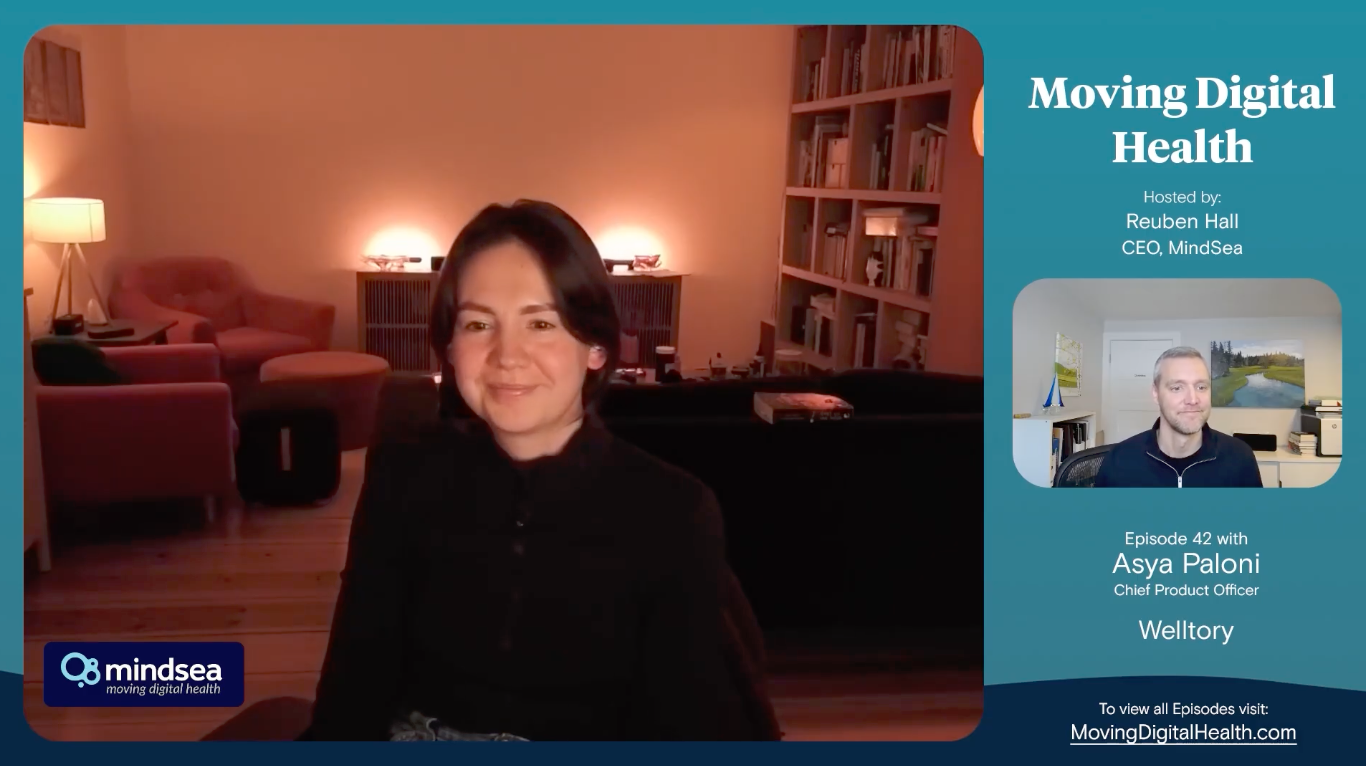
In this episode of Moving Digital Health, host Reuben Hall speaks with Asya Paloni, Chief Product Officer at Welltory, about what seven product pivots taught her team about building a health app that 16 million people actually keep using. Asya shares how each iteration brought Welltory closer to a core insight: the engagement tactics most health apps rely on are often the same things driving users away. She walks through the UX philosophy that replaced them, how Welltory’s data architecture handles 1,200+ device integrations, and why her team threw out traditional dashboards in favor of animated visual metaphors.
“Don’t try to motivate people through guilt and performance metrics. Try to focus on relevance. If the data helps you feel better today, not like 10 years from now, not like compared to another person. If it helps you avoid that 6 p.m. crash, if it gives you your time back, people will come back. Not because they’re chasing a higher score, but because you’re giving them back something truly valuable. And people don’t get tired of data. They get tired of data that feels like judgment.“
– Asya Paloni, Chief Product Officer, Welltory
Topics Covered in Episode 42 of Moving Digital Health (Asya Paloni of Welltory):
- How Welltory goes beyond health tracking to help users make sense of their data (02:31)
- Why tracking biomarkers like HRV over time matters more than point-in-time readings (04:40)
- What a decade of stress data changed about how Asya understands stress (08:32)
- The self-discovery model that lets users identify their own stress triggers (11:41)
- Why Welltory replaced dashboards with animated visual metaphors (13:44)
- Why personalized recovery patterns matter more than generic wellness advice (16:30)
- Has global stress actually increased over the past decade? (18:39)
- How Welltory’s two-layer architecture handles 1,200+ device integrations (20:53)
- 7 complete product overhauls and the engagement principles that finally stuck (22:48)
- Removing judgment from health metrics to drive long-term user retention (26:28)
Find Moving Digital Health on Apple Podcasts and Spotify, and subscribe to the MindSea newsletter to be notified about future episodes.
Read Transcript:
Reuben Hall (00:01)
Welcome to Moving Digital Health, a podcast series from Mindsea Development. I’m your host, Ruben Hall, CEO of Mindsea Development. Each episode, we sit down with leaders and innovators in healthcare to hear their personal stories and explore how they’re moving digital health forward. Today, I’m thrilled to be joined by Asya Paloni the Chief Product Officer at Welltory. Asya has spent a decade analyzing stress and energy data from over 16 million users worldwide.
She’s an expert in heart rate variability and has built a platform that translates complex physiological data into simple actionable insights that help us understand why we’re tired and how to actually recover. Welcome to the show, Asya.
Asya Paloni (00:48)
Hi, thanks for having me. That’s a better intro than what I would have done. So thank you.
Reuben Hall (00:53)
Okay, excellent. Well, maybe you could start by introducing yourself and telling us a bit about your background.
Asya Paloni (01:02)
Yeah, so I’m Asya I’m the Chief Product Officer at Welltory. It’s a health app with 16 million users. I think in terms of my background, the most important thing to know is what you said. I’ve been in digital health and at Welltory specifically for almost exactly a decade, like a couple of weeks ago, in various roles. And at this point, I probably spent more time staring at people’s health data than is socially acceptable.
And I swear, this is the most exciting thing about me. I’ve even turned it into a little bit of a party trick, which I call the Oracle. So if I’m at a party, someone asked me what I do. I say, open up your Apple Health for me, and I look at their data and then I start telling them about what’s been happening in their life because I know when they were hung over.
I know when they had COVID, I know when they had jet lag, sometimes I even know what was going on at work. A lot of it is like dark magic of sorts. But the funny part is, is none of this is really secret information. The body leaves its fingerprints all over and most people just don’t know how to read the signs. So over time, that’s what I became, kind of a translator of all this various data.
How Welltory goes beyond health tracking to help users make sense of their data
Reuben Hall (02:31)
Okay, well I know I’ve been out sick for the last couple days, my Apple Watch is not very happy with me at all. So for someone who has never opened the app, how would you describe Welltory and how does it go beyond being just a health tracker?
Asya Paloni (02:50)
Yeah, so I think it’s a good thing that you use the term tracker. Most health apps are trackers. Even if they get into kind of more complicated tracking, like they can tell you what their stress level is, which is like the new cool thing that they do. It’s still, it tells you how many steps you walked. It tells you what your heart rate was. Sometimes it tells you what your stress level was.
But what we noticed over time is that that wasn’t actually the question that made our users curious. It’s not how much did I walk or what was my heart rate. It’s why do I feel wiped out? Even though I’m technically either doing everything right or not really, I haven’t changed how I live in the past like five years. Why am I all of a sudden so wiped out or otherwise just like not doing as well as I used to?
So what we do differently is we make sense of your data in context. We basically draw you a timeline of your day, and then we use heart rate and other data to show you exactly the points during the day when the energy drain happened. So a lot of people think it’s like a workout or something that wipes them out, but the data will show something different. It’s like a three hour back to back meeting. Or sometimes people think, that they are resting when they’re sitting on the couch. But again, the data says it was actually a moment of drain and not recovery.
So instead of just tracking, we help you see what’s going on so you can start manipulating the timing of your day a little bit better and have more energy in the evening instead of collapsing on the couch at the end of the day.
Why tracking biomarkers like HRV over time matters more than point-in-time readings
Reuben Hall (04:40)
Okay, so, Welltory really leans into heart rate variability, or HRV. How would you explain HRV to a lay person, and why is that a better compass for health and steps or just resting heart rate?
Asya Paloni (04:49)
I wouldn’t say that it’s better or worse. It’s just a little bit different. So heart rate variability is the variation in the time intervals between your heartbeats. And that variation reflects what’s going on with your nervous system.
So just like to dumb it down completely, basically when your HRV is higher,it means the parasympathetic part of the nervous system that’s responsible for regulating like rest and digest is more active. And when your HRV is lower, it means that the part of your nervous system that’s responsible for the stress response is more active.
So at any given point, it’s just telling you the balance of these two parts of your nervous system. Higher means more rest and digest and lower means more stress response.
The thing is that one HRV reading tells you almost nothing because I’m sitting here talking to you. I could have had a coffee. I could be nervous. Something could be going on and my stress response could be activated, but that doesn’t mean I’m unhealthy. It doesn’t mean anything is wrong. It just means at this point in time, that’s what the balance of my nervous system is.
What’s important is how your heart rate variability behaves over time. So a lot of times if you measure it consistently at the same time during the day or at night when you’re sleeping, you’ll see like if there’s a gradual drop over time, you might be feeling a bit worse or if you see a sharp drop for one like one night to the next, you might be getting sick. Or if you see a gradual increase over time compared to your usual baseline, it probably means that you’re getting more fit. But one measurement, all it tells you is that there is some sort of balance of your nervous system. It’s one way or the other, but it doesn’t mean that you’re healthy or unhealthy.
Reuben Hall (07:09)
Okay,from a very simple point of view though, I’m thinking, shouldn’t my parasympathetic nervous system be high when I’m just resting on the couch?
Asya Paloni (07:25)
Ideally, that’s what you want, but it’s not something that you can consciously regulate a lot of the time. And a lot of times, no. So I think that we see this in the data a lot. A lot of times when you’ve had a tough day at work and you come home and you kind of collapse at the end of the day on the couch, your nervous system is still activated. So your heart is still pounding fast, your sympathetic nervous system is activated and you’re not actually resting or recovering. Like your heart rate is still very high.
So what you’re doing is because your heart rate is high but you’re sitting, you’re actually doing more damage to your body systems and you might be better off going for a walk or something. It’s not real rest, unfortunately. I really want for it to be.
Reuben Hall (08:19)
So what happened before you got on the couch has a lot of impact to how that time affects you.
Asya Paloni (08:29)
Exactly. Exactly.
What a decade of stress data changed about how Asya understands stress
Reuben Hall (08:32)
Okay, so you said you spent 10 years looking at stress and energy data of millions of people. Looking back to when you started, what were some of the things that you believed about stress and date that now has been demystified now that you’ve had that access to data and has proven to be wrong?
Asya Paloni (08:58)
So before, I think the big thing is before I started working in digital health and sorting through all this data, I believed that stress is something that happened to you. So like a deadline is stress or someone yelling at you is stress or a difficult conversation is stress. But what the data forced me to realize is stress is not the event, it’s your body’s response to the event. So you could have two people sitting in the same quote unquote stressful meeting. One is stressed and the other isn’t. It’s not what’s happening. It’s how your nervous system is responding to it. And that was a huge shift for me because you obviously can’t control the world around you. You can’t control every deadline or every annoying person you encounter.
But you can influence your body’s response to it. And even if you can’t influence it in the moment, you can prevent damage from accumulating later. So you actually have quite a bit of control over the damage that stress is doing to your body.
Reuben Hall (10:15)
So what are some of those things that you can do to influence your body’s response to stress?
Asya Paloni (10:22)
I think, so everyone has their favorite, right? My favorite is just getting up. What I learned from working at Welltory, this has been my biggest insight. When you’re moving, stress can’t harm you. Because when you’re moving, you’re under stress, your heart starts pounding very fast. And that does damage to your arteries and blood vessels. The minute you get up, that extra blood goes to your muscles and stops doing damage to your arteries and stops wearing your body out so much. So sometimes like the minute I see that I’ve been under stress for a long time, I’m like, well, time to get up and go for a walk. That’s not everyone’s preferred method. A lot of people try to meditate or do other stuff to keep sitting, but bring their heart rate down. I’m just not very good at that.
Some people are. But I think for everyone, can’t really give, you know, like general advice because what works for people is so incredibly and vastly different. It still shocks me.
The self-discovery model that lets users identify their own stress triggers
Reuben Hall (11:41)
Is there a connection from the data that you would get from the app to give people insight into what might work for them?
Asya Paloni (11:54)
So you see, because we lay out a timeline of your day and we kind of mark it and tell you at which point you were stressed or relaxed or reversing the damage done by stress or in like some sort of neutral state. And then we let you mark exactly what you were doing at that time. You can actually develop your own personal formula for handling stress and see what causes, what triggers stress for you specifically and what helps you specifically relax, you know for some people it’s reading for other people.
It’s like talking to a friend for a lot of people. Talking to other people I don’t know that they hate it and it causes a stress response even if it’s like someone nice like their mom. But it’s it just varies greatly for everybody I can tell you some of the most surprising ones that I found for a lot of people, they find that deep, meaningful work is restorative and puts them in a rest state. So you kind of expect, you know, when you’re doing like a lot of thinking and you’re thinking over a hard problem, that that would be stressful for you. But it turns out it’s usually the noise, you know, the meetings, the people calling you and jerking you around at work. That’s what causes the stress.
Reuben Hall (13:21)
All the interruptions and context switching.
Asya Paloni (13:25)
Yeah, when you can sit down and like immerse yourself in a problem that you love, very restful. Another cool one that a lot of people say is putting their kids to bed. Almost always a restful state.
Why Welltory replaced dashboards with animated visual metaphors
Reuben Hall (13:44)
I can definitely agree with that. So for you as Chief Product Officer, you have to balance the scientific rigor with the user experience on the consumer side. So how do you educate the users about the science behind that?
Asya Paloni (14:03)
So this is, I don’t want to say it’s, I’m going to say it. It’s the hardest part of building the product. There are a lot of hard parts, but this is the hardest part because there’s so much science behind what we do. It’s like autonomic nervous system balance. No one knows what that is, no one knows what heart rate variability is. No one cares. So we’ve learned that education isn’t something that happens through like little hints or explanations, or even lectures, although we do a lot of that as well. It happens through emotions and visual relatability. So instead of overwhelming people with physiology, we turn the science into very strong visual metaphors.
For example, we visualize the state of your nervous system as this liquid that changes shape and color and behavior, depending on what’s happening inside your body. Like if the rest and digest part is more dominant and you’re at rest, then it turns into like an ocean blue. Or if you’re riled up and stressed, it’s almost like it’s red and it’s almost like bubbling over.
Or another thing we do is instead of giving you like a chart with your activity levels over the past week, we turn it into a beautiful mountain landscape, which changes color and height depending on how much and in which heart zones you were active. And I think that things like that work a lot better to get people to intuitively understand the science, instead of giving them lectures and explaining to them what a nervous system is and that they have one. I am convinced that most people don’t really care. They just want to feel better.
Reuben Hall (16:11)
Okay, not just your everyday, you know, graphs and numbers, but adding on like visual metaphors and icons to really communicate in a deeper way.
Asya Paloni (16:27)
Yeah, sometimes they’re even animated.
Why personalized recovery patterns matter more than generic wellness advice
Reuben Hall (16:30)
Very cool. You talk a lot about what real rest looks like. Most of us think rest is like you said, sitting on the couch, watching some Netflix. What does the data tell you about what really helps us rest and recover versus what our stereotypical ideas of rest are?
Asya Paloni (16:51)
Yeah, I mean, I already, I think I already told you there’s no, there’s no secrets. I have no secrets for you. I am so sorry. The thing is that, what the data says is that it’s deeply individual because our nervous systems and our heart and our entire bodies have learned to respond to things based on our biology, based on our past experiences.Based on current context.
And so what might help me recover might not help you recover at all. It really depends on the person. Some people, really, I mean, like people say that doom scrolling is bad for you, but for some people it’s not. I was so surprised when I saw my friend’s data and she was like, yeah, here I was just like looking at TikTok and I was like, well, that’s a really…
That’s a really restful scroll right there. First time I’ve ever seen that. But really, it just really depends on the person. I don’t have any overarching tips. I think what works is if you follow really closely and you get feedback from your body along the way and you learn what works for you over time and what doesn’t because it will be different for everyone.
Reuben Hall (18:16)
Right, so what really works is understanding your own body and how it responds and just getting a deeper connection to that so you can be more intentional about finding those rest times.
Asya Paloni (18:34)
I could have said it like you and it would have been better.
Has global stress actually increased over the past decade?
Reuben Hall (18:39)
So with such a massive data set, so many users over so many years, have you noticed trends or shifts in global stress levels or recovery patterns over that time? Is the modern world getting more stressful or are we worse at recovering?
Asya Paloni (18:58)
So I can’t really lie to you. So, I wanted to look at our longitudinal data to give you something. But the thing is, it would be a bit dishonest because our audience has changed, right? The demographics have shifted. So it would not really be that honest of a comparison.
What we do see and what the broader studies kind of confirm is that burnout is very high. Actually at an all time high. I think about, depending on which study you look at, about two thirds of workers in the US report burnout at some point in their lives. And what’s interesting is, is that the, used to be the like kind of late thirties, early forties when you would have the most stressful period in your life, right? Because you have kids and aging parents at the same time. But now we’re seeing it pop up in younger and younger people. So people in their 20s are having the most stressful time ever. And I don’t think it’s necessarily because the world itself is more stressful. I just think we no longer have like a stop sign.
We no longer get a break from the stress because we’re always connected, we’re always on our phones, we’re always reachable. And the media is also constructed in such a way that everything is an emotionally charged clickbait article. So I think probably the world is just as stressful, but for us, it no longer ever stops. And that’s what’s bad.
How Welltory’s two-layer architecture handles 1,200+ device integrations
Reuben Hall (20:53)
Welltory connects with over 1200 devices and apps. How are you bringing together and normalizing that data from so many different sources to give users those insights?
Asya Paloni (21:11)
I think when people see that number, like over a thousand data sources, they kind of imagine that we have this big mathematical formula that pulls it all together into an algorithm and that it’s just like, it’s magic and we do it all and normalize it all. So no, it doesn’t quite work that way. What we have is we have a really small subset of physiological signals that we use to kind of ground our basic physiological model. So signals that we use to analyze what’s happening to your body in real time. And this is a very small, it’s like heart rate, heart rate variability, blood pressure, if it’s available, calories, things like this. And that kind of lets us see how your body is behaving.
Everything else is the contextual layer on top of the physiological model. So like everything else we use, okay, you were stressed here, here’s what could have been going on based on your calendar or like your food, here’s what you were eating. But it doesn’t really require us to really normalize like tens of hundreds of thousands different data flows. It’s not quite like that. The big secret is everything is tailored to your baseline, not a device or anything like that. We are only comparing you to you and not to other people.
7 complete product overhauls and the engagement principles that finally stuck
Reuben Hall (22:48)
OK. So as someone who works in app development myself, I’ve seen many apps designed and built and launched, you must have been through many iterations of the app over time and improvements. What are some of the changes you’ve made in the app that have made it either a better user experience or better at collecting the data to get to where it is today?
Asya Paloni (23:21)
I don’t, God, Welltory has had…seven pivots, I think. And I don’t mean minor changes. I mean, like, complete, like, let’s throw everything up and start over. Because behavioral change is so difficult in health, right? We think of health as something that, like, we know we need to take care of, but we’ll see the payoff, like, 10 years from now. And so the kind of incentive to do something here and now, it’s not really there. What’s gonna happen if I put it off for another day? Nothing, but then it’ll compound over the next 10 years. But still, not that much incentive to change anything today, here and now. And I think we’ve tried every which way out there to solve this problem. So we had, I think at some point we had our own wearable.
We had Google Analytics for Health where we basically have like big dashboards with all your data and we tried to find correlations and show them to you. We tried like little quests, like little health tasks that you had to do every day. Tried streaks. What have we not tried? And I think that at the end of the day, we landed on a few kind of core principles that have stuck with us.
One is what I mentioned, the visual metaphors. So instead of explaining the science of physiology and bodies and health to people, it helps to visualize things in a way that makes people understand it intuitively.
The other thing that I think is really important is that people get data fatigue, but not necessarily from a lot of data. It’s when they feel like the data is yelling at them, that they’re doing a bad job. So we try not to do that. We try not to scold people.
And another thing that we tried that has worked out well for us, and I really recommend this is if you look at the health apps that people use that don’t solve, like, that don’t do a job here and now, like Uber or something, it’s apps like Facebook and Instagram. So things that kind of give you something new and interesting every time you open them. And we’ve learned that this is a good way to also kind of keep people coming back to the app and finding more health information that’s good for them.
But also with a little dopamine hit. You weren’t expecting it. And that’s there. It’s there for you because you opened the app. That has been something that’s worked for us.
Removing judgment from health metrics to drive long-term user retention
Reuben Hall (26:28)
Nice, well those are good lessons that can translate to other health and wellness apps as well. So we’ve traditionally used health data to see how sick we are. How is Welltory helping shift the needle towards using data to stay well and perform better?
Asya Paloni (26:48)
So I would have to reject perform better right off the bat. Because I’m a big hater of performance optimization culture. I think that health is not a competition. And human bodies are not machines to optimize. What I really want people to have is you know at the end of the day after 6 p.m when the transactional part of your day is over, you’re done with work, you’re done with your boss, you’re done with people and you come home, and you have no energy left to spend time with the people you love, you have no energy left for yourself for creativity to think to make yourself dinner.
I want Welltory to help people get those few hours of their day back to themselves. I think that’s a much more worthwhile goal than optimization. And the entire app’s experience is designed around this goal.
Reuben Hall (28:08)
Well, I would say that could still be optimization, but just optimizing for different things, different priorities. Yes. So for all the founders and product leaders listening who are trying to build health tools that people actually use, what are some of the secrets to keeping user engaged with their health data without causing fatigue? You talked about some of the visuals already. You mentioned something new or exciting or surprising when you come back to the app. What are some of those things?
Asya Paloni (28:50)
I don’t want to beat a dead horse, but every app out there is trying to make you better, faster, more optimized, more productive. It’s just, it’s a lot. So don’t try to motivate people through guilt and performance metrics. Try to focus on relevance. If the data helps you feel better today, not like 10 years from now, not like compared to another person. If it helps you avoid that 6 p.m. crash, if it gives you your time back, people will come back, not because they’re chasing a higher score, but because you’re giving them back something truly valuable. And people don’t get tired of data. They get tired of data that feels like judgment. And I think that’s the most valuable insight I can impart upon the world.
Reuben Hall (29:53)
Okay, well that’s excellent. That’s a great way to wrap it up.
Asya Paloni (30:16)
Thank you for having me. It was so much fun talking to you.
Reuben Hall (30:25)
And thanks to everyone for listening to the Moving Digital Health podcast. If you enjoyed this conversation, please go to movingdigitalhealth.com to subscribe to the MindSea newsletter and be notified about future episodes.