
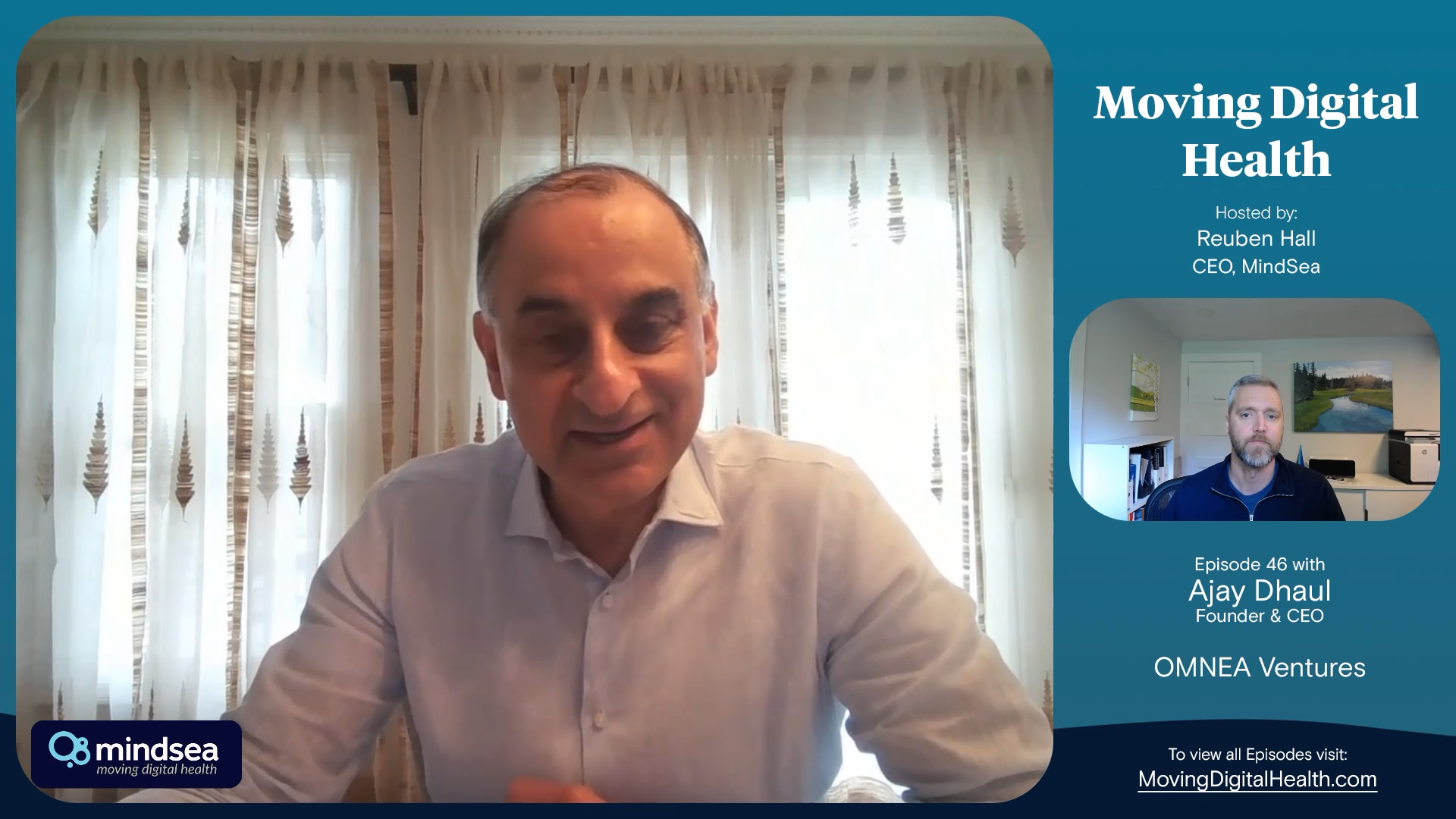
Healthcare organizations have spent years preparing their data for AI, and Ajay Dhaul argues the hard part was never the technology.
Ajay is founder and CEO of OMNEA Ventures, an advisory firm working with boards and executive teams on enterprise transformation, and he sits on boards across the healthcare value chain. He spent 25 years at Johnson & Johnson, most recently as SVP and Chief Digital, Data and AI Officer, after a decade at Dow Chemical.
In this episode of Moving Digital Health, Ajay joins MindSea CEO Reuben Hall to explain why healthcare data stays fragmented long after everyone agrees it shouldn’t be. They get into what clean, complete, connected data actually requires, why the executives funding these programs are often the least equipped to evaluate them, and what founders should understand before selling into a legacy health system.
“There is no quick fix on what I like to say is clean, complete, connected data. That is just sheer hard work.”
— Ajay Dhaul
Topics Covered in Episode 46 of Moving Digital Health (Ajay Dhaul):
- How did you transition from consumer health executive to leading AI transformation? (00:54)
- What changes when you move from operator to advisor? (02:54)
- What does continuous, contextual care actually look like to the patient? (05:06)
- Will patients ever own their own health data? (08:17)
- Where is AI adding value in healthcare right now? (09:37)
- Has AI accelerated healthcare software development? (12:29)
- Why do AI pilots stall before they scale? (16:12)
- How do you get staff to adopt AI tools? (20:05)
- How should you reimagine a process before applying AI? (23:09)
- What does an AI success story look like in practice? (25:43)
- Why is healthcare data harder to connect than financial data? (29:15)
- What should founders know before selling into a health system? (32:44)
- Should enterprises build innovation internally or buy it? (35:09)
- Who do you design for when the user is not the buyer? (37:44)
Find Moving Digital Health on Apple Podcasts and Spotify, and subscribe to the MindSea newsletter to be notified about future episodes.
Read Transcript:
Reuben Hall (00:01)
Welcome to Moving Digital Health, a podcast series from MindSea Development. I’m your host, Reuben Hall, CEO of MindSea. Each episode, we sit down with leaders and innovators in healthcare to hear their personal stories and explore how they’re moving digital health forward. Today, I’m thrilled to be joined by Ajay Dhaul. Ajay is a world-class digital transformation leader who spent 25 years managing iconic consumer health brands including Tylenol, Neutrogena, and Johnson & Johnson. Now operating in a second chapter as an executive advisor and investor, Ajay bridges the gap between enterprise operations and AI fluency to help organizations shift from fragmented systems to continuous contextual care. Ajay, welcome to the show.
Ajay Dhaul (00:51)
Reuben, it’s really nice to see you.
How did you transition from consumer health executive to leading AI transformation?
Reuben Hall (00:54)
You have a fascinating career trajectory. You manage some of those iconic brands we mentioned and on the commercial sales and marketing side before pivoting to lead global digital transformation and applied AI. Can you take us through that career journey?
Ajay Dhaul (01:13)
Yeah, Reuben, I was very fortunate to work for two extraordinary companies.
First was Dow Chemical, where I spent a decade, and then most recently I spent 25 years at Johnson & Johnson in the Consumer Health Division. And my career journey was, especially at J&J, a chance to work with very iconic brands like you mentioned, Johnson’s Baby, Tylenol, Neutrogena. These are very beloved brands for a billion plus consumers around the world.
I was also very privileged to actually build a career trajectory that spanned multiple functions, marketing and sales, supply chain. I was able to work in different locations for the company. So was in Switzerland, I was in Canada, Los Angeles, and obviously based in New Jersey, which is the company headquarters. And then to your point, I had a very interesting career pivot over the last six years, where, you know, despite being a business executive, I got to lead the data, AI and digital transformation for the company globally. And as you can imagine, that was a steep learning curve, a pretty significant career pivot, but probably also one of the most enjoyable ones, especially given what’s happening in the world in terms of the power of data and AI in turbocharging, you whether it’s consumer brands or healthcare in general.
What changes when you move from operator to advisor?
Reuben Hall (02:54)
And you’ve recently entered another chapter moving from the corporate career to more of a dynamic portfolio career as an executive advisor, investor, and strategist. What’s been what’s been the biggest shift in mindset moving from enterprise to advisory?
Ajay Dhaul (03:14)
Yeah, great question. You know, I would say it’s still work in progress. I have been an operator for 35 years at these two incredible companies of Dow Chemical and Johnson & Johnson.
And I’ve spent these last three decades being highly accountable to outcomes and delivering on KPIs and have been mostly the throat to choke, as we like to say, on delivering to expectations.
In the second chapter, the transition, as you said, is I’m now really guiding and advising multiple companies, mostly at the intersection of data analytics and AI, and obviously business enterprises that are talking about how do we really reimagine our business enterprises by leveraging some of this new emergent capability.
So it’s been a transition to go from being an operator to being more of an advisor and now a board member where I’m providing a lot of oversight. But what’s interesting is I suddenly feel like I’ve been able to widen my aperture across multiple companies, across different parts of the healthcare value chain. And what that’s allowed me to do is to really amplify my impact way beyond what was previously this tremendous ecosystem of J&J as an example. So very inspired about the shift, still work in progress in terms of shifting from an operator to becoming more of an advisor and a guide and a board member. But very inspired by my ability to widen my impact.
What does continuous, contextual care actually look like to the patient?
Reuben Hall (05:06)
And in those advisory roles, you’re helping organizations move away from looking strictly through the lens of an insurance payer or hospital provider toward more of an end-to-end view of the healthcare ecosystem. In your opinion, what does true continuous contextual care look like to the patient?
Ajay Dhaul (05:28)
Yeah, Reuben, great question. So, you know, I have to say it’s really been the last, I would say 18 months where I’ve gone fairly deep in terms of the payer and provider side of healthcare.
As we all know, this space is highly fragmented, highly siloed, and there’s a lot of work that’s taking place across all of the healthcare value chain to say, how do you get that point of visibility in a seamless fashion to the patient? And so to me, contextual care with the patient at the center is really making sure we stitch together end to end visibility on the patient and or data that obviously progresses from the point of care through clinicians, obviously to the life science companies that are building the drugs for patient care. Then most importantly, the payers to make sure that there is seamless integration that’s being provided in all aspects of claims and reimbursements.
I think there are companies right now that I’ve had visibility that are trying to tackle this, call it end-to-end value chain visibility all the way to the patient. It’s work in progress, it’s really hard work, especially given the data is segmented. There’s lots of privacy issues with the data. There’s issues in terms of sharing the data across these different industry segments but you know there’s a tremendous opportunity there is positive momentum. I think there are also some disruptors coming into this space, and so ultimately, I think the patient is going to win. We will see progressively better patient care. We will see the providers see less call it administrative load on them so that they can really you know spend their energy in terms of real patient care. I think there’s gonna be lot more streamlining and seamless integration of data between payers and providers.
And then there’s a whole world of AI that’s also now being applied in terms of what could be taking place in terms of faster and more robust clinical trials and robust development for products. So I think that care continuum with the patient at the center is the ultimate vision.
Will patients ever own their own health data?
Reuben Hall (08:17)
And in that model, how do you see the patient ownership of their own data? Is that a realistic goal where they have the agency to be able to pick and choose who gets that access?
Ajay Dhaul (08:38)
Yeah, I think you’ve said it well, Reuben. I think that is the end goal. I think there is progressively going to be, all of us, aka patients, getting greater visibility to what we have. A great example of this is just the wearables right now that many of us as consumers and patients are leveraging to see what’s with, call it near real time, call it self condition, if you will. So I think that’s where we’re headed. I think there’ll be greater control in terms of the patients having direct visibility of their own data to your point. How that all actually then flows through the healthcare system in terms of how do we build more personalized treatment is still work in progress.
Where is AI adding value in healthcare right now?
Reuben Hall (09:37)
And how does applied AI serve as part of this shift? Is AI’s greatest value right now in analyzing massive back end data sets, or is it more in the real time consumer facing personalization for patient engagement?
Ajay Dhaul (09:56)
Yeah, Reuben, I would say it’s all of the above. So to our earlier discussion, right, there’s heavy fragmentation across the payers, providers, drug manufacturers, all the way to the patient.
Now, what we’re seeing is we’re seeing AI being leveraged first and foremost with the clinicians in terms of really addressing their administrative workload. So how do we shift and leverage AI technology so that there’s better patient care that’s taking place by the clinicians? There’s lots of great work and emerging technology that’s being applied in that space. Separately, there’s also work that’s taking place with the payers and the providers and that call it interchange.
And what you have there is a lot of legacy systems. And so a lot of the work there right now is first and foremost, very data related. So how do you get clean, complete, connected data? How do you kind of migrate this data to more, call it modernized data stacks and the tech stacks, if you will. And then there’s application around intelligent automation so that you start reducing some of the human workload, again, back to all of the administrative stuff that’s taking place because there’s incomplete and inaccurate data, if you will. And then there’s AI being applied, obviously, to start becoming more predictive in terms of the patient journeys.
There’s work, like I said previously, also happening in life sciences companies to say, how do you really begin to expedite clinical trials? How do you begin to look at drug discovery? And what I would say is we clearly have pockets of excellence. The AI journey is still relatively new. It’s beginning to pick up positive momentum. My personal views, it’s going to be the next five to 10 years where a lot of this will begin to happen at scale and patients like you and I and others listening to this podcast become real beneficiaries of what hopefully becomes a much more end-to-end connected value chain that’s addressing our needs.
Has AI accelerated healthcare software development?
Reuben Hall (12:29)
There really are so many different applications and so many different ways to leverage AI. it’s yeah, it’s AI itself is it’s not a very descriptor of all a very good description of, you know, all the different ways it it can it can be applied. you know, w one of the ways is, you know, I at MindSea, you know, running a software development company the AI tools to to write code and and build software are just getting better and better and better. Have you seen an acceleration of building digital health solutions going to market with the use of these tools like Claude Code for example?
Ajay Dhaul (13:21)
Yeah, you know, I would say absolutely yes. know, kind of think of, know, was, ChatGPT broke, think it was November of 2022. And it’s not like we did not have machine learning and data science and work that was happening with health tech prior but I think the advent of ChatGPT and generative AI was a big spike in terms of this acceleration of this emerging technology of AI.
There are lots of examples right now where, whether it’s on the provider side with ambient listening, whether it’s on the payer side in terms of how do I start looking across that value chain on predictive claims, resolution of patient claims, obviously a whole host of work that’s taking place in terms of how do I personalize medicine, how do I get much more robust clinical trials and get them done more expeditiously. So the short answer is yes, there’s a lot of work that’s taking place. The underlying base of a lot of this AI is data dependent and that continues to be a real constraint.
And there is no quick fix on what I like to say is clean, complete, connected data. That is just sheer hard work, right? That’s legacy systems, highly fragmented, frankly have been kind of, you know, below the curtain. Most of the business executives who also have the purse strings haven’t really been schooled enough to know the criticality of clean and accurate data.
And so I think part of the AI journey in the whole healthcare value chain is going to be how quickly we can start getting what I’m going to say is connected and accurate data. That’s going to give us visibility all the way down through this value chain to the patient. And that’s hard work that’s going to take time. And so I think it’s going to be a journey and it’s going to be a journey that’s going to take place over the next decade albeit with very bespoke solutions that are being built and being scaled by some of the early adopters.
Reuben Hall (15:53)
Hm. very strong points. You know, if you don’t it’s kind of the garbage in, garbage out metaphor, right? If you don’t have good clean data, really the you know, AI is is not gonna be able to help you.
Ajay Dhaul (16:10)
Indeed, indeed.
Why do AI pilots stall before they scale?
Reuben Hall (16:12)
A typical scenario we see is that you know, an organization gets excited about a new AI capability, they run a pilot, and then it gets stuck in this endless proof of concept limbo. And, you know, based on your experience scaling initiatives across large organizations, what are the reasons that those pilots fail or get stuck and how do you get unstuck?
Ajay Dhaul (16:40)
Yeah, Reuben, so I think most of the world right now is, including me when I was kind of leading this journey at J&J, went in through the emergent technology, getting proof points, frankly learning while doing some of these proof of concepts for real business impact.
So, you know, kind of my learning and I think it’s a learning that’s now widely held across the healthcare industry is first and foremost, there’s a recognition that there is limited fluency on this new technology of AI. And so how do we create fluency up and down the chain, but most importantly with call it the C-suites, the boards and the executive leadership that ultimately becomes a sponsor of these AI solutions that are chasing after real business problem resolution. So I think there’s an element of AI fluency that is an investment.
There’s also been in our excitement and euphoria of ChatGPT and the possibilities of generative AI. While we fostered experimentation, which is the right thing to do, a lot of companies are now taking a step back to say, how does this work really aligned with our strategic objectives and making sure that these proof of concepts, these problem statements, you know, have real project chartering and have visibility at whatever portfolio level to make sure that there’s a level of accountability in terms of seeing this entire proof of concept or the resolution of the problem end to end. The third piece is there’s a lot of human friction on adoption and that is again back to
I think combination of the fear of this technology, doesn’t help that you and I wake up every morning to saying, know, X percentage of head count has been eliminated because of AI. And frankly, that’s crippled a lot of employees and has really set this very, call it a negative tone in terms of, you know, is this thing coming after my job versus shifting that energy to, boy, this could really augment what I do and free me up from the administrative stuff that I’ve been doing and allow me to kind of do more cognitive work. So we’ve got tangled up in that for a bit.
And then last but not least, sponsorship is really key, right? It’s early emerging technology. It needs to be pointed at real business problems. And so these proof of concepts really need what I’d call the tender loving care from the executive on down to make sure that they go through the journey. The organization learns, but there’s great accountability at the end in terms of adoption, impact, and obviously traceability to either a growth or some level of profit and loss statement.
How do you get staff to adopt AI tools?
Reuben Hall (20:05)
The human aspect and the friction you mentioned, I think that can’t be underestimated because you can roll out the you know the greatest tools and solutions, but if the clinicians or the administrators or whoever is using that tool is not on board, then you’re gonna have a terrible time of it. And certainly there’s a a spectrum that I’ve experienced of, you know, people that are excited about the you know the new thing or the you know the new tool and are eager to adapt and and to learn and to take advantage of it. And there’s the other end of the spectrum, which is that this is actually a net negative to my output. It makes my job worse and I could do this better and faster the old way, without this solution. And then of course everyone in between.
You know, getting everyone on board with that solution is is no easy feat.
Ajay Dhaul (21:13)
Yeah, I agree Reuben. You said it, it’s a massive shift and you know, the technologists and the tech founders are super psyched about this. You brought up Claude. They are super excited. They are energized by the promise of this technology.
But the rest of the world, is the bulk of non-technologists, they are still going about doing their job, trying to get fluent with this technology. And so I think there is an interesting collision that’s taking place. And my personal view is like the advent of any new technology, it’s got to marinate. People have to become schooled in it. Companies need to invest in that upskilling. And progressively, we will see that this also like the internet and like previous launches of you know significant technology this too will take hold and ultimately become a hell of an augmentation of the way work gets done and really augment what we are doing as humans.
But I think we’re in the teething pain phase of this whole launch, if you will. And I think progressively we’ll see over the next three, five, 10 years that this will become very weaved into how you and I and the rest of us really leverage this technology and how it’s impacting us. I think the promise of the technology is significant. I think in this conversation on healthcare, it’s even more profound. And so I think it behooves all of us to say, do we step through this in a very responsible way, take everybody along for the journey and obviously invest in demystifying this technology.
How should you reimagine a process before applying AI?
Reuben Hall (23:09)
Yeah, similar to how you were saying, good clean data is a requirement for for AI to work properly and and also connected data, the implementation of solutions is gonna be huge over the next decades. Though those people who can help manage that process of you know not only connecting the old technology with the new technology so everything can talk to each other, but also understanding the clinical workflows and ensuring that the software and the AI works around that and folds into that cleanly as opposed to trying to redefine a clinical workflow.
Ajay Dhaul (24:05)
Yeah, very salient point made by you Reuben because slapping this incredible technology onto a bad process and bad data is just a royal waste of money. So I think again in our euphoria of this new technology, some of that has been done. I’ve made the same mistakes in the early part of this call it earlier transformation.
I think what’s essential, like you said, as a critical ingredient is how do you look at the current process and then reimagine it first and foremost. So really looking at how could this, you know, whether it’s a clinical process or other processes in the whole healthcare value chain, the tip of the spear needs to be the business process, how it gets reimagined. The next piece is how does data really flow end to end?
And then ultimately is, how do you apply different aspects of AI and have the human and machines collaborate to ultimately deliver an outcome?
And what I’ve seen is there’ll be aspects of applying generative AI, there’ll be aspects of agentifying some of this process, there’ll be aspects of some classical data science that becomes a better predictor of an insight. All of that needs to be stitched together against a new re-imagined process to ultimately give a better, more efficient, more enhanced outcome.
What does an AI success story look like in practice?
Reuben Hall (25:43)
And are you able to share a specific example from your experience where you’ve seen all that come together and a success story, if you will?
Ajay Dhaul (25:59)
Yeah, happy to. I’ve got a number in my mind, but there’s one I think that’s probably more relatable to what you and I and everyday consumers and shoppers go through. And this was all about how do we make sure that for these iconic brands at J&J that we discussed, that we have very high availability of our products on shelf, whether it be the physical shelf when you go into a Shoppers Drug Mart, or maybe I go into a Walmart here in the US. And really to start predicting that we have the highest levels of on-shelf availability at that point of purchase when a consumer or a shopper like you and I walk in into the store or also the digital store. So if you’re on amazon.com or one of the direct-to-consumer websites for these retailers or a brand sites.
And so a lot of this work was actually leveraging all aspects of building clean data sets, making sure that the data sets were integrated into what I would call a 360 data product, something that became the universal source of truth in terms of all the inputs that were coming in.
It needed datasets to actually collaborate between, in this case, the ultimate drugstore and the retailers and change as a manufacturer of these products. It needed classical data science in terms of being able to build these predictive algorithms. We had brokers that were going into these retail stores as a final, call it, checkpoint to see what was really taking place with product being on the shelf versus being hung up in the back room of these retailer outlets. How we took some of their input and leveraged generative AI aspects to take some of their reports, you know, both text as well as call it graphics data.
Not to belabor this, but that whole chain of process, data, collaboration across different aspects of the value chain, classical data science around prediction, generative AI, and eventually the process continues to now get agentified so that you get more touch-less in terms of being able to predict and then obviously making sure that there’s great execution. So when you and I are in the store, either physically or in the digital store, at that point of purchase, we always have a product fully stocked. So one of these projects that has taken a couple of years to kind of first do it in the US, Canada, scale globally with great value proposition and frankly tremendous customer and consumer delight at the end of the chain.
Why is healthcare data harder to connect than financial data?
Reuben Hall (29:15)
I’ve heard some people ask other industries have had their data in a clean, secure and interoperable place for years, right? Like take financial for example, everyone you know has their app where they can see their online bank and financial transactions.
And they asked, well why can’t health be the same? Why can’t I see my health data that easily? Why isn’t it cleanly and securely available to me at all times? And I think at the end of the day, healthcare is a little bit messy, right? Like there’s issues with the clean data because it’s people are involved and people are kind of messy. So it just there’s just a whole other level of complexity to to deal with there. And the amount and type of data that you get is so much more complex than, you know, some other industries or fields that have already had this figured out years ago, right?
Ajay Dhaul (30:33)
Yeah Reuben, I think you’ve said it really well. It’s super messy, right? You have, you know, millions of provider points of care built on legacy systems. You’ve got, you know, multiple payer companies. You’ve got a whole plethora of call it life science companies that are developing the next set of drugs.
And so far, broadly speaking, the incentives have been misaligned. I think that’s part of the complexity of health care right now is to say, listen, if I were to really win with the patient and really stitch things together with the patient at the center and provide personalized care and personalized medicine, how do I do it? And I think it’s that messy web that we need to traverse and obviously do it with great respect for the privacy of the patient data also begin to open up what needs to happen across this value chain between payers, providers and call it drug manufacturers. So to my earlier point, it’s beginning to happen. It’s beginning to happen in pockets, but there’s a ways ahead and it’s a substantial investment that needs to come behind it. And that investment is, you know, a bit foundational.
And I think that’s some of the hesitation that takes place in some of these legacy enterprises is in a way you’re trying to untangle this, make it less messy. That requires an investment today and the return could be a couple of years out. And that’s a tricky piece that enterprises are balancing in terms of they recognize they need to make the investment. They recognize there’s a delay in terms of outcomes and real positive impact. And I think that’s the journey that we’re all trying to reconcile and go through.
What should founders know before selling into a health system?
Reuben Hall (32:44)
A hundred percent agree. To our audience of digital health builders and founders out there who are in in the system, they have a brilliant vision and are navigating the realities of getting funding, winning their first client, or onboarding patients. if you were sitting with them as an advisor, what’s the number one skill or advice you would give them to to help them through that process?
Ajay Dhaul (33:14)
Yeah, great question. So Reuben, what I would say is I actually have had this privilege of being exposed to a number of founders in the last, you know, 18 months or so is part of my second chapter because I’ve had the time to really dig in and get visibility to what’s taking place. I’m also advising a number of founders through things like the New Jersey AI Hub and Princeton University collaboration amongst other forums that I’m leveraging.
The very first thing I would say is I am in such awe of the founders in terms of their fearlessness and their candid attitude. So I would just say a tip of the hat to these founders. My advice is be humble. As great as your product is, be intellectually adaptable because applying these products in these broader enterprises, which many of the founders generally don’t have experience with, there just needs to be recognition that there is a level of navigation that takes place in these big legacy enterprise, non-digitally native companies that the founders need to navigate. And obviously then surround yourself with people who can bring great expertise, guidance, experience in how do you find the paths of least resistance in these enterprises to ultimately go solve problems. So I think my piece of advice is humility, listen and be intellectually very adaptable with your product and I am very very optimistic you’ll be successful.
Should enterprises build innovation internally or buy it?
Reuben Hall (35:09)
Great advice. You’ve seen innovation both within large enterprises homegrown within their enterprise or the startup side of innovation coming out and then enterprises adopting that emergent innovation. What do you see as the benefits or trade-offs of both of those?
Ajay Dhaul (35:34)
Yeah, so you know the good news is that both of them need to coexist. So I think there’s a recognition on a number of companies and large enterprises to say that it would be foolish not to pay attention to what’s happening in terms of external innovation and being humble enough to say that, listen, while we may have significant investments and have had, you know, decades of R&D, that there is some great work that’s happening at a much greater velocity in some of these companies externally, call it some of the startup founding companies.
I think the difference is that, inherently, when you do development in large enterprises, you navigate a much more bureaucratic, process-driven, approval-driven, more risk-averse enterprise. It’s just the nature of the beast. When you’re a small startup or a founder-led company, the risks failure and the downside are significant but the risk of if it went wrong, it’s not like you’re impacting a multi-billion dollar P&L if that makes sense.
So, my personal view is that and it’s happening today with many enterprise companies is they’ve invested in their venture studios to say, how do we look at innovation both within the four walls of a company as well as invite external innovation.
And I personally feel that that combination is what’s going to keep all of us in healthcare and across frankly other industries to kind of keep innovating faster than any other part of the world.
Who do you design for when the user is not the buyer?
Reuben Hall (37:44)
Mm-hmm. You often advise looking at two vectors to find immediate value. Follow the money and delight the customer. So in a complex space like digital health, where the person is using the tool, like a clinician, isn’t always the one paying for it, hospital, insurer, payer, how do you balance those two vectors to thread the needle of traction?
Ajay Dhaul (38:13)
Yeah, you know, really good question because there’s a real inherent tension in this. My personal view is if you anchor on delighting the patient or the customer, as you said, that needs to be the tip of the spear and that’s where the energy needs to go first. And to me, that is the greatest leveler, if you will, across any value chain, because then it can be monetized and it can be monetized over the long run. So, I would tip the balance to delight the patient, delight the customer, start there, build that foundation by solving real problems that the patient or the customer has.
Now the follow the money pieces, that’s where discipline comes in on execution. And I think that’s where an experienced hand is one I would surround myself with to say, how do we make sure that the investments that are being made on delighting the customer also then are being done with great diligence and discipline so that we’re getting the biggest bang for a buck. And it’s being done most efficiently. So I think that’s the balance. But Reuben, to your question, I would tip the balance on delighting the patient or the customer.
Reuben Hall (39:52)
Okay, excellent. Well, thank you so much for all your insights and the conversation today, Ajay, and joining me on the podcast.
Ajay Dhaul (40:02)
Yeah, thank you, Reuben. I’ve really enjoyed this. I hope this is of great value to you and all of your listeners. And I look forward to doing more of these with you in the future as I continue my second chapter. Thank you.
Reuben Hall (40:14)
Definitely. And thanks to everyone for listening to the Moving Digital Health Podcast. If you enjoyed the conversation, please go to movingdigitalhealth.com to subscribe to the MindSea newsletter and be notified about future episodes.