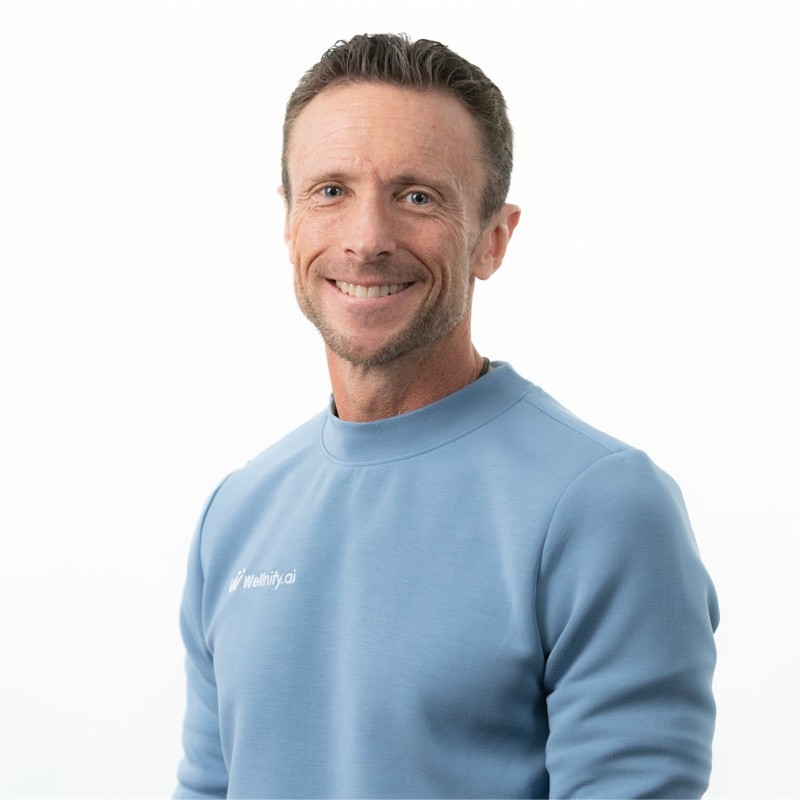

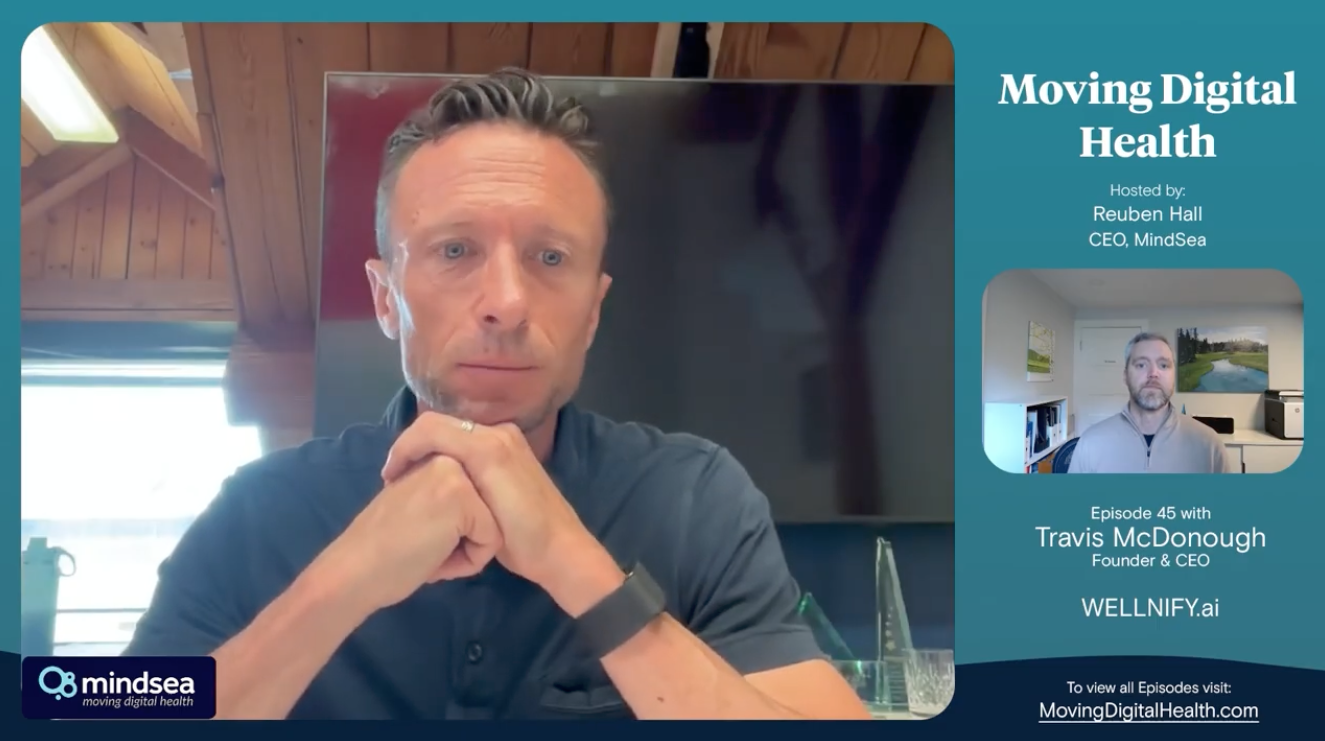
In this episode of Moving Digital Health, Reuben Hall talks with Travis McDonough, founder and CEO of Wellnify.ai. Travis previously built Kinduct, the athlete management platform used by the NBA, NFL, and MLB. He now applies that same data science to public health, working with school boards and municipal governments to get whole community populations moving.
Travis walks through how the platform works, from augmented reality workouts to rewards for volunteering and donating blood. He and Reuben also dig into the economics of prevention, including why its payoff takes years to prove and how Wellnify plans to show governments the ROI.
If you’re building a wellness program or health app, you’ll want to hear what 30 pilots taught the Wellnify team about driving lasting behavior change.
“We’ve spent 60 years building a sick care system. What we want to do for the next 50 years is build the best health care system, which is the one that prevents people from entering it in the first place.”
— Travis McDonough, founder and CEO, Wellnify.ai
Topics Covered in Episode 45 of Moving Digital Health (Travis McDonough):
- The founding mission behind Wellnify’s community wellness platform (00:54)
Why is the healthcare system so resistant to funding prevention? (04:10)
Turning screen time into an agent of change for kids (06:38)
How does a community wellness engagement platform work? (10:06)
What did 30 pilots reveal about changing health behaviors? (18:53)
Proving preventative wellness costs less than chronic disease (23:42)
Can preventative wellness become a public utility? (27:18) - Making decisions your great-grandkids will thank you for (32:44)
What does success look like for Wellnify over the next five years? (35:08)
Find Moving Digital Health on Apple Podcasts and Spotify, and subscribe to the MindSea newsletter to be notified about future episodes.
Read Transcript:
Reuben Hall (00:01)
Welcome to Moving Digital Health, a podcast series from MindSea Development. I’m your host, Ruben Hall, CEO of MindSea. Each episode, we sit down with leaders and innovators in healthcare to hear their personal stories and explore how they’re moving digital health forward. Today, I’m joined by an innovation powerhouse, Travis McDonough. Travis is the founder of Kinduct Technologies an elite athlete management platform used by the NBA, NFL and MLB, the marker of Canada’s most significant tech excellence. Now, as the CEO and founder of Wellnify.ai, Travis is leveraging behavioral science, augmented reality, and gamification to take the data science built for the world’s greatest athletes and democratize it for grassroots communities, schools, and public health systems. Travis, welcome to the show.
Travis McDonough (00:50)
Thanks so much for having me. Looking forward to the conversation.
The founding mission behind Wellnify’s community wellness platform
Reuben Hall (00:54)
With Kinduct, you built the gold standard for elite human performance, helping athletes optimize their training at the highest levels of sport. When you stepped back after that acquisition, what drove the shift to get sedentary kids and local communities moving through Wellnify?
Travis McDonough (01:11)
Yeah, yeah. Look, I think the first chapter, as you referenced at Kinduct was an amazing journey and it was really focused in on allowing athletes to become the best version of themselves.
We were literally trying to get them to be 1% or 2% faster or stronger or more efficient. By doing so, you know, with the whole team, oftentimes that could be the difference that wins a championship. And while that was thrilling, and while that was an incredible odyssey, you know, to do from Nova Scotia, I think immediately after the sale, we realized as cool as that was, there’s a much more noble and scalable mission that is worth putting our efforts, our experience, our passions into.
And that was really how do we help to create healthier and happier communities? So we decided, look, why don’t we take what we used to do for the LeBron James and Tom Brady’s and colloquialize it, productize it and above all, democratize it and put some of these tools in the hands of communities to allow them to be the best version of themselves.
So I think that’s what drove a group of us to bring the band back together and take what we used to do at Kinduct but scale it properly to create healthier and happier communities.
Reuben Hall (02:41)
And what’s the why behind that? Why is that mission important to you personally?
Travis McDonough (02:47)
Oh, wow. I think first of all, we feel some sense of responsibility to pass on the knowledge that we’ve accumulated and we’ve sort of soaked up through osmosis and the professional sporting world.
And it would be unjust of us to sit on it. And so the opportunity to be purveyors of behavior change, gamification, and ultimately creating healthier and happier habits that people can instill to give them agency and dominion over their health sort of futures was something that we just felt, you know, really compelled to do. We almost felt like we had some type of responsibility to do it, and we’re very hell bent on making sure that preventative health and wellness gets its day in the sun.
Right now, it’s often dismissed. It’s overlooked. It’s underfunded, it’s under undervalued. And we’re on a mission to make sure that, you know, it enters into the decision makers at the municipal level, at the provincial level and at the national level, because you’ve heard us use the saying that the time is now to start building stronger fences at the top of a cliff, rather than more ambulances at the bottom. And, you know, that’s really what we’re trying to accomplish here.
Why is the healthcare system so resistant to funding prevention?
Reuben Hall (04:10)
Yeah. And you’ve spoken about that macro shift happening in healthcare away from the acute treatment and towards prevention. And you know, that phrase really helps illustrate it. Why is the legacy health care system so resistant to funding that fence at the top of the cliff?
Travis McDonough (04:29)
I think it’s a lot of reasons, I think. First of all, I want to acknowledge that being a health care decision maker or a policymaker or being in government is not easy. We have skyrocketing chronic diseases, unsustainable health care cost. We’ve got, you know, all of these issues and problems. So they’re faced with making tough decisions all the time. I think. However, the problem is, is preventative wellness sometimes takes a couple years for the seedling that you planted to poke through to turn into the oak tree.
And oftentimes that’s beyond a normal political cycle. And it’s easier for politicians to have a ribbon cutting ceremony when they open up a new wing of a hospital or they announce a new MRI machine, you know, than it is to talk about prevention. That will absolutely pay dividends in the long run, but they might not be there to reap the rewards.
Look. And I think that the other reality is that people will never know about the surgeries that were not needed because of prevention. They’ll never know about the the wait list times you’ve shortened because people don’t need to see a physician. You know they’ll never know about the heart attacks that didn’t happen. And that’s a problem. I think we need to start to quantify that.
And we need to start to make decisions that our great, great grandchildren benefit from. I’m not comfortable handing the receipt of our neglect to our great grandchildren, and I don’t think any of us should be. So, you know, we use that saying a lot that societies grow great when old people plant trees who’s shade they’ll never lie under.
And at the end of the day, that’s the decision making that we have to, you know, filter a lot of our decisions through because the longer term play is where we’re going to see the huge, the astronomical return on investment as it relates to prevention.
Turning screen time into an agent of change for kids
Reuben Hall (06:38)
A big shift we’ve seen in society recently is the access kids have to devices and how much time they spend on screens. I mean, parents and governments are terrified of how addicted kids are to to social media and just any screen in particular. Instead of trying to lock the phones away, how does Wellnify motivate kids and communities towards healthier lifestyles?
Travis McDonough (07:03)
Yeah. Look, I want to first of all acknowledge there is a huge problem with with with phone usage and it cannibalizes a lot of our wellness activities.
And it’s, you know, it’s an ever growing problem. And I think kids don’t realize they’re in the inside, one of the most powerful and insidious machines or systems that our planet has ever devised. So I want to make sure that I acknowledge it’s a huge, huge problem. However, we are also realistic to realize that, you know, kids will never completely get off their phone.
So we want to take something that’s historically been responsible for lethargy and turn it into an agent of change. And if we can’t get them completely off their phones, let’s at least use it as an instrument or a vehicle to help to cultivate healthy habits that, again, you know, give them some structure of of health as they build these long term healthy habits over their lifetime.
We’ve also built very interesting tools inside, you know, the youth versions of our platform where kids can’t get access to a lot of their social media apps until they’ve hit certain step thresholds. Activity minutes done. So many community events. So we want to make sure that you know that through that sort of Hawthorne effect, that what they track, they’re more aware of what they’re more aware of.
They’re more willing to sort of change the behavior. But ultimately they realize that, you know, doing these things will unlock the opportunity to do things rather than just giving them sort of unfettered access. And I think the other thing that, want to make sure we point out that in youth and in adults, fitness historically has been a solo pursuit.
It’s been an individual journey. That is not the case with what we’re doing. Community is at the backbone of, you know, the the paradigm here. So you’re doing things with your school, with your school board, with your class. You are collectively moving towards a North Star. That might be how many pieces of litter you pick up. It might be how many hours you collectively volunteer. Or it could be something physical, like step counting, or how many minutes in nature that you logged. But we really want to make sure that, you know, it’s it’s a collective experience and there’s a lot of interaction with others. And the last thing I’ll say, Reuben, is that its goal is never to replace human interaction. It’s more to augment and facilitate more interaction.
So we’re building in the social prescription science into it as well. So there’s responsibilities inside the daily quest that make it paramount that you are interacting with your other classmates and your school members.
How does a community wellness engagement platform work?
Reuben Hall (10:06)
So you’ve touched on a few different ways that the app works at a high level. Can you take a little bit more time to dive into some of the features, and exactly how some of that might work to get kids off the couch?
Travis McDonough (10:23)
Yeah, maybe even at the highest level, trying to give you like the, the 30ft view. I mean, what we are trying to do is help to create healthier and happier communities. And we’re doing that by leveraging this AI driven digital ecosystem that we call a community wellness engagement platform. And what we’re doing that is different that you’ve referenced.
We’re combining the emerging science of behavior change that everyone’s talking about because it’s responsible for new habit formation. But we’re smashing it together with the fun of gaming or gamification to really reinvent the way that bottom up wellness programs are being offered. And at the at the highest level with the federal government, the conversations were having is, look, one of the things that makes us Canadians is that while health care isn’t free, it’s freely accessible to all.
Yet when someone wants to stay healthy and prevent disease, they have to pay for it. It’s behind a paywall, and that allows for people like you and I who can afford a Woop or an Apple Watch, or a trip to the spa, or to the private health care facility. It allows us all to get access to that. But the vast majority of people that’s out of reach.
So we are trying to remove the firewall and provide the democratized access for people to give them, again, control and influence on how they shape their future. The mission we’re on is we’re all about allowing people in a community to fall in love with the joys of healthy behaviors, to ultimately convert them into becoming a lifetime participant of wellness. That’s our ultimate goal here. And, you know, we’ve touched on the problem skyrocketing chronic diseases, unsustainable health care costs to disconnected sense of community, 10 million shortfall of health care professionals in the next decade. You know, we are convinced. And I know this statement sounds harsh Reuben, but we are convinced we’re witnessing the world’s largest self-inflicted serial killing in the annals of humankind.
It’s almost extinction level behaviors. And because we’re in the jar right now, we’re not reading the label. But in 300 or 400 or 500 years, we’re going to look back at today and go, can you imagine? We let this happen to our population. So we do feel some sense of urgency. We feel some sense of responsibility and agency to do something about it.
So we have created a highly configurable white label digital ecosystem that connects an organization like a government or a municipality, for a school board or an indigenous community, or other underserved communities like the menopause community, seniors, rural. But we connect them to their end population, where we’re leveraging a combination of the science of behavior change and the fun of gamification, really to highly engage the user, to allow them to create these healthy habits.
And to come back to your question that you asked initially is how does the platform work? Well, we have two parts to the technology. We have a back end, Reuben, and the back end is where the secret sauce is. We have about 85 different tools and features that we can turn on or off based on the go to market population, but we can also take a lot of their existing content that right now resides in a PDF format or sits six clicks deep on a website.
But we put it into the back end through our highly engaging gamification engine, and then we configure the platform within a matter of hours or days, as opposed to months or years. And then we create a unique QR code, and then the individual now at the population level, enters into the app, where the first thing they see is something called their wellness quest, which is a action plan.
It’s about a 12 minute action plan daily where we engage the user under four wellness categories body, mind, spirit, and community. And underneath each category, Reuben, we have a plethora of gamification features that really allow the user to have a ton of fun. So under the body section, for example, we’ve got about 200 augmented reality movements that through proprietary algorithms in the phone, the phone recognizes your movements with about 98% accuracy and then converts them to a live rep counter and then a live leaderboard.
It’s almost like doing a video game workout with your community while you’re doing this physical activity. So it’s a ton of fun. But we have also a step counting. This is where your workout plans are. So that’s the body category. We have a mind category because we know knowledge transfer is paramount to creating healthy habits. So people watch a relevant 30 second to two minute video, and as soon as they watch it, a little quiz pops up to literally have fun with transferring knowledge.
And then we have a spirit section, which is what it sounds like. It’s mindfulness minutes. It’s meditation content, it’s nature sounds. It changes every day. But what we’ve recently added, which you might find very interesting, we’ve added something called community. And why community? We’ve gone around the world and we’ve studied the healthiest cultures on the planet, places like the Blue Zones and, you know, the Amish. And the common denominator for these communities was less that they had access to a good life, but it was more these communities prioritized serving other people in their community. So what we’ve done is we’ve created intentionality and gamification around pay it forward actions. So if you pick up a piece of litter and you take a picture of it, if you volunteer your time.
We have an expanding relationship with some of the largest non-for-profit in the in the country. If you donate blood, if you buy a local product, you do this not just on behalf of yourself, but you do this on behalf of the community that you work with, that you go to school with, that you live with, and all of it leads to a threshold that if you hit it, you’re earning a discount for that community, a discount on groceries, you know, free bus passes, free gym memberships and other luxuries. I shouldn’t say luxuries. I should say, you know, things that really drive health and wellness for you and your community. So sorry to give you a long winded answer to a narrow question, but I thought it was helpful just to give that bit of a backdrop, because it helps to frame what we’re doing and probably more importantly, why we’re doing it.
Reuben Hall (17:28)
That’s perfect. That gives us a really great understanding from the high level down to the day to day interactions of of how it works. And it’s really interesting how you’ve tied things together into communities. So right now it’s early July. And myself, like many parents, are thinking, oh, how am I going to keep these kids busy now that they’re home from school? And I know that the app is available in the App Store, but that you need to be part of one of these pilot communities to be able to, to use it.
Travis McDonough (18:05)
Correct. We’re hoping to change that. We’re hoping to change that. We you know, you probably are aware of what we’ve done in Texas. And in Texas, they’re rolling this out to 3200 different organizations. So that’s towns and cities and districts, but it’s also corporations and school boards. But we do have a agreement on the one yard line with one of Canada’s largest provinces, where we’ll be integrating with their primary health care app, and rolling this out to a myriad of different communities across their province.
And we’ve got four other provinces that, you know, I’d say they’re on the five yard line. So what was once on the edge of conceivably is now in striking distance of making happen and at at a national level, which we’re really proud of.
What did 30 pilots reveal about changing health behaviors?
Reuben Hall (18:53)
And yeah, there’s many pilots on the go, like you mentioned, 30 plus pilots around different communities around North America. So from small to large, what are some of the key learnings that you’ve had from those pilots so far?
Travis McDonough (19:10)
Yeah, I mean, I think I’ll take it. That’s a great question. Maybe I’ll break that into two answers. One is very specific metrics. And even before I talk about metrics, I want to say that the number one thing that we have found is that in this country and in North America as a whole.
There is no baseline data in this species of data. So there’s a there’s no baseline metrics on physical literacy, on step counting and communities, activity minutes, actions of volunteerism, blood donations, litter pickup that literally doesn’t exist up until we found a creative way through this gamified mouse trap. To be able to pull in some of those very valuable metrics, which to start, gives us a baseline of where we are to know where we need to go.
But through the pilots and the reason why the pilots are so beneficial is you learn something on every pilot. I think we did our first pilot only about a year ago here in Nova Scotia. But we again, we take we took learnings from that and all the way along. But collectively those 30 pilots have. Yeah. Given and illuminated some tremendous insights on what the platform can do on their objective impact. So number one we see about on average a two and a half thousand increased step count, you know, per individual before versus during the utilization of the platform. And the reason why that’s so important is that for every 1000 extra step someone takes in a day, they have a corresponding 15% reduction in comorbidities. So at 2500 steps on average, you’re talking about a 35% reduction in comorbidities, which is about the same impact that a lot of chronic disease medication has.
So I think that’s really important to point out. And we’re really, really proud of that. We’re really proud too that over 72% of the users go from ….that were under the 150 minute weekly recommended average to over the 150, which also changes the game on reducing a lot of the chronic disease symptoms. So we also see huge spikes and increase in, again, community actions, everything from picking up litter to volunteering time to buying a local product. So I think we’ve got we’ve gestated a lot of the data on our measurable impact, and we’re only just getting started. I think the other findings that we’ve really found have been that to change behaviors, you need community. You need to make sure that you’re doing this with other people than just yourself. So I think that’s one thing that we’re very, very proud of.
We’ve got two algorithms in the app. One’s called the Personal Wellness Score, which gives you a reflection of your consistent behaviors and tells you if you’re trending up or down. But more importantly, we’re aggregating everyone in a community’s personal wellness score into an overarching proxy called the Community Wellness Score, which has helped the government to illuminate blind spots.
So why does this community walk, on average 3000 steps more than this? Or why does this community, you know, reach the 150 minutes a week on average and this one doesn’t? Well, maybe it’s because there’s not sidewalks or there’s not enough access to public parks, or maybe there’s a lack of programing. So we’ve really been able to help influence decision making on infrastructure, on policy and programing.
So those are those are really, really, you know, exciting things for us. But I think, you know, learning the importance of community versus just the individual making sure that there’s motivational and behavior change nudges at the right time based on your preferences. I think encouragement is something that’s that’s needed and necessary. So I think these are some fundamental philosophies that we understand now that’s going to move the needle on engagement and therefore behaviors.
Proving preventative wellness costs less than chronic disease
Reuben Hall (23:42)
That’s really interesting. Understanding that part of the value here is collecting that data in the first place to establish a baseline and understanding the difference between these different communities and the opportunities for improvement there. I know you’re currently working on publishing clinical research to prove that it cost governments and corporations more money not to use a preventative wellness platform like Wellnify. Is it difficult to prove that ROI without, you know, longer term like longitudinal population data?
Travis McDonough (24:20)
It definitely takes time, right? And that’s the biggest challenge that we face because anytime, again, you can you need to show the impact on prevention. You know, sometimes it takes 12 months, 18 months, 24 months, even longer. But thankfully we’ve worked with some very progressive and innovative provinces who were willing to allow us to push our data into their LLMs that have data on hospital stays, E.R. visits, GP visits, pharmaceuticals, and we’re already seeing a positive impact on what the platform is doing on those costs and on those numbers as well.
It will take more time, but we’re convinced that we will be able to show a enormous return on investment. And, you know, if anyone says, oh, well, investing in prevention is costly. Well, it doesn’t even compare to the cost of chronic disease. So we will be able to show we are 100% convinced that this platform costs the government a lot more to not use than use. And we’re halfway there being able to prove that now, which is super exciting for us.
Reuben Hall (25:37)
Wouldn’t that be amazing to be able to create a new blue zone based on, you know, what we’ve learned, you know what works. And then to make those adjustments on the community level over time to eventually, you know, get that, you know, healthy lifestyle and longevity that, you know, as a community.
Travis McDonough (26:03)
That’s it. That’s the holy grail, right? We want to make sure that we create hundreds of future blue zones in this country. And let’s make sure we we do one first, hopefully that’s here in Nova Scotia. But you know, that would be legacy. That would be impact. Look, we’ve spent 60 years building a sick care system. What we want to do for the next 50 years is build the best health care system, which is the one that prevents people from entering it in the first place..
And so we want to make sure that the preventative wellness gets the investment it needs. It deserves. There’s no longer a lack of evidence. There’s just a lack right now of of long term decision making to invest in this all to ensure again that our great, great grand kids don’t pick up the tab for our neglect.
Can preventative wellness become a public utility?
Reuben Hall (27:18)
You mentioned before the paradox of health care in Canada being freely accessible, but wellness often hidden behind a paywall. How do you position Wellnify to become part of the infrastructure for school boards and the public sector to make wellness more universally accessible?
Travis McDonough (27:32)
Well, I think this is, you know, this is part of our value proposition that we want to be the scalable, gamified wellness platform and out of the box wellness strategy for the country.
We have scale, we have interoperability. We do integrations with the primary health care apps. You know, we have a highly sophisticated technology back end that allows us to understand the data points that we’re pulling in, but we also have a highly sophisticated AI engine that delivers very personalized wellness quests based off your needs, based off your interest. I think the federal government loves the concept that people will have their own strength coach, their nutritionists, their exercise physiologist, and their community motivator in their pocket, and that that’s going to allow for scalability and and huge, huge impact.
And look, right now we know everyone doesn’t have a mobile phone, but we should look at India who provide phones for as little as $8 because they’ve realized that’s the only way they’re going to be able to scale their health care system. And, you know, other countries like Singapore and Denmark and Finland and people who have actually proactively invested in preventative wellness and are seeing the return on the investment now.
But I think I may have mentioned to you, Reuben, that I’ve been participating in a group called the Health Care Transformation Lab. It’s been 30 thought leaders from across the country. It’s been funded by the Canadian Medical Association and the folks involved in the thirty are the CEO of the Canadian Space Agency, CEO of the Canadian Medical Association, CEO of the Canadian Nursing Society.
We’ve got three chief medical officers of the largest insurance companies. We’ve got a bunch of deputy ministers of health. We have leading indigenous thought leaders, and it’s been an incredible opportunity to sit around the table to reimagine what the Canadian health care system could look like over the next 30 to 50 years. The people running the process are the same people that ran the mediation process during the apartheid, you know, process. So they also ran the mediation between the Colombian government and the Colombian cartel. So we’ve met four times as a group. It’s been intense. But to have such a great sense of dispersed judgment, so people with different backgrounds, different ideas, different thoughts, different thinking have allowed us to come out with four different scenarios that might play out over the next 30 to 50 years.
It’s been fascinating to see that in each one of those scenarios, prevention is a fundamental key component, and it’s one that’s found its way as a founding principal on how we can reimagine what our our health care system could look like. And we keep using one lens to think about. That is what society and system do we want our great, great grandkids to, to live in and grow up in. And that’s helped us clarify what we need and allowed us to make longer term decisions.
Reuben Hall (31:18)
I love that because as a country and as a society, you know, we need to plan beyond the, you know, the four year political cycle. And just looking at the next term, right, like, what’s that long term vision for, for, for the nation and then, you know, work backwards from there. So yeah, looking forward to seeing what comes out of that, that group. And you know. Over the next few years.
Travis McDonough (31:50)
It’s been interesting. And to steal a phrase from my mother in law and, you know, my mother herself gets a lot of recognition for the impact that she’s made, which, you know, she she deserves. But my mother in law, she has influenced my thinking also in, in a huge way.
And she’s always said, be a good ancestor, be a good ancestor. And to me, that’s really stuck with me, because if we can think about decisions we make now with that top of mind, that’s going to allow us to ensure that in three generations and four generations, we’ve done the right thing and hopefully we make preventative wellness literally a public utility rather than something that’s only available for the wealthy.
Making decisions your great-grandkids will thank you for
Reuben Hall (32:44)
Yeah. You mentioned your your mother, who is a, you know, a great politician for many years and obviously, you know, spent her life in public service. Is that idea of like public service, you know, come through you, but almost like through entrepreneurship, right? It’s like it’s it’s public service through entrepreneurship, not just, you know, working within the the confines of the government.
Travis McDonough (33:12)
Yeah. Look, I think, you know, it’s it’s funny. I mean, it impacts you in so many different ways, right? When you have a front row seat watching your mother chase, a big goal that really was monolithic again. You know, she, she became the leader of the her party at a time when there was not even a female washroom, right in the Nova Scotia legislature.
So she really. Yeah. Made a big impact on how I watched her chase a big, lofty goal. And she taught me so many valuable lessons. But, hey, join a cause not because it has a high chance of succeeding, but because it stirs your soul. That was something that really stuck with me. And service is the rent you pay to others. That’s just what you do. And you know, we have a responsibility to pay it forward. We were lucky enough to sort of be born rounding third base without ever having to hit a triple. And, you know, you can’t apologize or feel guilty for the position that you were lucky enough to have.
But what what that does do is it makes you feel full of gratefulness, and it makes you full of agency, and it makes you full of responsibility that you can help allow someone else get to third base. And you can allow for hopefully generations of people to, you know, yeah, just be able to do really meaningful and impactful things and that so that does drive me forward. That drives the whole company forward. Because collectively we all embrace that that thought process. And it’s, you know, it’s what wakes us up every day with urgent purpose, that’s for sure.
What does success look like for Wellnify over the next five years?
Reuben Hall (35:08)
You’ve stated that this chapter of your life is about human impact more than, you know, corporate share price. What does the definition of success for Wellnify look like over the next five years?
Travis McDonough (35:22)
We’re in business. We need to grow a company that’s got a financial backbone that allows us to be sustainable. And so of course, we want to grow a great company. But that’s second to we are focusing in on making an impact and creating significance. And rather than just the share price, where we know we move the needle is when someone comes up and says, hey, my son, who all he did was play video games in the basement, he lacked confidence.
He’s now fallen in love with the joys of moving his body, and he goes out and he’s playing activity with all of his friends, and he’s now got a new found sense of confidence or. My father was able to walk me down the aisle when he, just eight months ago, wasn’t able to get out of bed, you know, and at a higher level, we want to make sure that we change the narrative around sick care and that preventative wellness becomes included in the budgets on a go forward basis.
And again, we want people to embrace that slow slogan that societies grow great. When old people plant trees who shade, they will never lie under. And I think if we can have that mentality and philosophy apply to decision making as it relates to prevention, that’s the legacy that we want to leave. And that’s, you know, again, I almost think that the word success we’re going to take out of the vocabulary and it’s we’re going to replace it with purely significance or impact.
Reuben Hall (37:07)
Well, it’s great to hear about what you’re doing with Wellnify, Travis, and how ambitious the mission is there. Thank you so much for joining me on the podcast today.
Travis McDonough (37:36)
Really enjoyed it. Thank you so much for having me, and thanks for the important work that you do. You know, I’ve listened to some of the great podcasts in the past and they’re so helpful to again pass important information and knowledge on so and I know you’ve been a pillar in the community here in Nova Scotia. So again, thanks for all the great work that you continue to do.
Reuben Hall (37:39)
And thanks to everyone for listening to the Moving Digital Health podcast. If you enjoyed this conversation, please go to movingdigitalhealth.com to subscribe to the MindSea newsletter and be notified about future episodes.