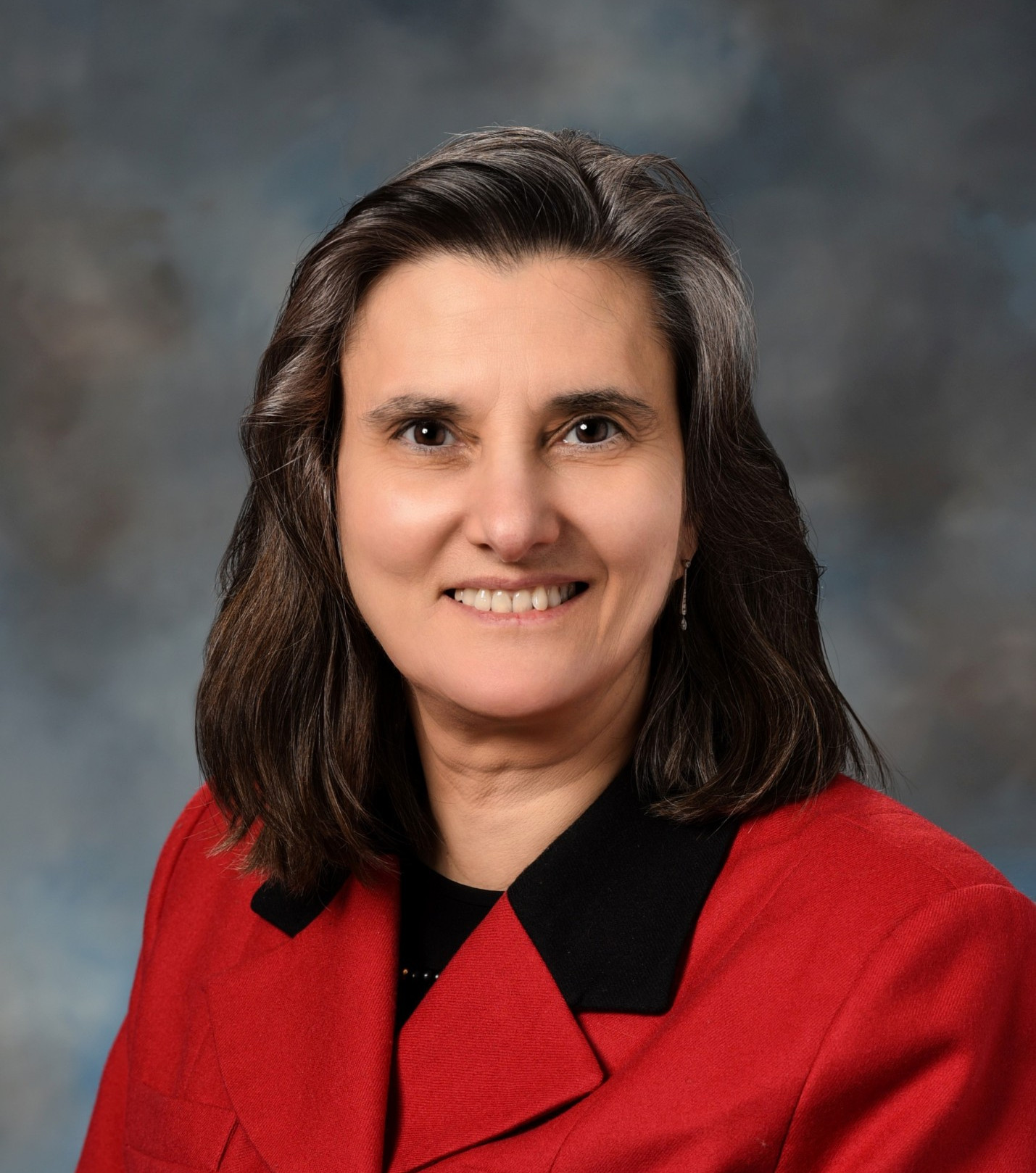

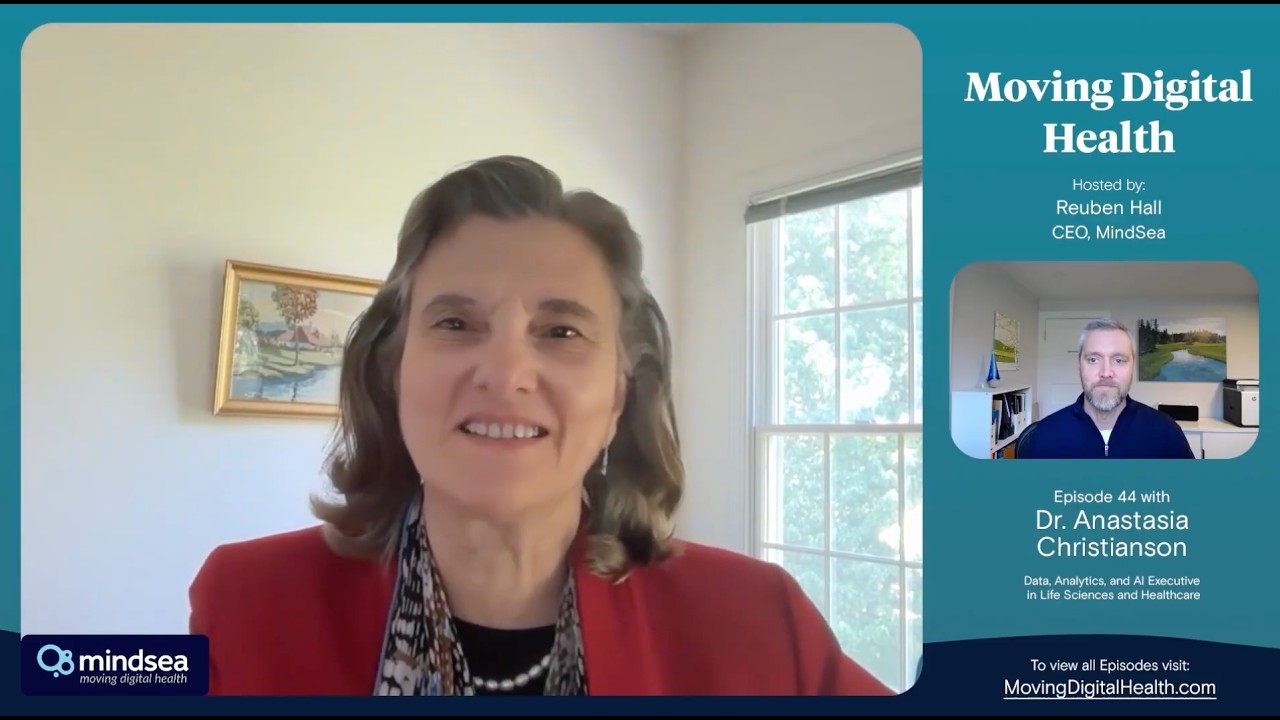
Most digital health pilots never make it to production, and according to Dr. Anastasia Christianson, the reason usually has nothing to do with the AI itself.
Dr. Christianson has led AI and global informatics at Pfizer and Johnson & Johnson, and now advises healthcare organizations on agentic AI and clinical trial design.
In this episode of Moving Digital Health, Dr. Christianson joins MindSea CEO Reuben Hall to talk through why most pilots never find a path to P&L. They also cover the real question clinician-founders should ask before going all-in: do you love the business problem, or the clinical solution?
“”If a pilot doesn’t have a path to a P&L or to a value, then it’s really a hobby.”“
— Dr. Anastasia Christianson
Topics Covered in Episode 44 of Moving Digital Health (Anastasia Christianson):
- How should leaders bridge the gap between AI pilots and a real business strategy? (00:50)
- What operational realities kill AI pilots before they can scale? (03:18)
- When should clinician-innovators become founders versus stay at the bedside? (07:05)
- How is AI making clinical trials less burdensome for patients? (11:08)
- What wearables and devices are improving clinical trial data collection? (15:06)
- How are clinical trial leads using agentic AI in day-to-day operations? (18:25)
- Can community hospitals use AI without modernizing their infrastructure first? (22:44)
- Why does FAIR data matter so much for AI-driven clinical trials? (25:15)
- Where do knowledge graphs fit into the clinical workflow? (29:06)
- How do we keep AI from widening the global health equity gap? (32:17)
- How do you build an ethical AI framework that doesn’t slow innovation? (38:19)
Find Moving Digital Health on Apple Podcasts and Spotify, and subscribe to the MindSea newsletter to be notified about future episodes.
Read Transcript:
Reuben Hall (00:01)
Welcome to Moving Digital Health, a podcast series from MindSea Development. I’m your host, Ruben Hall, CEO of MindSea. Each episode, we sit down with leaders and innovators in healthcare to hear their personal stories and explore how they’re moving digital health forward. Today, I’m joined by Dr. Anastasia Christianson. She is a data science and digital transformation icon who has led AI and global informatics at the highest levels of the industry, including Pfizer and Johnson & Johnson. She is at the forefront of agentic AI and the revolution of clinical development. Welcome to the show, Anastasia.
Anastasia Christianson (00:41)
Thank you so much. Thank you for inviting me to join this conversation. I’m honored and I’ve been looking forward to it.
How should leaders bridge the gap between AI pilots and a real business strategy?
Reuben Hall (00:50)
So you’ve advocated for the idea that organizations shouldn’t have a digital strategy, they should have a business strategy enabled by technology. For leaders currently playing it safe with small AI pilots here and there, how do they bridge the gap between a cool experiment and a strategy that actually moves the needle?
Anastasia Christianson (01:13)
Yes, that’s a couple of different questions. The first one is mainly a digital strategy or a technology strategy or an AI strategy should be based on the business that you work in. So if you’re in healthcare and life sciences and a pharma company, then your digital strategy should be based on what are the business problems, what are you trying to address from a business perspective, what’s the goal that you’re trying to achieve. When it comes to experiments and pilots and so on, it really does come down to the concept of don’t have a tool that’s searching for a problem, but rather focus on the business problem and how technology can be a vehicle to solve it.
So you have to start with a problem you have in mind first, kind of like Stephen Covey, start with the end in mind. What’s the problem you have? What are you trying to achieve? That’s the end in mind. And then how are you going to achieve it? And normally you also have, whether it be, again, technology or AI, you have multiple tools in the toolbox. figure out the right tool that you need to use. Don’t take a sledgehammer to hammer in nail or to hammer in a screw when you can use a screwdriver, which is much more effective. And be sure that you’re co-creating that strategy with your business partners, with your business owners. So you’re not just going up to the mountain, developing the solution, coming back down, and here’s the strategy, here’s what we’re going to do, but rather you’re co-creating.
What operational realities kill AI pilots before they can scale?
Reuben Hall (02:59)
So let’s say you’ve done a good job on the strategy, you’re solving a real problem, you got your pilot going and things are going well. What are the operational realities that can kill those pilots before they get a chance to scale?
Anastasia Christianson (03:18)
So if a pilot doesn’t have a path to a P&L or to a value, then it’s really a hobby. So what you need to do is ensure that you have a clear owner for a clear owner, clear mandate for the problem that you’re trying to solve and for how you’re going to get beyond a pilot. So, what change management is going to be needed.
Is it a matter of data fragmentation and poor data infrastructure? Do you need to fix that first? I remember an example from the past where there was a brilliant technology that was being tested, evaluated. The innovator knew how it was going to be used and start developing the solution. I got pulled in by my team to help and we were going down a really good path, everybody was excited about it. But then came the question of, so this was like a digital health solution that was going to be used in clinical trials. So which clinical trial? We don’t know that yet. Okay, which program? We haven’t sorted that out yet. Okay, what therapeutic area are we going to start with? Okay, that’s gonna come later. No, no, no, it can’t come later because how you develop this has a lot to do with what therapy area and what the patient population looks like and how you’re going to engage the patients, how you’re going to engage the people who are going to make this happen. So you have to start with that from the beginning. Needless to say, we had to go back to the drawing board on some of this because that approach wasn’t going to yield to something beyond a pilot that was really cool and really neat, but nobody was going to touch it because there was all those implications for change management and how that was going to affect the bottom line.
Reuben Hall (05:21)
I understand you might not be able to discuss all the details of that project, but I’m curious, were you able to steer that in the right direction or did that eventually die on the vine?
Anastasia Christianson (05:34)
That particular one died on the vine, but we’ve had other ones that actually were, where we caught them early enough and they were successful and we were able to kind of backtrack and get the buy-in. But for that particular one that I’m thinking of, unfortunately it didn’t make it to where it was intended. It was just too premature. I think it ended up several years later, maybe get started again and on a different path. And the technology have moved on by then anyway, so it was probably just as well.
Reuben Hall (06:07)
Yeah, sometimes timing is everything.
Anastasia Christianson (06:11)
Absolutely.
When should clinician-innovators become founders versus stay at the bedside?
Reuben Hall (06:13)
I’ve seen the double edged sword of clinicians who are innovators within their field of expertise and they come up with something brilliant, a digital health intervention that’s actually solving a problem. It’s actually useful. But it would mean completely changing their world from being a practicing clinician to essentially a startup founder who is, now I’m driving this innovation as a product and maybe trying to sell it. How should clinicians look at that crossroads of whether they want to take that route or other ways to move those innovations forward?
Anastasia Christianson (07:05)
Yeah, so this is a very personal decision. So most clinicians answer it kind of by accident. They’ll end up there because they got pulled in that direction or it seemed like the right thing to do is to go from being a clinician to being an entrepreneur to now being a CEO.
Some of them will stay there happily. Some of them will be frustrated and be trying to go back. It really is a personal decision and it’s based on a few questions that they would need to ask themselves is, do you love the business problem or do you love the scientific or clinical solution?
Because that’s what it comes down to. Because if you love the business problem, then you’re trying to solve a business problem. You’re going to be pulled into more of a fundraising, operational, how do you influence, what’s the marketing material, what’s the market size look like, and all those things that a clinician was probably not trained for in medical school, but some clinicians will have done an MBA along with a clinical degree. So that’s fine. They can definitely have both, but honestly, it does come down to also, what are you leaving behind? So some clinicians are irreplaceable at the point of care.
Others are one in many, and maybe that’s not in the end their talent, and they are really more entrepreneurs and needed to learn medicine in order to be effective entrepreneurs. So the best clinician innovators probably aren’t CEOs or aren’t trained to be CEOs.
But some will be. So that’s the hard decision that they’re going to need to make. And the ones that are trained to be CEOs, they are the ones that are going to be successful in having the mission succeed. The rest will be focused on, is it working well enough? Do I need to enhance it? What’s the next iteration of it? What’s the next innovation that’s going to take us beyond this? And that’s not going to make for the best CEO until a very long time later when you actually have an established organization and you’re looking for more than one product in the next product. So I hope that answers your question, but the takeaway really is it’s very personal and it does depend on the individual where their passion really lies.
Reuben Hall (09:38)
Yeah, I think you make some really good points and at MindSea we work with quite a few doctors and clinicians who are innovating within their field and they bring us on as the technology partner to help them build that digital health solution. And sometimes it’s just a lack of time. They’re so busy practicing, and they’re also moving forward this startup idea and depending on their specific role at the practice, they might have the free time to be able to juggle that. Or sometimes it’s just been very difficult to find the time for moving that forward.
Anastasia Christianson (10:34)
And I think that’s where it comes down to where your passion is, right? And I say that often because I teach a course at Penn in drug discovery and development. I do some mentoring of senior leaders, not so senior leaders, people who are starting in the field. And you have to balance the the passion as well as your strength. What are you really good at? What are you really strong at? What are you bringing to this world? And make sure that you don’t lose that.
How is AI making clinical trials less burdensome for patients?
Reuben Hall (11:08)
Well, I know you’re very passionate about patients and improving their outcomes. How is AI currently being used to make clinical trials less of a burden for patients, specifically in terms of recruitment and engagement?
Anastasia Christianson (11:27)
Absolutely. Thanks for the question. So we’ve spent decades optimizing trials for sponsors and sites. And it makes sense because if they’re not optimized for sponsors and sites, there’s no chance of optimizing it for patients. More recent years, maybe actually even before the popularity of AI, we started bringing the patient into trial design, which was at the time revolutionary, but it makes so much sense.
AI is finally letting us really optimize trials for patients. So you mentioned recruitment, certainly from the point of the best way to match patients to trials, matching.
inclusion exclusion criteria against electronic health records to surface the most eligible patients in minutes instead of months and therefore allow those patients to enroll in the trial. Conversational agents that answer questions for patients that are either enrolled in trials or thinking about enrolling in trials. And at 2 a.m. if that’s the best time for them, right? Not make them wait a week or two to connect with a study coordinator. Of course there is a limit as to how many questions or what kind of questions the conversational agent as a chat bot or other AI driven tool is able to answer. But at least engaging the patient, answering questions that can be answered and helping them through so they’re not searching through volumes of documents that they’re reading, but going directly to the answer that they’re looking for. And if they reach the point where, you know what, this is not a question that I can answer, but I can put you in touch with someone and I can help you schedule. we can do the scheduling a little bit easier, a little bit faster with a coordinator and we can do it at 2 a.m. because I can help you schedule it and it may not be tomorrow morning or this morning if it’s at 2 a.m. but it could be this week. I guess other ways is also wearables, ambient sensors, replacing burdensome patient diaries, know patients in trials have had to keep very careful diaries. And sometimes there’s a lot of gaps in those diaries that end up getting in the way of interpreting the effectiveness of the therapy. So now wearables and sensors can actually help with that, reduce the burden on the patient, get better data to the healthcare provider. And I already mentioned about the scheduling and travel, helping with schedule and travel. really in the end, a trial that respects a patient’s time is a trial that is more likely to finish on time and have the best outcomes. And I love the St. Jude mission and commercial. I’m sure that you’ve seen those there on TV. St. Jude takes care of all the logistics so the parent can just focus on helping their child survive or something like that. I don’t know if I have the right terminology, but it’s something about, you know, there’s a lot of logistics that need to be taken care of when you’re a patient or or caregiver for a patient. And the more of those logistics you can take away and allow the patient or the caregiver to help the patient focus on their health, the better.
What wearables and devices are improving clinical trial data collection?
Reuben Hall (15:06)
Yeah, that’s a great message for sure. And I see your point about data collection on the patient side and getting accurate data during the trial has been a burden to have to manually enter that. Definitely seen some very positive things using wearables like Fitbit or Apple Watch or Bluetooth connected devices to the mobile phone as well to gather real measurable data, not just user reported text. What are some of the other wearables or devices you’ve seen to help collect that data?
Anastasia Christianson (15:47)
Yep, exactly. Well, I guess without making advertisements, there’s the whoop, there’s the Oura ring, you’ve got a variety of Fitbits, the Apple Watch, knockoffs on any of these. Those are the ones that the patient can get access to themselves, right? But in addition, there’s heart monitors, there’s diabetes monitoring.
When my mother was aging, we monitored her blood thinness actually at home by having to do a test. It was a prick test, but we can send the results directly to her caregiver, who could then adjust her medication as needed. So there’s a whole lot of them that are by prescription, and there are a whole lot of them that the patient can, by themselves, even glucose monitoring. Now for a week, you can send away and get one and monitor your glucose spikes and decide accordingly what you’re gonna do about it or share the data with your physician. If a physician, a scientist, they’ll give you usually a better devices and devices that will transmit the data directly back to the either themselves or their healthcare system that you belong to. So someone can be monitoring and getting back to you, especially with clinical trials. So they can be monitoring and you might get a message or a call that says, we need you to come in tomorrow morning for us to check something, which is amazing, right? As opposed to waiting until the patient actually realizes something isn’t right. Maybe waits a little bit longer because maybe it’ll get better. You actually have the monitoring that then alerts the healthcare system to give the patient a call and bring them in or ask them some questions to get some clarification.
Reuben Hall (17:58)
Yeah, remote patient monitoring has been a great use case for just getting that data in more in real time and being able to act on it faster and get more timely interventions. Going back to the use of AI and specifically for a clinical trial lead.
Anastasia Christianson (18:10)
Absolutely.
How are clinical trial leads using agentic AI in day-to-day operations?
Reuben Hall (18:25)
How have you seen them using agentic AI to be their collaborator on the day-to-day work of running a trial?
Anastasia Christianson (18:37)
So just a little bit of definition. There’s AI agents and agentic AI. Traditional AI answers questions or performs tasks based on instructions. Agentic AI and AI agents pursue a goal. So it can adapt, it can reason, it can collaborate dynamically. So those are subtle, not-so-subtle differences. And depending on what you’re doing, you might employ AI agents, or you might employ agentic AI as more of a strategic partner, so to speak. So in the clinic or in trials, the AI agents could actually provide dashboards. An agent can monitor enrollment, can flag onto performance and so on. And then the monitor the trial monitor would come in in the morning, either every morning or specific times and look at those dashboards and act accordingly. If you have agentic AI, if you have agents actually that are able to perform some decision making such that, okay, so the enrollment has dropped here, now flag that up, there’s underperformance and propose a solution either directly to the site or to the monitor. So it’s not only reporting, right, like in a dashboard, but it’s also proposing solutions where it’s a solution that does not require a human intervention. It can coordinate with another agent to adjust some of what the other agent is doing in order to overcome, if you will, the bottleneck that they have found. So initially, you’re managing tools. You get to a point where you stop managing tools and you start managing teammates, some of whom are algorithms or bots, and you’re overseeing the work that the agents are doing and you tweak them along the way.
Reuben Hall (20:58)
Yeah, it’s an interesting transition for some people from being the individual who is doing the thing to be the individual who is directing the agents to do the thing. It’s almost like a switch from an individual contributor role to more of a management position where you’re managing and orchestrating the agents.
Anastasia Christianson (21:23)
And to be clear, we’re still on a journey. We’re not yet at the point where we have AI agents running trials with humans overseeing them, but we have some and we’re able to monitor, learn from them and advance and that is the direction that we’re going and for most…
For most study monitors, let’s say, or study coordinators, whose job has been juggling a number of trials, a number of sites, a number of challenges daily, I think it’s a welcome once they get comfortable with it. And some of them have, and some of them are probably still working on it their job evolves to them moving to higher value activities. So it’s not the repetitive grind that they have to do every day. It’s now, as you said, more of an oversight, but a very important oversight because you also need to be able to flag.
If there’s any actions that have been taken, are those the right actions? Do you need to do some corrective action or is it the right action that was taken by your AI agent? Is it different than supervising a junior member of the team? Probably not. So we’re still in that learning phase for sure.
Can community hospitals use AI without modernizing their infrastructure first?
Reuben Hall (22:44)
Similar for sure. You also noted that symptoms need modernized infrastructure before this type of AI can work. For a community hospital, for example, that’s still using legacy software, is AI an option or they need to focus on getting the infrastructure in place first?
Anastasia Christianson (23:15)
It really depends on what you want to use AI for. Is it for note taking? Is it for summarization? Is it for collecting patient data, scheduling patients? Or is it to actually collect data from tests, collecting patient data? The couple of first ones that I noted about taking notes and summarization, those don’t need huge infrastructure depending on how you implement them. if your data effectively, if your data are liberated, then you can use AI. If your data are not liberated, and what I mean by are not liberated, they are either non-existent, not captured, buried somewhere, then an AI strategy is a is dream that you can get to, but not easily achievable. So in a small community, hospital or healthcare, can you employ AI? Yes, but careful how you’re employing it and what you’re employing it for. If you think of a house, AI is the roof, your data are the is the foundation and then you need something between the roof and the foundation for the roof to actually for you to be able to install a roof. So you can’t install a roof.
Without a foundation and without the in-between the rooms and the framing and so on. But does the house need to be 100 % complete with all the rooms all taken care of, all the paint on, all the plumbing done and so on before you put the roof? No, you obviously put the roof on earlier. So you can keep working on some of the foundations and some of the infrastructure, but you do absolutely need to have a solid foundation that you can put the framing around and then put the roof on. I hope that analogy works.
Why does FAIR data matter so much for AI-driven clinical trials?
Reuben Hall (25:15)
That does help bring things into perspective for sure. You also mentioned the importance of FAIR data. So that’s Findable, Accessible, Interoperable, and Reusable. Why are these sometimes referred to as unglamorous data standards actually so important for AI-driven trials?
Anastasia Christianson (25:40)
Yeah, mean, most people want to just use the data and build the models and get the output. So it’s making your data FAIR requires a level of understanding of the data, some standards around the data, putting the data somewhere where they can be found. You need some metadata. If I may geek out a little bit, you need the metadata that describes the data so that you’re actually able to use them. And when you’re able to, when you have all that in place, you’re able to reuse the data. When you’re able to reuse the data, now you have FAIR data and now your AI can actually use the data. If a human can reuse the data, not just the person who generated the data, but another human can use that data and use it effectively, then you can rely on AI being able to use that data. when you think about it, everyone wants to build the models, but the regulators, they care as much about the data as they do about the models because if you have bad data, you have bad models. So they care about what the data are and where they’re sitting. If the data are FAIR, if they’re representative of all the populations and so on. So they don’t just make a decision on the model, they also look at the data. So FAIR isn’t boring or mundane or nice to have or optional. It’s the difference between an AI model that gets approved and one that gets a form 483, which is basically a citation from the FDA reporting some objection to the condition or the practice or the data not being up to par or not being clear enough, the metadata not being there and so on. So it really matters having your data and order matters a lot in what you’re able to do with the data and how you can use AI. I’ll go back to the foundation of the house. If you’re building a big house, you have the basics, the main aspect of the foundation, not everything, all the plumbing has to be done across the entire house. You can start framing, can build the roof and so on, and you can continue enhancing some aspects of the foundation. So we need to think about that with the data. Because some people will get just hung up on all the data have to be pristine, clean, standardized, and so on. Well, all the data you use in a model, depending on what model you’re building, yes.
But if you’re the house with multiple rooms for different utilities, just like you’re building multiple models for different purposes, then you can have some data that are ready for an AI model, and you can have other data that are still becoming ready, and you’re going to build a different AI model. You’ll extend your initial model to actually include those. And it’s important to make that distinction. Don’t wait until all the data are perfect before you actually start using the data. Think about what questions are you asking, what model do you need, and then look at are those data usable? And if those data are usable, you can go ahead and start using them, and then you can extend your model later for another question where the data aren’t there yet.
Where do knowledge graphs fit into the clinical workflow?
Reuben Hall (29:06)
Where do knowledge graphs come into the clinical workflow? And where do see the potential for the application?
Anastasia Christianson (29:16)
So knowledge graphs haven’t yet earned their place at the bedside. And I say yet, I’d argue that it’s a feature of where we are in the maturity curve for knowledge graphs. It’s not really a verdict on the technology or anything like that. The frontline clinic is probably the last place that a knowledge graph would show up, not the first place. And why is that? Because you have to prove its worth because your clinician isn’t going to have the knowledge experience or the time to look at a knowledge graph and try and figure out what it’s telling him or her. So knowledge graphs have been successfully used in drug discovery, in target identification, where you’re connecting genes to proteins to pathways to disease and compounds. So in ways that humans can’t hold all that detail in their heads, so they rely on knowledge graphs to look at connections and connections that you might miss. In clinical trials, they’re being used similarly to make connections and to look at feasibility of trials matching protocol criteria against real world populations, against study sites and trial sites, and in pharmacovigilance and even in regulatory submissions. But not yet at the front line. So think of it as the knowledge graphs are already changing some of the back office of medicine. The front office is next. And it’s a harder problem. And you need to have it ready for physicians, clinicians to interpret. So the knowledge graph needs to be more than this complicated picture of all the connections.
It has to allow someone to easily navigate from point A on one side of the graph to point X on the other side of the graph and what that means and why one path versus another path. So the clinician wants to see the output of the knowledge graph, right, to help him or her make a decision. And that’s actually, we’re probably about three to five years, I’m guessing here, not seen that carved anywhere, we’re probably about that time, about three years away, at least, for knowledge graphs to be used at the patient level for…cross-institutional graphs, being able to look at longitudinal trajectory of a patient with a certain disease, to be able to look at interconnections between different comorbidities of patients. Hugely valuable for sure, and we’re getting there. We’re not quite there yet.
How do we keep AI from widening the global health equity gap?
Reuben Hall (32:17)
So you’ve served as a strategic advisor for organizations like TIP Global Health. How can we ensure that the forward-thinking AI strategies built in the US and Europe and Canada don’t end up widening the health equity gap globally?
Anastasia Christianson (32:41)
Yeah, you or some of the listeners may have heard me say this before. I really truly believe that AI can be the universal equalizer of healthcare. And I always add, if only we let it. And what I mean by that is if we use it ethically and responsibly, if the data are available and so on. So if we’re not careful, you’re right, AI can exacerbate health inequities. But with all the guidelines and policies that are in place for exactly this reason, we are able to rely on those to ensure that the data that we’re using are equitable. And there are tools actually that now help you when you build a model. There are tools that will help you look at the data that were used to build the model and not only tell you if the model has some inefficiencies, if you need to validate it against a different data set, but it’ll also look at the data that were used and let you know if there are gaps in the data and those other kinds of things that we’re learning from and we’re doing and we need to be continually paying attention to. as the technology, because AI technology is continually evolving, some of the guidelines also need to evolve with them. I would say, though, that we need to keep in mind that it’s not just about taking what we’re doing in the West and bringing it to a different part of the world. And are they ready for it? When I was working with TIP Global Health, I was really impressed by the adoption rate of digital health tools, mostly because TIP Global Health, the team, the organization was actually working hand in hand with the health care providers there and with with the healthcare system, with the Ministry of Health and so on, not actually sending them something because we think it’s gonna work for them and we’ve used it where we are, but rather co-developing. And my point earlier about co-developing with the people who are gonna use it. But we also need to keep in mind that some areas don’t have the legacy that we do. So adopting something new is actually easier and faster in some countries because they don’t have to replace something, rip out something that they had before. They can start with something new and they’re so excited to enhance their healthcare that they’re very eager to learn and they’re very eager to try new things and eager to embed processes that they don’t have. They don’t have to rip out processes. They don’t have to try and figure out how that fits with existing processes.
Anastasia Christianson (35:40)
They can just start, but the main point is don’t take a process from the US and try and put it in another country that has completely different system. You’ve to review, co-develop that process and make sure that the tool that, if you’re bringing a tool that already exists, can you use it as is or do you need to rebuild it or modify it so that it meets the needs that they have there?
Pretty amazing actually what’s possible and how far you can reach into rural areas that have nothing right now but are really eager with an iPad and a way to synchronize in healthcare providers who are willing to travel to a rural area with an iPad to perform whatever it is, their examination of or monitor a newborn or help with delivering a newborn and bringing that data back and sometimes bringing the patient back if needed, right, if it warrants that.
Reuben Hall (36:42)
I think that’s a great point that sometimes the lack of infrastructure can be an opportunity for leapfrogging and kind of skipping some of those awkward stages that US healthcare has moved through and just jumping to connected digital health solutions. Kind of similar to where all the infrastructure wasn’t there for landline phones in many developments. So when the mobile phone took over, it just became ubiquitous everywhere and just kind of skipped that whole part of everyone having landlines that we live through.
Anastasia Christianson (37:33)
Absolutely, and that’s one of the enablers actually in Rwanda and also in other countries and that’s where typical health started out actually was in Rwanda. The impact that they’ve had is phenomenal and they’re expanding beyond there and part of it is they didn’t have landlines so everybody now has mobile phones and the network is improving on mobile phones so they can and that’s why I said they can take an iPad anywhere and then bring it back and synchronize it where there is a connection because sometimes there isn’t a connection, but with an iPhone or an iPad you can do miracles. So equity is, it’s not really a feature that you can add at the end, it’s a decision that you make at the start and you aim towards it.
How do you build an ethical AI framework that doesn’t slow innovation?
Reuben Hall (38:19)
So how would you build an ethical AI framework that is robust enough to protect patients, but flexible enough that it doesn’t become another way to play it safe and slow down innovation?
Anastasia Christianson (38:35)
So ethics and speed aren’t opposites. So they sometimes seem to be, if you have to follow ethics, you can’t go fast. And that’s not really true because unchecked speed is what eventually forces a hard stop. And that can take longer to recover from than if you went a little bit slower from the beginning. So it really does depend on fit for purpose. What are you trying to achieve?
starting with the end in mind, where you’re looking to go. The end in mind for AI, obviously the end keeps moving. So you just work with what you have, where you are now, you try to envisage where you need to be in three to five years to the extent possible, but it also needs to be flexible to adjust. So we went maybe a little overboard at one point in the…23, maybe even early 24. There were so many guidance documents and policies and so on. Everybody was developing their own. I think that’s settling down a little bit. There were big efforts actually to try and consolidate some of that and not have every organization need to reinvent the wheel. You also need to think about fit for purpose.
If I use two examples, two companies that I worked with where one of them went with a governance model that was, you everything had to go through one governance framework and one governance group which then became the bottleneck. was so much excitement and interest in everybody developing tools and they had to go through one funnel actually to get approved. Another company at the same time, not because one learned from the other, but I certainly was associated with both and there was a bit of really good learning, went with a two tier where the first tier was actually federated, if you will, following the quality framework that they already had in place for organizations for what does quality need to look like in discovery, in clinical, in manufacturing, and so on. So you had teams already that were looking after quality more generally, and now we’re adopting an AI framework for how will they review AI tools to see if they are safe and if they’re equitable and using the right data and so on. And that helps a lot because you have the experts to understand that domain. So the review goes faster. You then end up able to review more appropriately and faster. And then it goes to the second tier, because I mentioned it’s two tier. Then it goes to a global organization for learning for any concerns that may come up for a review for making sure that it’s equitable. And that was working a whole lot better because it was moving faster and you could actually get through the large volume. So fit for purpose, right? And being thoughtful about…the reason for does everything really have to go through the same framework or can you have slight variations of the framework based on what you’re trying to achieve. You always need to keep the human in the loop by design. I think that’s really important the reason for having governance is for transparency, as well as making sure that you’re following the right guidelines, especially for transparency. So the organization knows what is being worked on. So keeping the human in the loop, keeping it simple, evolving the governance, it’s not a once and done, but it’s gonna need continuous iteration.
Reuben Hall (42:41)
All great insights. Thank you so much for joining us on the podcast today, Anastasia.
Anastasia Christianson (42:55)
It’s been an absolute pleasure. Thank you so much.
Reuben Hall (42:58)
And thanks to everyone for listening to the Moving Digital Health podcast. If you enjoyed this conversation, please go to movingdigitalhealth.com to subscribe to the MindSee newsletter and be notified about future episodes.
Anastasia Christianson (43:12)
Fantastic. All right.