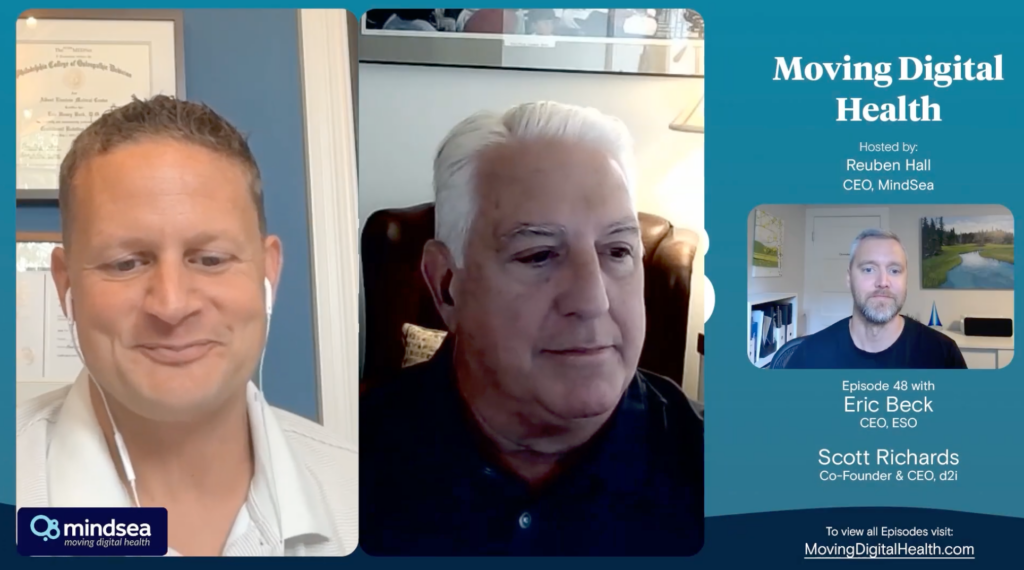

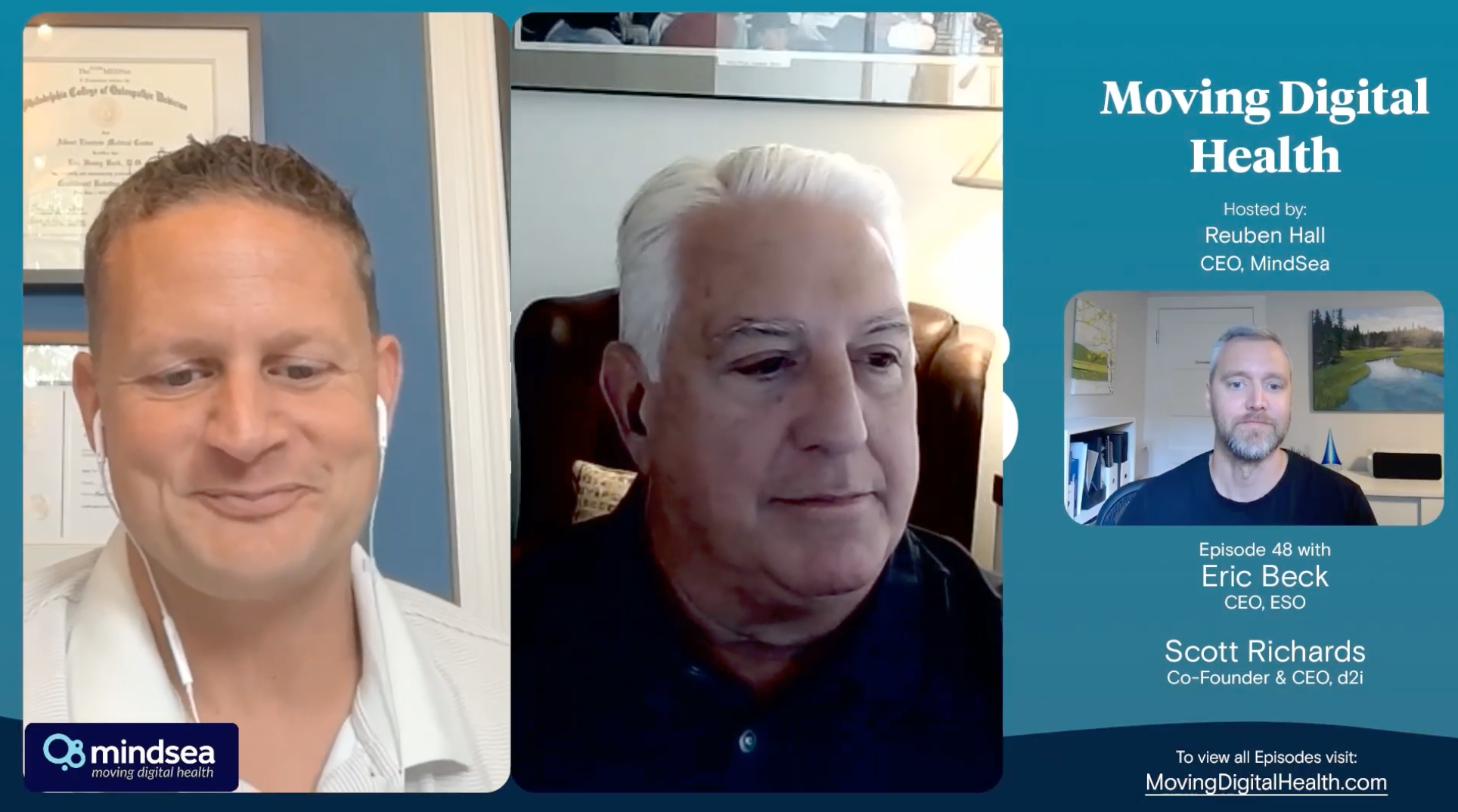
Paramedics spend entire careers wondering what happened to the patients they handed off. The ambulance doors close, the crew clears the bay, and the data stream stops. Meanwhile the emergency department team receives a patient with almost no context about the twenty minutes that preceded arrival. Both sides make decisions inside a blind spot the industry has tolerated for decades.
Dr. Eric Beck has worked nearly every job on both sides of that handoff. He served as a firefighter and paramedic, an emergency physician, EMS medical director for the City of Chicago, and president and CEO of a 23-hospital health system. He now leads ESO, the category creator in prehospital data. Scott Richards spent 30 years in healthcare IT and co-founded d2i, a hospital analytics platform running across 450 hospitals, which ESO acquired in April 2026. Together their platforms cover thousands of EMS agencies, more than 3,000 hospitals, and over 10 billion data points.
In this episode of Moving Digital Health, Eric and Scott join MindSea CEO Reuben Hall to walk through what opens up when those two halves connect. For example, a dispatcher who codes a call as a suspected stroke sends the crew out prepared, and that patient’s odds of survival double. A hospital finance leader can also see the full arc of services rendered from the 911 call through discharge. That view has largely been an estimate until now. Eric and Scott also name where founders go wrong when they try to sell software into emergency care.
“If the emergency medical dispatcher suspects stroke and dispatches the ambulance crew for stroke, you have a two times better chance of surviving your stroke.“
— Dr. Eric Beck, CEO, ESO
Topics Covered in Episode 48 of Moving Digital Health (Eric Beck & Scott Richards):
- Where does patient data break down between EMS and the hospital? (01:19)
- What problem was d2i solving for hospital emergency departments? (02:33)
- What becomes possible when you connect 911 data to hospital discharge? (04:51)
- How does closing the feedback loop change paramedic care and morale? (06:20)
- How do you harmonize EMS flat files with hospital EHR data? (08:37)
- How hard is it to merge two mature healthcare data platforms? (10:22)
- Which customers see results first after a healthcare data merger? (12:03)
- How do you deliver real-time clinical alerts without overloading ER staff? (14:06)
- How does prehospital data help hospital CFOs fix throughput and revenue leaks? (15:24)
- Where does AI fit in emergency department forecasting? (17:57)
- What is the golden rule of UX design for clinicians under stress? (20:05)
- How do you balance enterprise customization against platform discipline? (21:10)
- How do you get frontline crews to adopt new data tools? (22:17)
- What is the biggest mistake founders make selling software into emergency care? (23:19)
- Is healthcare interoperability getting better or more fragmented? (26:11)
Find Moving Digital Health on Apple Podcasts and Spotify, and subscribe to the MindSea newsletter to be notified about future episodes.
Reuben Hall (00:00)
Welcome to Moving Digital Health, a podcast series from MindSea. I’m your host, Reuben Hall, CEO of MindSea. Each week we sit down with leaders and innovators in healthcare to hear their personal stories and explore how they’re moving digital health forward.
Today, we’re joined by two leaders who are solving one of the oldest, most critical blind spots in healthcare: the gap between prehospital emergency care and the hospital emergency department.
Dr. Eric Beck is the CEO of ESO. He brings an extraordinary 360-degree perspective to healthcare, having worked as a firefighter and paramedic, an emergency physician, EMS medical director for the City of Chicago, and president and CEO of a 23-hospital health system. Joining him is Scott Richards, a 30-year healthcare IT and operations innovator and the co-founder of d2i, which was recently acquired by ESO.
Together, ESO and d2i manage data across thousands of EMS agencies and more than 3,000 hospitals, encompassing over 10 billion data points. For the first time, they’re giving the healthcare industry a unified, connected view of a patient’s journey from the moment a 911 call is made all the way through hospital discharge. Eric and Scott, welcome to the show.
Eric Beck and Scott Richards (01:16)
Good to be with you.
Where does patient data break down between EMS and the hospital?
Emergency care data breaks at the handoffs, and there are hundreds of them. A single patient record passes through dispatchers, ambulance crews, ED staff, inpatient teams, and billing before the episode of care closes. Eric Beck argues that the break starts before the ambulance even arrives, at the moment a caller’s address gets translated into the first fragment of a clinical record.
Reuben Hall (01:19)
Eric, you’ve literally held every job in emergency medicine, from riding in the back of an ambulance as a firefighter paramedic, to treating patients in the ER, running Chicago’s EMS system and executive leadership. How did seeing healthcare from every rung of the ladder expose where the data breaks down between public safety and enterprise health systems?
Eric Beck (01:40)
It’s been an interesting opportunity that gave me an authentic appreciation for all the handoffs between the different stakeholders. It starts even before the ambulance, when someone calls the emergency number for care, when there’s something happening, and how that information gets translated from an address or a location of an emergency into what ultimately becomes a patient record. And how that data in the ambulance, the hospital, and even post-hospital goes through literally hundreds of individuals over time.
So it’s really been a ground-level view of all those handoffs that has informed my appreciation for the opportunity that allows us to do better there.
What problem was d2i solving for hospital emergency departments?
Hospital leaders rarely lack data. They lack timely data they trust. Scott Richards built d2i around data integrity first, giving emergency department clinicians and administrators a single source of truth that mirrored their actual workflows. The platform covered everything from ED arrival through discharge or admission, which left one significant gap: everything that happened before the patient came through the door.
Reuben Hall (02:33)
And Scott, you spent 30 years in health IT and co-founded d2i to manage billions of data points across 450 hospitals. What was the core problem d2i was solving for hospitals? And why did merging d2i’s analytics into ESO’s prehospital network feel like the missing piece of the puzzle?
Scott Richards (02:57)
Clinicians and departmental stakeholders in hospitals, and generally the ED, are the ones who have to drive change and improve patient care and operations. They really don’t have access to timely data that they trust. And we know it’s not for the lack of data. We do know the data is there. We knew that the data had to be a foundational part of anything if they were going to be able to trust it.
So from day one, we built d2i with a data-integrity-first mindset. Our goal was pretty simple. It was to provide clinicians and healthcare leaders with a single source of truth that mirrors their real-world workflows, and took the complexity out of the data while making it all actionable.
As powerful as d2i’s engine has been inside the hospital walls, it started at the ED door. We were analyzing the care continuum from arrival to discharge or admission, but missing a really crucial segment of patient care: what happened before the patient ever came to the emergency department. That’s where the merger of d2i and ESO picks up. When we first started talking to Eric and his team at ESO about some partnering opportunities, it quickly became clear to both of us what the potential was.
ESO is the premier prehospital source of data in the ecosystem, and d2i is deep hospital analytics. Now we’re able to deliver a complete picture, connecting the dots from 911 all the way to the patient’s safe discharge. What we’re doing now is turning two really amazing partial views into a single comprehensive source of truth.
What becomes possible when you connect 911 data to hospital discharge?
Learning cycles. Eric Beck frames the value as an improvement loop rather than a reporting upgrade, because both sides can finally see the consequences of their decisions. Connecting the two halves also surfaces relationships nobody could measure before, where an upstream choice in the field shapes a clinical, operational, or financial outcome days later.
Reuben Hall (04:51)
Amazing. And historically, the moment an ambulance crew dropped a patient off at the ER, the data stream broke. EMS rarely learned what happened to the patient, and the ER had zero context about what happened in the field. What becomes possible when you bridge that gap from 911 to discharge?
Eric Beck (05:13)
That is the question that I think we all are chasing, and it fundamentally is about better care for the patient, first and foremost. Everyone in that healthcare ecosystem is really trying to serve that patient. So certainly clinical care can improve. But how does it improve?
Well, it improves through learning and through an improvement cycle. That learning comes from being able to understand what happened before arrival and what happened after arrival, so that both stakeholders can better inform the decision making and the work that they’re doing in their respective areas.
It also helps unlock new insights, new knowledge that wasn’t there before, in which something upstream in the prehospital phase can influence the downstream outcome for the patient, whether that’s clinical, operational or financial. And that’s really what gets unlocked when we’re able to bring that data together in a unified view, as Scott said.
How does closing the feedback loop change paramedic care and morale?
Paramedics who never learn a patient’s outcome start to question whether their work matters. Eric Beck calls the feedback loop a game changer for job satisfaction, and the clinical case is stronger still. Linking hospital outcomes back to EMS and dispatch records revealed a large volume of strokes going unrecognized in the field, which turned into a targeted performance improvement program for crews and dispatchers.
Reuben Hall (06:20)
And Eric, paramedics are incredibly passionate about patient outcomes. Yet for decades they’ve operated in this black hole. How does closing the feedback loop and letting a paramedic see what happens to the patient after they’ve dropped them off improve the clinical quality and even crew morale?
Eric Beck (06:42)
Well, the crew morale, I think it’s a game changer. If for your entire career you’ve taken patients to hospital and wondered what happened to them, it makes you wonder if you’re really making a difference, if you’re living up to your potential, if you’re providing the right care. So certainly there’s a huge job satisfaction and professional identity feedback loop there. That’s important.
But as you said, quality and improvement in patient outcomes is really the ultimate goal. We know that we can provide a clear understanding of the opportunities for paramedics to better identify patients and conditions, to better inform treatment care, to provide improvement relative to protocols and performance metrics. As I mentioned earlier, it even extends prior to the paramedic. Even the emergency medical dispatcher who’s fielding that call has an important opportunity to learn from the feedback loop.
One piece of research that I think illustrates this well is linking hospital outcomes data to the EMS and the emergency medical dispatch data. It allowed us to identify a large number of strokes that were going unrecognized by ambulance, and that allowed us to create a performance improvement program for paramedics to improve the recognition and identification of stroke.
More importantly, when you take that all the way back to the dispatcher, we now know that if the emergency medical dispatcher suspects stroke and dispatches the ambulance crew for stroke, you have a two times better chance of surviving your stroke. That’s that important cascade of upstream decisions, setting in motion care trajectories that improve outcomes downstream for the patient.
How do you harmonize EMS flat files with hospital EHR data?
Through a normalization pipeline built on a domain-specific data model. EMS systems produce flat files and computer-aided dispatch exports, while hospitals run complex enterprise platforms, so both ESO and d2i had independently built ingestion engines designed for highly varied inputs. Scott Richards frames the real work as signal-to-noise filtering rather than volume management, because surfacing 10 billion data points to a clinician helps no one. We run into the same pattern in EMR and EHR integration work, where a standards-compliant connection is the starting point and normalization is the actual project.
Reuben Hall (08:37)
That’s excellent. And Scott, from your perspective, integrating prehospital electronic patient care report data with hospital EHRs and financial records is notoriously messy. EMS uses flat files and CAD systems, where hospitals are running on complex enterprise platforms. How did you architect d2i to harmonize all those data points, semi-structured and structured, without creating friction for administrators?
Scott Richards (09:11)
It starts with how we built the architecture around a robust and scalable data interchange and ingestion engine, and how you get that into a normalization pipeline. What was really cool is when we got to know ESO, they had been working on and had done the same thing. We both had designed domain-specific data models capable of ingesting highly varied data.
So the beauty of ESO’s EMS EHR, and all the data they acquired from other vendors and legacy system flat files and NEMSIS, is that our data warehouse already had a high degree of match between our two data sets. That’s starting to be leveraged into some really interesting research and some other ways. It really comes down to reducing the signal-to-noise ratio when you’re putting this stuff together.
Just because you’re managing billions of data points doesn’t mean you’re surfacing those data points to clinicians. It really is our job as architects to filter out all that noise and then push only those things that are relevant into the ED workflow.
How hard is it to merge two mature healthcare data platforms?
Customer overlap made the technical merge tractable. Both companies already served many of the same communities and sites of care, so the teams could start working with data on the same patients almost immediately. Scott Richards describes the integration as a process rather than a challenge, and that shared foundation has already produced research heading to publication.
Reuben Hall (10:22)
And so when ESO and d2i came together, was it really difficult to bridge and merge those technologies together? Or, like you’re saying, there was already some synergy and shared architecture there?
Scott Richards (10:38)
It’s going to be a work in progress. But we’ve already come to a lot of really cool understandings about one another. I do believe, because we’re both on pretty advanced data models and products in the space, that bringing them together is going to be a process more than it is a challenge.
Eric Beck (11:01)
One of the things, Reuben, that was I think most striking is that we had a significant degree of overlap in our customer bases in terms of sites of care and communities. That created a natural foundation for us to work with data for the same patients. That’s become the foundation upon which we’re building our go-forward integrated approach.
As Scott mentioned, that initial overlap has allowed us to already provide some really meaningful research that’s been presented and is being presented in the coming months. That’s going to help nurses and physicians in the hospital, it’s going to help paramedics and emergency medical dispatchers, and it’s going to help healthcare leaders managing the revenue cycle around all of that activity make better decisions, take better care of patients, and capture appropriate reimbursement for their activity. That’s the beginning, and it’s informing where we’re going next.
Which customers see results first after a healthcare data merger?
Research findings reach the market before integrated product does. At roughly 100 days post-acquisition, the combined data set is already producing posters and papers, while the first joint solution goes on display at the American College of Emergency Physicians meeting in October. Scott Richards also notes the practical constraint: integration work layers on top of two organizations still onboarding new clients.
Reuben Hall (12:03)
You mentioned customer overlap. Were there customers that were already with d2i and ESO that are already seeing some of those benefits of the platforms being merged?
Scott Richards (12:14)
Yeah. Again, this is what, Eric, 100 days old?
Reuben Hall (12:17)
So it’s still pretty fresh?
Scott Richards (12:19)
It is in motion in some really exciting ways. I think the research that Eric mentioned is coming out in posters and papers, so it is already having an impact for the market. But I do think that the time to integration of product suites is on the horizon. Coming up at the American College of Emergency Physicians meeting in October, we’ll be showing off some of the first integrated solutions that pull their data and our data into the first solution that we’ll be delivering.
Reuben Hall (13:02)
Yeah, no, I imagine it’s a lot of conversations and a lot of effort happening right now, planning how to bring everything together. It’s a large volume of data, and numerous customers, to try and figure out how to really seamlessly tie things together.
Scott Richards (13:25)
And the other challenge is we’re both growing. So the integration step is layered in on top of our day jobs. Right now we’re onboarding some 15 different health systems, probably around 75 different hospitals for different clients. And of course ESO has that much or more moving through their onboarding processes.
So it puts us in a really exciting spot where you want to get all this integration done, but you’ve got to keep serving clients and grow.
How do you deliver real-time clinical alerts without overloading ER staff?
By embedding a small number of role-specific signals directly into the workflow. Eric Beck describes capturing prehospital data as close to real time as possible through ambient voice capture and monitor integrations in the ambulance, then feeding predictive models that anticipate what the patient will need. The receiving team gets the signal that applies to their role rather than a 50-page chart.
Reuben Hall (14:06)
When an ambulance is five minutes away with a critical patient, the receiving team doesn’t need a 50-page chart. They need specific, actionable signals. How do you design systems that deliver real-time predictive insights, like sepsis or stroke alerts, without adding too much information and cognitive overload to an already overwhelmed ER staff?
Eric Beck (14:30)
ESO has been on a journey to create actionable insights that can drive actual decisions and workflow in the emergency department through the real-time exchange of prehospital data, and more recently with predictive models.
The goal is to capture that data in a way that is as near real time as possible. Things like ambient capture, the ability to listen and capture voice, and monitor integrations from other data sources in the ambulance, all feeding that real-time predictive model, is the primary focus. The ability to then surface that in the emergency department in role-specific, workflow-embedded ways, such that we have the ability to anticipate the needs of the patient, is really the primary focus.
How does prehospital data help hospital CFOs fix throughput and revenue leaks?
Emergency departments generate 60 to 70 percent of a hospital’s inpatient admissions, which makes them the primary engine of hospital operations and financial health. Scott Richards notes that d2i pulls billing, revenue cycle, physician scheduling, and patient satisfaction data alongside the EHR feed, giving executives a view into demand, staffing, boarding, and revenue integrity. Eric Beck sharpens the case with a second figure. About 20 percent of ED patients arrive by ambulance, and those patients are four times more likely to be admitted. Blake Sollenberger made a parallel argument in an earlier episode on fixing revenue cycle operations before adding AI.
Reuben Hall (15:24)
Emergency departments are often called the front door of the hospital, but they’re also massive operational bottlenecks. Beyond clinical care, how does linking prehospital arrivals with hospital throughput data help hospital CFOs and CEOs fix staffing, bed utilization, and revenue cycle leaks?
Scott Richards (15:45)
Something that a lot of people aren’t aware of is that emergency departments account for 60, sometimes 70-plus percent of all inpatient admissions for hospitals. So it really is a primary engine for hospital operations and financial health.
When you combine ESO’s prehospital data, their inbound data, with d2i’s ED data, the important thing to understand about the data we get from the emergency department is that it’s not just from the electronic health record. We integrate that data with billing data, revenue cycle management data, with physician hours and schedule data, and patient satisfaction and engagement data. So it gives a really comprehensive 360-degree view.
CFOs and CEOs, and certainly the emergency department medical directors and service line administrators, gain some really deep insights into things like demand, staffing, boarding, and revenue integrity. All of those have some play on improving throughput and operations, which could lead to staffing changes that increase the number of patients you can see. By resolving boarding, you’re addressing a number of factors that could even lead to patient safety issues. And when you look at a recent white paper that was released by ESO, it clearly indicated the value of leveraging their patient documentation from the ESO EHR into d2i’s data from a revenue integrity and reimbursement perspective.
Eric Beck (17:21)
Just building on that, Reuben, there’s a really important extension of that statistic Scott mentioned. If 70 percent of patients in the hospital come from the emergency department, they either walk in or they arrive by ambulance. About 80 percent of folks walk into emergency departments and 20 percent arrive by ambulance. But if you arrive by ambulance, you’re four times more likely to get admitted.
So understanding that prehospital phase of care, those EMS arrivals to the emergency department drive a disproportionate amount of that throughput and that inpatient load.
Where does AI fit in emergency department forecasting?
On two fronts. Internally, AI accelerates how ESO’s own teams build products and data models. Externally, the models give responders and ED clinicians advance notice of acuity, likely admission, bed type, and expected length of stay. Eric Beck ties responsible use to both fronts, since a model that clinicians cannot trust in their workflow has no value regardless of how it was built. That trust question shapes how we approach healthcare AI development for clinical settings.
Reuben Hall (17:57)
And so with all these prehospital and hospital data points now under one roof, where does AI fit in? How are you moving toward predictive models or forecasting emergency department volume before the crisis hits the door?
Eric Beck (18:18)
It’s a great question. I think it’s such an exciting time because AI is enabling a whole new set of possibilities that just weren’t available to us before. There’s probably two ways to think about it.
One is how our teams are using AI inside of ESO to help create products and data models, so it’s accelerating what’s possible there. It’s augmenting human capability to build those models.
But then the models themselves can serve responders and clinicians in the field and in the emergency department with advance notice. Being able to understand the acuity, the downstream needs of a patient who will be admitted, what type of bed they need, their length of stay, goes to support all of those points that Scott mentioned about driving throughput, helping to support documentation integrity and reimbursement.
So really powerful. At the end of the day, responsible use of AI requires us to use it on both fronts, to unlock what’s possible in the product development cycle, but also to use it in ways that can be trusted by our clinician and responder partners in their workflow.
Scott Richards (19:30)
That was one of the things that really excited d2i about becoming part of ESO. I think it’s fair to say that AI is front and center with regard to the ESO strategy. And I do believe that, from a responsible use of data and AI perspective, the thing I mentioned before about being able to take all the complexity out of the data, we’ve been doing that through algorithms and programmatically. Now with AI, that just sends us down the path so much faster and further to be able to do that for physicians and hospital leadership.
What is the golden rule of UX design for clinicians under stress?
Make the right thing to do the easy thing to do. Eric Beck warns against digitizing legacy paper processes, since a screen that mirrors an old form carries all the original friction into the new tool. The design work starts with understanding a specific clinician’s workflow and then removing steps from it. Our UX design practice starts in the same place, with observation before wireframes.
Reuben Hall (20:05)
And Eric, you’ve used software riding in the back of an ambulance going 80 miles an hour, and you’ve used software running a hospital. What’s the golden rule of UX design when building those tools for clinicians working under that level of intense physical and emotional stress?
Eric Beck (20:26)
I think the overarching theme is we’ve got to make the right thing to do the easy thing to do. So that’s about removing friction in the workflow, and that’s about understanding the workflow of the individual clinician or responder in that sequence.
What does that really mean in reality? It means that we can’t just digitize legacy processes or paper databases or data collection mechanisms. We really need to think about that workflow, and what’s the best way to accomplish the goal, while reducing friction and making it easy, embedded and specific to the workflow of a particular clinician or responder.
How do you balance enterprise customization against platform discipline?
Hold the core data model steady and allow tailoring at the edges. Eric Beck describes this as the standing challenge in any digital health environment, because every healthcare organization has legitimate local requirements that no scaled platform anticipates. The discipline sits in the data set, while configuration handles the local variation.
Reuben Hall (21:10)
And how do you balance custom requests from specific large customers that want things to work a little bit differently for their workflow, versus having a platform that you have to make work for all of your customers?
Eric Beck (21:29)
I think that’s always the challenge in almost any digital health environment. It’s having the discipline and the focus to build things that scale and meet the needs of everyone, while also having capabilities for customization, configuration and tailoring on the end.
Every healthcare organization is inherently unique and has some activities that need to be accounted for in their own local environment. So we really pride ourselves on being disciplined about the data, but also appreciating the unique needs of individual organizations and being able to tailor locally without disrupting the discipline around the core data set.
How do you get frontline crews to adopt new data tools?
Reduce the number of clicks and stop making users leave their workflow. Scott Richards puts it plainly: added burden kills adoption. Tools that inject insight into an existing workflow and strip out administrative noise get used, while tools that ask for a big lift get worked around.
Reuben Hall (22:17)
Scott, health systems and public safety agencies are notoriously resistant to changing legacy software workflows. From a consulting and product leadership standpoint, how do you get frontline crews and hospital staff to actually adopt new data tools rather than working around them?
Scott Richards (22:38)
I think Eric gave a pretty good answer to that already, but I’ll just add to it. It comes down to this: if you add burden to the end user, adoption fails. The number of clicks matter. You don’t want them moving from one tab to another tab in order to continue their process. When you sacrifice their workflow, that’s where you run into problems.
So you have solutions that inject insights into the workflows, that extend the user, that make their job easier, that remove administrative noise. That’s all going to drive utilization and adoption. When you’re not paying attention to that is when you run into problems. You don’t want to give them a big lift. You want to take away the big lift.
What is the biggest mistake founders make selling software into emergency care?
Underestimating what healthcare data integration actually takes. Scott Richards warns that a clean API does not deliver clean data, because storage, implementation, and configuration vary even within a single EHR at a single hospital. Eric Beck adds the strategic version of the same error: building without starting from the outcome the customer needs to improve.
Reuben Hall (23:19)
Makes sense. So for the digital health founders, clinicians and product leaders listening who want to tackle fragmented care challenges, what’s the biggest mistake you’ve seen people make when trying to sell software into that emergency care ecosystem?
Scott Richards (23:38)
From my perspective, the biggest technical and business mistake is misunderstanding the complexity of healthcare data and what it takes for integration. All those data points don’t exist in one place, even within an EHR.
Eric kind of mentioned it. If you’ve been in one hospital, you’ve been in one hospital. The same is true of data. How the data is stored, even within a single EHR, is different in terms of how you have to pull it out, because of how it gets set up. Implementation varies, and what data ends up in what parts of the EHR varies.
So from a founder’s perspective, we often try to build a really slick algorithm, that’s now getting replaced by slick AI, or a user interface, assuming hospitals are going to easily export data via some API. But even if it’s a really clean API, the data that’s coming to us in our experience is still dirty, it’s not standardized, and it tends to get locked up behind the legacy infrastructure. If you don’t account for that deep data normalization and workflow integration from day one, I think you’re going to have more challenges later on.
Eric Beck (24:59)
I would add that under-appreciating the complexity and the uniqueness, as Scott said, is certainly sage advice. I think the other piece that’s important is that for data to be useful, you really need to start with the end in mind. What are you trying to do with that data? What outcome are you trying to improve, and working backwards from that to really build the right foundation?
That foundation is both technical, but it’s also about understanding the users of that data and the role-based workflows, as Scott said. So getting really close to the customer, understanding the outcomes that matter to them, and using that as the lens to inform your strategy. I see a lot of folks trying to boil the ocean, trying to bring solutions without having done that frontline connectivity.
So for us, a big part of that is how do we bring the right functional expertise and the right clinical expertise from the industry into that conversation with customers, so that we’re able to ensure alignment around the outcomes that matter most to our customers.
Is healthcare interoperability getting better or more fragmented?
Both, depending on where you look. Scott Richards points to CIOs actively shrinking their vendor portfolios, which raises the bar for any new entrant and makes near-term ROI a requirement rather than a nice-to-have. Eric Beck agrees that standards-based interoperability has moved the industry forward while local data nuance keeps the work messy, and both expect AI to change the pace over the next two to five years. Brian Book made a related case in an earlier episode on what the VA can teach you about real healthcare interoperability with FHIR.
Reuben Hall (26:11)
And with your customers and the hospital systems you’re working with, do you see the fragmentation and interoperability getting better over time as things are communicating and talking to each other better? Or is it getting increasingly complex with more vendors and systems trying to tie into legacy and building new things on top of old things? Which direction do you see us headed, on the ground floor?
Scott Richards (26:48)
I think CIOs in healthcare, and probably across all industries, are really trying to minimize their vendor portfolios. That’s one of the things you’ve got to take into account when selling into health systems. The thing that I feel is really important is you’ve got to get the CFO. You talked about them a bit earlier. You need something that is tangible from an ROI perspective in the near term, not in the long term.
But I do think that from a data interoperability perspective, this has been a decades-old challenge that hasn’t been solved. I do think that AI is going to change things, and that’s going to be an exciting part of what we get to experience over the next two to five years. If you think back ten years ago and what we were doing five years ago, it’s pretty similar. If you think back five years ago to what we’re doing today, very different.
Eric Beck (27:48)
I would add to Scott’s point. ESO has always been vendor agnostic, both on the prehospital clinical record and on the hospital EHR. And while standards-based interoperability has done a lot directionally to move us forward, I agree with Scott, it’s still quite messy. There is so much inherent local nuance to the data that it requires ongoing effort. So it certainly isn’t a silver bullet.
AI is changing the game. It makes solving that equation exponentially easier, and it’s getting easier by the day. But as you said, the fragmentation, in spite of CIOs’ best effort to consolidate the number of systems and platforms, is a real challenge. That’s why the work that we do really matters. That’s why our approach to EMS interoperability and emergency department prehospital care interoperability is so core to our DNA. We were the category creators over a decade ago in that space. I think things are better, but there’s still a long way to go.
Reuben Hall (28:58)
Well, hopefully you’re right, and things will continue to improve with AI in terms of data interoperability, which will make all of this easier in the future. Thank you so much for joining me on the podcast, Scott and Eric.
And thanks to everyone for listening to the Moving Digital Health podcast. If you enjoyed this conversation, please go to MovingDigitalHealth.com to subscribe to the MindSea newsletter and be notified about future episodes.