
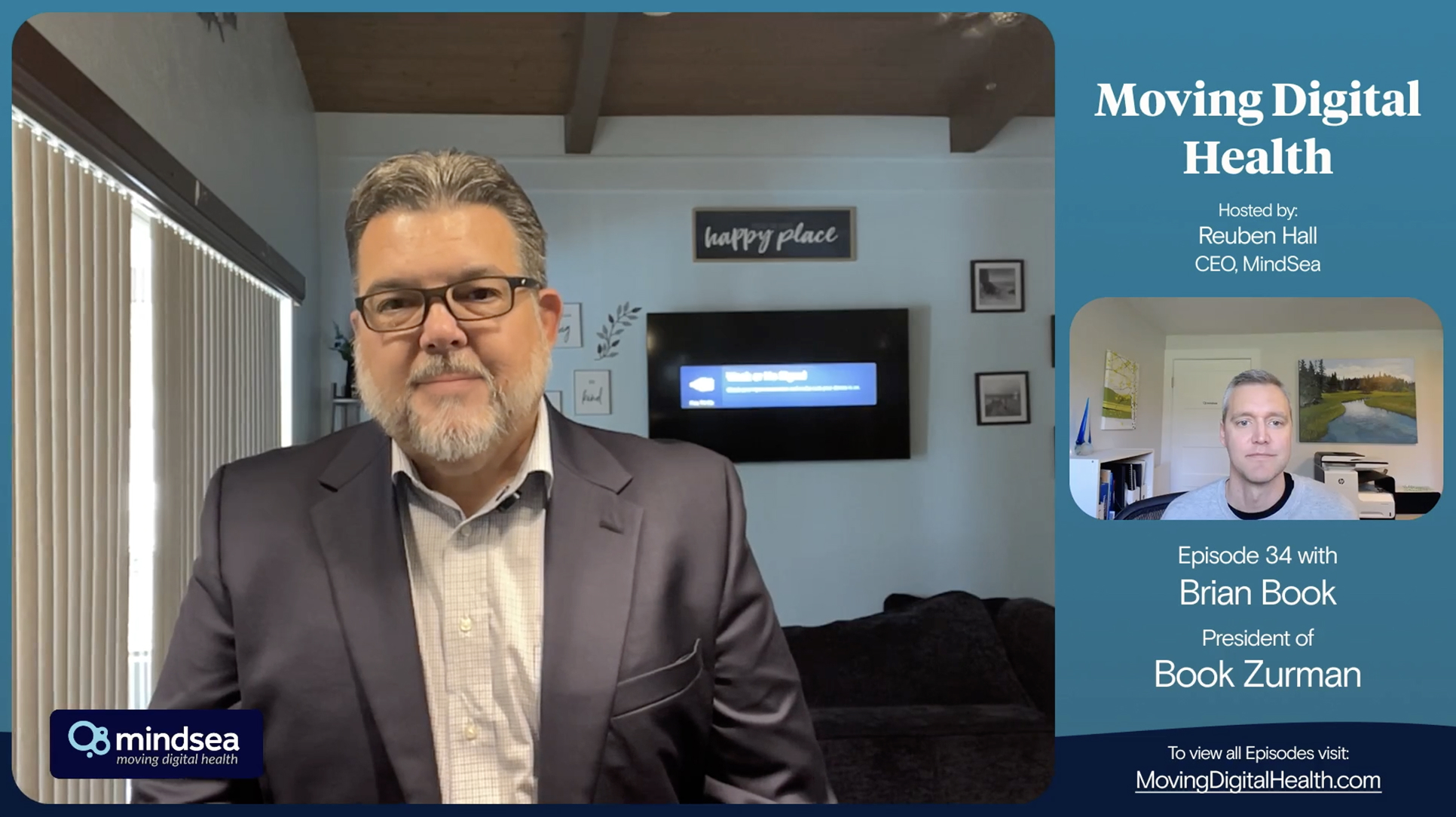
Our guest this episode was Brian Book, President at Book Zurman. Brian joined Reuben Hall to discuss healthcare interoperability, and how veteran-led innovation is reshaping digital health.
“As a disabled veteran, I am a consumer of the VA product. And so I have a vested interest in making sure that the work that we do not only benefits me, but also benefits other veterans and disabled veterans.” — Brian Book on building meaningful, standards-based digital health tools.
Find Moving Digital Health on Apple Podcasts and Spotify, and subscribe to the MindSea newsletter to be notified about future episodes.
Read Transcript:
Reuben Hall (00:01)
Welcome to the MindSea podcast series, Moving Digital Health. Our guest today is Brian Book, president at Book Zurman, incorporated and healthcare interoperability expert at CareNexus. Thanks for joining us today, Brian.
Brian Book (00:16)
Thanks for having me. Happy to be here.
Reuben Hall (00:19)
Great, could you start by telling us a little bit about your background?
Brian Book (00:23)
Sure. So Book Zurman Incorporated started in 1996. And in 2010, we decided to move into the government space. And so we’ve worked as a government contractor since 2010 and almost exclusively for the Veterans Administration since we started.
Over the years have worked with just about every part of the VA except for cemetery. And we, for the last 15 years or so, have been representing the VA in the interoperability standards development community. And we have leadership roles in those communities like HL7 and OMG and ISO and a bunch of others. And we actively participate in the development of health care standards on behalf of the VA. We vote for them in those communities and then we bring that subject matter expertise back to the VA and advise them on interpretation and implementation of their standards.
Reuben Hall (01:37)
So you’ve had a remarkable journey from serving in the US Army during the Gulf War to leading healthcare IT innovation. What inspired you to transition into healthcare technology specifically?
Brian Book (01:51)
The majority of my professional experience was in manufacturing. And when I got out of the military, I worked in circuit board manufacturing and glass and plastic and building products. I’m a disabled veteran. And I read an article that the federal government was setting aside contracts for disabled veteran-owned companies.
One of the friends, Craig Zurman, who’s the Zurman of Book Zurman, him and I went to high school together and I was living in Texas and I moved back to Florida where I am now. And I was fishing with him and I had told him that I read that article about them setting aside work for veteran companies. And he’s been an entrepreneur his whole, his entire career.
And I said, you know, we should we should start a company and try to do something with this. And he blew me off and fast forward to Christmas time. And he goes to a Christmas party and he meets a pretty high up VA guy who says, if you really want to do something, you should go find a disabled veteran and start a company. And so that’s how the company got started in the first place. But we, over the years, we did a lot of work around program and project management for the VA. And we met a group of people that were in the interoperability space. And at the time it was really super niche and behind the scenes and hardly anybody knew anything about healthcare standards or anything related to electronic health records. The VA has pretty much been a leader in electronic health records over the years. And a lot of the things that they were doing were decades ahead of other parts of healthcare from an IT standpoint. And so we met a group of people and we helped them to continue to do the work that they were doing and that moved us into the interoperability space.
Reuben Hall (03:55)
Okay, interesting. So it really is a success story of the government supporting veterans and disabled veterans to become entrepreneurs and really add value to the system.
Brian Book (04:26)
Absolutely, without the set-aside programs that they have, it makes it very difficult for small companies to compete against the big monsters like Deloitte and Booz Allen and those types of companies. So there’s a lot of expertise that is in those small companies. A lot of those large companies will tell you that none of the small businesses have anything that they don’t have in exponential scale from small business.
But a lot of small business has a level of expertise that those large companies struggle in a lot of ways to try to capture. So it makes that competitive landscape a little fairer from a financial perspective. So I’m really happy that the government has put those programs into place.
Reuben Hall (05:31)
And I would assume from being disabled, you’ve had your own journey through the healthcare system. And how has that shaped your drive to improve the patient experience through technology?
Brian Book (05:47)
Absolutely. I’m as a disabled veteran, I am a consumer of the VA product. And so I have a vested interest in making sure that the work that we do not only benefits me, but also benefits other veterans and disabled veterans. So, I’m hypersensitive to the mission of trying to deliver the best healthcare that can be delivered to veterans and interoperability is a big piece of that.
So the VA and the DOD for a couple of decades now have had a level of interoperability between them that no other healthcare organization has. And I think they get a bad rap in the media trying to portray the VA systems and the DOD systems as antiquated. But in a lot of ways, they can do things that nobody else can setting the standard and a lot of the work that we’ve done in the community is the community benefits from the money that VA and DOD has spent to foster development of solutions, interoperability solutions and healthcare standards that never would have happened if it wasn’t for them.
Reuben Hall (07:11)
I don’t think a lot of people know that VA is actually leading in some of these categories when it comes to interoperability. And I know Book Zurman has been a key contributor to healthcare standards over the years. What are some of the milestones or wins that you’re most proud of there?
Brian Book (07:32)
I think that our work with FIRE has been pretty key in pushing that standard forward. We started working in that, in those workspaces and in that part of the community since its inception. And as I’ve said, we have leadership roles in those work groups that have allowed us to shape how that particular standard has evolved over the years.
And we’re finally at the point now where CMS is trying to roll out the requirements for the private sector to leverage fire as a standard. And so I’m really proud that we’re finally at a point where we’re starting to see implementations in the community that at some points I thought we would never see.
Reuben Hall (08:29)
And could you walk us through the mission behind CareNexus? How is that different from the work you do at Book Zurman?
Brian Book (08:36)
So, CareNexus was a proof of concept that there’s an organization in the federal government called SAMHSA that built a care coordination platform that was called Omnibus CurePlan. And we did some work with them to try to shape that product when there was a change in administration, the funding for that project went away.
And so, CareNexus originally was the continuation of the work of Omnibus Care Plan. And in a lot of ways, it was a proof of concept leveraging the implementation guides that we created in the standards community for things like FHIR and eCare plan and several other healthcare related standards where we took the implementation guides from the community that we had created and built CareNexus as a platform, a care coordination platform to support care coordination within a patient’s healthcare journey. And it was originally set up to be a patient facing or provider facing product. And now that Fire is finally starting to get traction in the community and that there are Fire endpoints that we can connect you to pull patient related data. We’re starting to move CareNexus from a provider facing tool to a patient centered tool. for example, people that have more than one chronic condition and are dealing with multiple comorbidities, it’s really difficult for multiple providers to share information with each other.
And so from a care team perspective, the care teams are scattered and the doctors don’t talk to each other. And it makes it really difficult for a patient to try to keep all of that healthcare information organized and consolidated in a way where they’re not having duplicate tests done and have information readily available that they can provide to a doctor when they see them that ensures that the doctor sees a full spectrum of what their care is rather than just the part of their healthcare journey that that doctor is providing to the patient. And so it’s filling a void that the community had, or the patient side of the community has had for, you know, since they started collecting patient data for patients.
Reuben Hall (11:38)
And CareNexus, is that strictly for integration with VA as well, or is that outside and available for other pairs?
Brian Book (11:55)
It’s available to anybody who wants to leverage that. And if you want to find more information about it, you can go to carenexus.app and find more information about it. But it’s not, and this is the beauty of healthcare standards, is because it’s a fully standards compliant platform, can be used, anybody can use it. So it’s not locked into just the VA or locked into any other EHR providers software ecosystem.
And it also has a smart on fire app store. And so we can build apps within care nexus that extend the functionality of the software so that we can rapidly build solutions that meet workflow needs that would take months or years in other platforms to develop. And then those smart on fire apps can also be launched from within other EHR platforms that are FHIR compliant. So anybody that’s FHIR compliant could take those smart on FHIR apps and launch them within their system. And so it’s not locked into a single platform.
Reuben Hall (13:14)
Excellent. Yeah, I’ll have to look into that more as well. It’s very interesting. I know working with the Department of Veteran Affairs must be both challenging and rewarding. How hard has it been to watch the impact of the recent funding cuts?
Brian Book (13:33)
It definitely has been a challenge, at one point Doge completely wiped out everything that we were doing at the VA. So every VA contract that we had was canceled initially. so I want to, although that was very difficult for us and we’re still trying to recover from it. The one thing that I will say is that Doge didn’t come in and just willy nilly kill everything. They came in and they said, if you can justify the work that you have, you can keep it. And so all they asked was that the owners of contracted work create a justification for the work that they’re doing. And so a lot of, and I’m going to say this and it’s going to get me in trouble, but a lot of the program and project related people, they threw themselves on the floor and they whined that Doge was taking everything away.
And they came in a second time and said, justify it and you can keep it. And in a lot of cases, they didn’t even care about the substance of the justification. They just wanted them to take the act of justifying the work that they had. And anybody that justified the work got to keep the work and the ones that didn’t take the time or energy to write that justification, all of the work went away. And so the work that we had that where our, the program people that we worked with were willing and able to write those justifications, that work came back to us. And we had others that didn’t write the justifications and all of that work went away.
So there are some programs that got crippled because they didn’t justify the work and others that may have been hurt a little bit, but that they’re still going. but it was, it really was an exercise that needed to happen within the VA. But I’m disappointed that they didn’t look at the Cerner implementation or the Oracle Cerner project that they have going on because that one is, it started as a $10 billion contract and it quickly went to $16 billion. It’s almost 10 years into that contract now. And there’s only a handful of VA facilities where they’ve implemented that software. And so the projections right now are that they need another 10 years and $50 billion to finish that project.
You know, we lobbied in the beginning when they were getting ready to implement that contract for the VA to go in a different direction. But that decision was made. And if it was up to us, would have we would have advised them to to create a data rights contract that basically says that anything all the patient records at the VA are owned by the VA and that they’re going to move all that into a standards-based format like FHIR, and then require the community to also adopt FHIR and build solutions to meet the requirements of the VA in FHIR.
And then you would have had an entire ecosystem working on solving problems for the VA instead of one monster company working on it who so far has really struggled to deliver anything. And even the implementations that they have so far, the few that they have completed, the capacity in those facilities is less than what it was before they started. So it’s hard for me as a taxpayer and as a veteran to justify how much money is being spent for so little return.
Yeah, that is, it’s hard to fathom the amount of money going towards that and the lack of execution and the time it’s taking. that so much money has been poured into that they’ll never switch away because it’s, we spent too much money onboarding Cerner to start all over from scratch with another solution right, and they’re just so embedded into the system.
There’s 147 VA hospitals. They’ve implemented that solution in like six. And so even though they’ve spent a ton of money, it’s never going to get any better. They’ve already proven that they can’t make the progress that they thought that they could make in the timeframe that they said that they could make it. if they quit now, it’s not like they lose a whole lot Vista is still in place, so they could put money into Vista modernization and fire all those projects back up again. And I think they would be in a better place than they are now. like I said earlier that the VA gets a bad rap. They try to portray that Vista is old and antiquated, but there are more than 1200 implementations of Vista outside of the VA.
So the VA isn’t the only one that is using that platform it’s based on the same software operating system that Epic is. So if VA is antiquated, then so is Epic. And Epic is number one as an EHR probably in the world now. So I think that that rings a little hollow for me that Vista is not worthy of continuing to be developed.
Reuben Hall (20:05)
Right, so if you were to go back into the past before they made the move to Epic, and it was up to you, what do you think the right way forward would have been or could be now?
Brian Book (20:20)
Well, there are two approaches that I think that they could have done. If they were going to use a COTS product and off the shelf product like Epic or Cerner, I think that they’ve already implemented Cerner in the DoD. It’s Oracle now, but Oracle Cerner, they already implemented it in the DoD. And if you really wanted to create true interoperability in the community, they should have contracted Epic to do the installation at VA and make the requirement that Oracle and Epic have to be interoperable with each other at the VA. And if they did that, then not only would you have interoperability between the two biggest EHR providers on the planet, but you would drive the development between the two of them to create interoperability that would spill over into the private sector. And if you didn’t want to do that, then like I said earlier, the other approach that I would have done is to set up a data rights contract and say everything is going to be in the FHIR format now. so anybody who wants to build a FHIR solution, you can market and sell and the VA and the community can leverage those FHIR solutions in that format.
And then you’re, you you become the, you drive the community to adopt standards rather than trying to force the proprietary EHRs to adopt standards because there’s no benefit for them to adopt standards. It destroys their stranglehold on patient data. So they’re not If they were going to become interoperable, they would have already done it.
Reuben Hall (22:20)
And what are some of the common challenges organizations face when implementing interoperability? Why is it so hard?
Brian Book (22:31)
It’s hard because I think that the approach to trying to get the community to adopt standards has been fractured. And in a lot of ways, they haven’t communicated it well to the community. For example, CMS has interoperability rules that they were rolling out that came out just before COVID happened. And so COVID delayed a lot of the timeline for the implementation of things like fire.
And then after the dust settled from COVID, they redid the timeline and started to move it out again. But they didn’t communicate well to the community that those requirements existed. Like one of the requirements in the interoperability rule says that every provider has to have a Firebase API that is available to patients to be able to access their patient record. And there was a timeline for that. But if you go into the community and you talk to providers in the community, I have yet to find anybody, any provider that knew that that requirement was coming or had already passed. so that timeline has already gone past. And there are still providers that don’t know that that is a requirement from CMS.
Reuben Hall (24:02)
What major trends or shifts do you see coming in healthcare interoperability over the next five to 10 years?
Brian Book (24:09)
Well, I think that you’re going to see a more workflow-driven approach to healthcare. A lot of the workflows for how patients are being treated are being digitized. Things like OMG, their BPM plus standard is a standard for creating automation and workflows for healthcare. And so I think that historically healthcare has really struggled to look outside of healthcare for solutions to their problems. And I think they’re starting to realize now that a lot of the problems that they have are not unique to healthcare and that there are solutions, IT solutions to their problems that have solved those problems with fabulous success over and over and over again. in other industries outside of healthcare.
Reuben Hall (25:11)
What’s one example of that that you could kind of hold up to move towards?
Brian Book (25:18)
Sure, like the workflow automation that I’m talking about that we’re outside of healthcare, the IT community has created dynamically driven workflow solutions that are not platform dependent. So you can have a workflow that captures everything that all the work that is required in that workflow.
But it’s not tied to technology in any way. And so then you can have automation engines like Red Hat has an automation engine that’s called PAM, which is a process automation manager. And what that does is take that platform independent workflow model and it can dynamically create that workflow in any architecture that you want to put that in. And so you can then the workflow doesn’t become constrained by each company’s architecture that they’ve created. So when you install PAM, you connect that to your architecture, to all the existing architecture that you have. And then you can drop that process model into PAM. And it can take that independent model and make it a dependent model for your architecture.
But it’s not constrained by the architecture. So when you pull that out, I can take it over to somebody else who has an implementation of PAM and I can drop it in over there and it dynamically creates that workflow in their architecture. so BPM plus within the OMG community is the start of the work to create that same kind of process automation within healthcare. And so that BPM Plus is built on business process modeling, which has been done outside of the VA and the manufacturing community has been leveraging that methodology for 40 years now. so the healthcare community is finally starting to realize that they can leverage the power of that and add the things that are specific to healthcare.
And still realize the benefits that everybody outside healthcare has been able to achieve in the IT development and IT technology that we have everywhere outside of the VA. I mean, when you think about the VA is, or not the VA, but the healthcare community is keeping the fax machine alive. They consider that interoperability in healthcare is the ability to send a fax from one organization to another because it’s secure. So that’s how many decades the healthcare community is behind the IT community outside of healthcare.
Reuben Hall (28:17)
Yeah. So if you could pick one issue in healthcare IT to fix Wave with Magic Wand and just make it work, what would that be? Kill the fax machine?
Brian Book (28:44)
So, well, the fax machine has to go, but I think the biggest problem that we have in healthcare right now is patient ID. And because we don’t have a meaningful approach to matching patient records and creating IDs across systems that ensure the reliability of matching patient records from one place to another. That failed process has created an enormous data quality problem that until we solve that, we won’t be able to leverage a lot of the things that are coming like meaningful analytics and machine learning and eventually AI that right now the data quality doesn’t exist in the current data that we have for us to even start to do machine learning in the healthcare community. And I’ll give you an example that I read an article, and this was several years ago now, that there was an organization in New England that was trying to build a machine learning platform that could predict Alzheimer’s. And I said that until we solve the data quality problem that we have, the first couple of passes of machine learning on the data that exists now, it’s going to make it seem like machine learning has Alzheimer’s in the output that we’re going to get from the existing data that we have. And so until we can solve that problem, we’re going to really struggle from a data standpoint. And we’ve had a couple of contracts over the years where we’ve built AI solutions that where we ran into that data quality problem over and over and over again, and until we solve it, it’s always going to be a challenge.
Reuben Hall (30:51)
Yeah, AI can’t work without good quality data and interoperability, really, the ability to connect different data sources together.
Brian Book (31:04)
Absolutely. If the data is in 10 different formats, the first thing that we have to do is go and try to map all the data into one common format before we can do anything with it. And that mapping exercise is just wasted energy, where if everybody would adopt standards, then everybody that’s compliant to the standard could share information easily from one organization to another without having to do any mapping exercises to try to get the same data in the same place from one organization to another.