
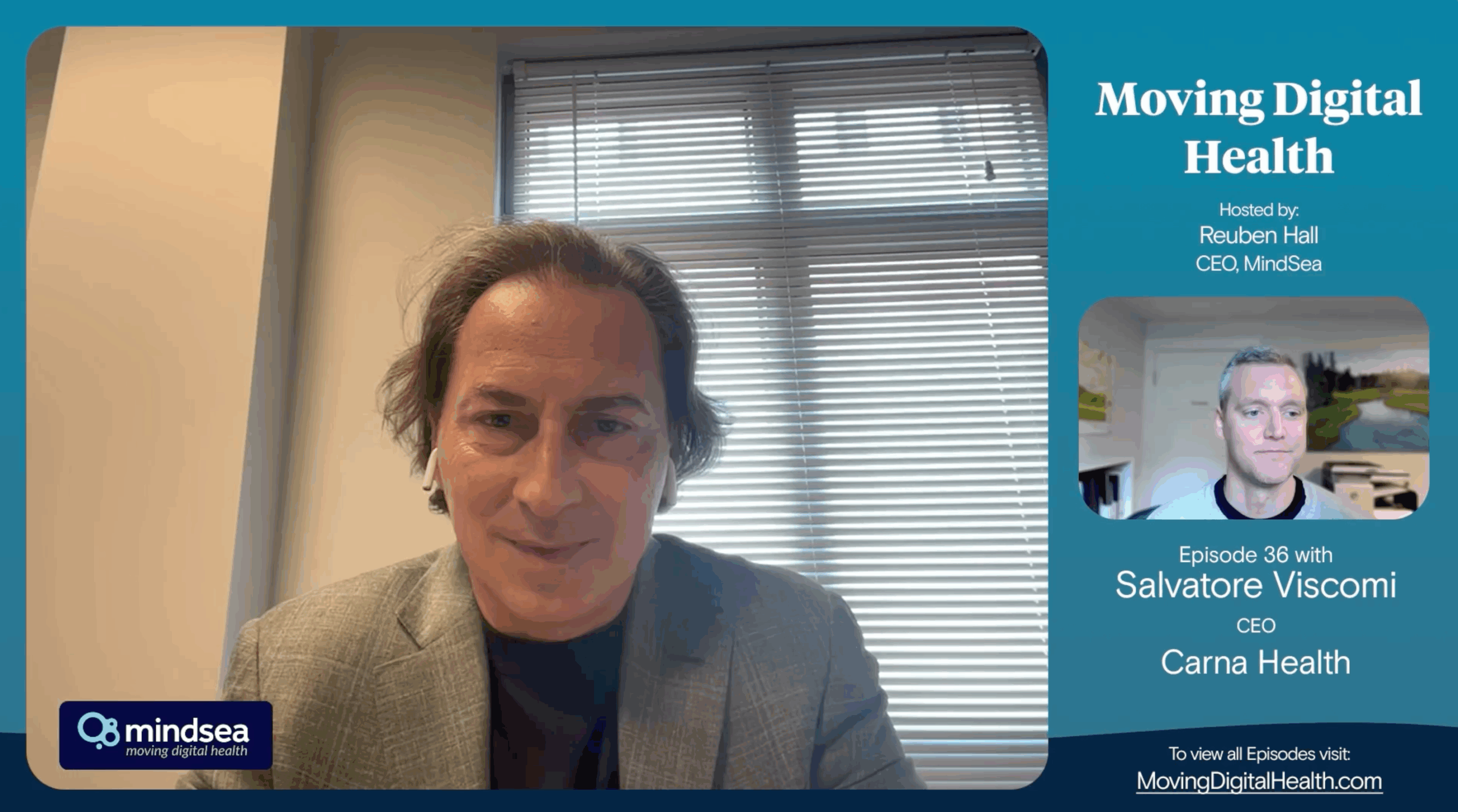
In this episode of the MindSea Podcast, Reuben Hall interviews Salvatore Viscomi, CEO of Carna Health. They discuss the urgent global health crisis of chronic kidney disease (CKD) and the innovative digital health solutions in development to address it. Salvatore shares his journey from physician to digital health entrepreneur. He’s now working at Carna Health on early diagnosis and preventing chronic disease. The conversation delves into the challenges faced in different healthcare systems around the world, particularly in the US, and the role of AI in personalizing patient care. Salvatore emphasizes the need for collaboration and finding champions in the healthcare space to drive meaningful change.
“We realized if we’re really going to have a massive impact, we can’t assume people will come to their traditional healthcare system for screening. We need to be where people are—malls, pharmacies, churches, mosques, temples. Otherwise the only time you’ll see some of these high-risk individuals is when they crash into dialysis, meaning the very first time they’re told they have kidney disease is at end stage. We want to disrupt that.” – Salvatore Viscomi on the importance of point of care testing.
Topics Covered in Episode 35 of Moving Digital Health (Salvatore Viscomi of Carna Health):
- Chronic kidney disease projected to become the 5th leading cause of death worldwide (01:17)
- What Bermuda’s pilot revealed about copays, referrals, and access gaps (06:01)
- Why U.S. healthcare struggles with preventative screening and insurance coverage (13:43)
- How prevention delivers ROI — saving $45 for every $1 invested (15:21)
- Why AI and local data are critical for global chronic disease management (18:20, 21:30)
What digital health entrepreneurs must do first: find champions before pushing solutions (22:48)
Find Moving Digital Health on Apple Podcasts and Spotify, and subscribe to the MindSea newsletter to be notified about future episodes.
Read Transcript:
Reuben Hall (00:00)
Welcome to the Mindsea Podcast Series, Moving Digital Health. Our guest today is Salvatore Viscomi, CEO at Carna Health. Thanks for joining us today, Salvatore.
Salvatore Viscomi (00:12)
Hi, Reuben. Thanks for having me.
Reuben Hall (00:15)
Could you start by telling us a bit about your background?
Salvatore Viscomi (00:18)
So I’m a physician by training. I spent most of my career at Harvard Medical School and Brigham and Women’s Hospital as an imaging expert in radiology on the diagnostic and occasional interventional side. And while there, I was an entrepreneur and I started one of first tele-radiology services in the world. And so that…
was an important moment for me to as much as I enjoyed a clinical medicine, also enjoy taking ideas and creating new businesses and services from them. So that’s my background prior to Cornell.
Chronic kidney disease projected to become the 5th leading cause of death worldwide
Reuben Hall (01:00)
OK, and your journey has been quite unique, transitioning from practicing physician, Harvard faculty member, to a digital health entrepreneur.
What was that moment that propelled you to found Carna Health initially?
Salvatore Viscomi (01:17)
Yeah, I think it was being exposed as part of a consultation project to point of care testing and seeing the being aware of the technology that existed that allowed for more accessible clinical grade testing and trying to understand what solutions could be created from that, knowing that testing alone was not enough. And so
exploring, talking to different people around the world about, if this technology was available to you in a platform form, what would it need to do? What diseases do you find most challenging? And it was really getting more exposure to the world of chronic kidney disease that realized that this was a good starting point. So chronic kidney disease is nearly a billion people in the world. The prevalence has been increasing double digits in most countries, the mortality has also significantly increased from decades ago, where it was 36th in mortality to 2040 when it’s projected to be the fifth cause of mortality. There are many parts of the world where it’s in the top three already. so just the size of the problem was alarming. The direction we were going in, alarming. And the fact that people were not talking about
solutions to prevent it, they were talking about how do we build more dialysis, biaster dialysis, dialysis while you sleep, dialysis at home, more transplantation, which is good, it’s a better option. And I thought, well, what about if we don’t think about only that, but also how do we prevent people from getting to the end stage? And so that was really sort of the mission, was really saying how do we create a solution that’s affordable, accessible.
available to any place in the world that tackles the lack of awareness because most people are like 90 % of the world whether you’re in a wealthy country or in a poor country the lack of awareness is about the same. Create the opportunity for early diagnosis and opportunity for intervention when needed, right? So an intervention meaning a medication or a lifestyle change.
that would either stop the progression or slow down the progression for people that were on this program. And so that’s what we started doing. And it’s been an amazing several few years.
Reuben Hall (04:02)
Okay. And you often speak about the global health crisis of chronic kidney disease. What are some of the parts of the world that are most affected by this?
Salvatore Viscomi (04:14)
Yeah, it’s almost nearly the entire world that has a problem. Now the prevalence rate can vary. For example, in the Philippines, we’ll be launching a program very soon. The prevalence rate is about 36 % based on Lancet, so incredibly high. They’re places in the world where it’s 14%. That’s relatively low to the Philippines, but it’s still incredibly high. That’s Turkey, for example. In the US, it’s probably over 10%.
I think we don’t truly know the exact numbers just because of the lack of awareness and lack of data collected in many of the populations that are not seeking care, not going for wellness visits. So it’s very high in most places in the world and it’s unfortunate. There are definitely even the US healthcare disparities. If you’re African American, you’re four times more likely to end up on dialysis. And so, yeah.
It’s certainly a problem in the US and everywhere that we’ve been. And so we’re in Asia, Europe, Africa, Latin America. the genetic risks may be different. Within a country, the risk factors may be different. For some places, heat stress is more important than other places. But it’s a problem everywhere.
What Bermuda’s pilot revealed about copays, referrals, and access gaps
Reuben Hall (05:40)
Carna Health has a stated goal of global impact. Your recent screening program in Bermuda is a great example of this.
What are some of the key learnings of that initiative and how is that changing your strategy for deployment in regions with vastly different healthcare infrastructure?
Salvatore Viscomi (06:01)
Yeah, no, Bermuda was our first pilot. It was a year long pilot. Definitely a lot of learnings. Bermuda was a great place to start because it’s a complex healthcare system that has both lives that are insured by private insurance companies versus government. It’s also a heterogeneous population in terms of European descent versus African descent. And then also lots of risk factors in terms of like diabetes, hypertension, obesity.
not so much heat stress compared to other parts of the world. Some of the learnings right away was that we started screening and you find disease at different levels is realizing that that’s not enough. It’s tracking patients and making sure that next steps happen. For example, about 16 % of people in the program that were screened had disease that required a treatment.
And most of them, almost all of them were unaware they had disease at all. So you have people that are asymptomatic walking around. You invite them for a free screening and now you tell them they have some treatable disease. And there is a referral that gets made. months go by, we track the patients. We find out many of them are not going to see the expert, the specialist. And so we discovered a couple of things. One is that there was a high copay.
up to $400. And the other thing is that when they went back to their primary care doctor, they weren’t getting referred to the nephrologist for various reasons, sometimes financial incentives. So we had to go back to the Ministry of Health and the Bermuda Health Council and say, well, you we need to solve for this and talk to our partners on the nephrology side. And we were able to accomplish a couple of things. One is we were able to accomplish
direct referrals from our screening program to the specialist. That was important. Two is the partner specialist eliminated the copay. So patients now refer directly from our program wouldn’t be required to have a copay. So you wouldn’t have that obstacle so they can go directly into treatment. And so that was one important learning is that if you don’t look for that, you assume patients are gonna get the right treatment, but it might not happen.
So understanding that you have to shepherd patients throughout the entire process. We also looked at our data and we saw that the female and male ratio was two to one. And so that was an understanding that women were more likely than men to come to free screenings, whether at a clinic or health fair. We realized that there are high risk males in the population that we need to find. And so we will be partnering with
a mobile unit that’s doing prostate cancer screening on the island and trying to be creative about where else we can be. We can be in pharmacies and malls and churches and mosques and temples. And to realize that if we’re going to really have a massive impact on this problem, we can assume that people will come to their traditional healthcare system for screening and monitoring. so…
that’s included in parts of our programs. But we need to be creative and to find out. We need to be where people tend to go, right? So they like going to malls. That’s been a really important learning is that we can, people, if it’s free and they’re made aware and you educate them and you make it easy for them, so they’re not missing work, know, little things that are important to them.
you’ll have a larger number of people that will come, including some of the highest risk individuals that otherwise, the only time you would see them is if they’re in the emergency room or when they crash into dialysis. And for many places in the world, including the United States, a majority of people crash into dialysis. That means that the very first time that someone tells them they have kidney disease, it’s at the end stage and there’s no other option except for renal replacement therapy.
And so we want to disrupt that, right? We don’t want people crashing into dialysis. We want people avoiding dialysis altogether, understanding they had this disease earlier when it’s modifiable.
Reuben Hall (10:36)
So what are you finding in the screening? Like what are the markers that are telling you what stage the kidney disease is at?
Salvatore Viscomi (10:47)
Yeah, so we do, based on accepted biomarkers, which are from blood, a creatinine, which then gets calculated into something called the EGFR. So that’s one number. The second biomarker is from urine, and it’s something called urine albumin creatinine ratio. So UACR or ACR. And some people have screened with one or the other.
We certainly feel being comprehensive is best because you may miss many if you use only one or the other. So those two tests really with that information provides you yes, no, someone has disease and how far along they are. There’s a staging system. And so when you get screened, not only do you get told that you have disease or not. And even if you don’t, we still want you in the program because you may be at risk for future disease, right? So it’s, we want to see you year after year.
If you do have mild disease, we want to still see you year after year and give you some educational material and pointers on the nutrition side and lifestyle changes. If you have more advanced disease, we want to see you more frequently, but also direct you to where you can get specific attention for the stage disease you have, which may include a medication. And so that staging happens through us and that referral pattern happens through us.
Reuben Hall (12:16)
Okay. And how does the patient interact with Carna Health? Is it like an app or an online portal or is it through traditional channels?
Salvatore Viscomi (12:30)
Yeah, so it’s a bit of both, right? So they interact with us when we’re on site and they’re there, you even before they’re on site and awareness campaigns, health fairs through their doctor’s offices, there’s educational material. They enroll in the program. There’s a patient app. So there’s educational material for them. So they understand what chronic kidney disease, diabetes, heart disease. They learn more about these diseases in general and how they’re relevant to them.
There’s alerts about like it’s time for your screening, it’s time for your follow-up, it’s time for you to see your specialist, it’s time for you go back to primary care, so that’s included as well. And then the interaction through the physician portal, so the physician has their data as well, and so they interact with their physician that has information about the stage disease they have and whether they need confirmatory testing next or whether they need a medication and so forth.
Why U.S. healthcare struggles with preventative screening and coverage
Reuben Hall (13:28)
You talked about Bermuda and some of the obstacles you overcame there in the healthcare system.
What are some of the biggest hurdles you’ve faced in the US getting health systems and hospitals to adopt this approach?
Salvatore Viscomi (13:43)
Yeah, so we haven’t launched in the US yet. But some of the challenges we expect is, well, who pays for this, right? In terms of is there a reimbursement model for screening for chronic kidney disease? Where can you find some champions for you to start this program? So we’re investigating that now. As you know, prevention is not a strength of the US health care system.
I mean, there are studies that show less than 10 % get the required or recommended screening tests done year after year. And so a lot has to change, right? So we definitely need a system that supports this. That raises the awareness, reimburses for people that are going through this process. That focuses on prevention, monitoring, and treatment of pre-dialysis cases because dialysis is obviously covered by Medicare and insurance companies and it’s very expensive. So we want to motivate everyone in the healthcare system, including the payers, that invest in prevention. It makes the most sense and it’s good for patients.
How prevention delivers ROI — saving $45 for every $1 invested
Reuben Hall (15:03)
Are you able to draw that line of how much ROI you might see on prevention as opposed to just treatment of kidney disease? And how has that conversation been going?
Salvatore Viscomi (15:21)
Yeah, I mean the health economics are very dramatic and there are many studies out there in the last few years. I’ll give you one for example that used osteoarthritis as a model. Every dollar that was invested in prevention using blood and urine testing had a $45 savings in downstream healthcare costs. So it’s a 1 to 45 ratio.
Reuben Hall (15:43)
Wow.
Salvatore Viscomi (15:46)
That’s in direct costs, Because dialysis is extremely expensive and has this transplant. But people on dialysis and transplant are also frequent flyers to the emergency room. So that’s an additional cost that you can add to that. Caregiver time, right? That’s an additional cost. And then think about the loss productivity. People on dialysis are generally not working, right? So not paying income tax.
And there’s also healthcare sustainability costs, right? Dialysis machines are utilized, if you’re a single patient on dialysis, three times a week, three hours each session. So a lot of water waste, a lot of CO2 emissions. There’s an impact on the climate as well. So the costs go beyond just the direct costs of dialysis. There’s so many other additional costs. And for many places in the world where there’s a labor shortage and
the diseases occurring in younger and younger people, it’s also a problem there, right? So there’s a cost in terms of, know, who’s gonna do some of the jobs that are needed to be done, young people doing work outdoors in many parts of the world that are having acute kidney injury because of the heat stress, and then ultimately resulting in a sort of rapid decline into kidney failure.
Reuben Hall (17:07)
What are some of the other diseases or conditions that could be tested for the same kind of pre-screening approach with basically the same test at the same time as chronic kidney disease?
Salvatore Viscomi (17:22)
Yeah, so this year we’ll launch in addition to kidney disease, we’ll be screening for diabetes with a test called HbA1c. Everyone in the program already gets tested, their blood pressure gets tested at the time of screening, so that’s another silent killer. In the future we’ll likely do some lipid testing as well in certain high-risk populations. So really the trifecta, it’s going to be chronic kidney disease, diabetes, and cardiomyopathy disease.
And we feel like that you could always do more, but that accounts for the large, large majority of the chronic kidney disease in terms of number of patients, in terms of mortality, in terms of costs.
Why AI and local data are critical for global chronic disease management
Reuben Hall (18:04)
Okay, so switching over to the technology side of it:
How is Carna Health using AI as part of this service?
Salvatore Viscomi (18:20)
Yeah, I think one of the unique things that we’re doing is that we’re collecting, important data, from all parts of the world that we’re in. And so when patients currently today around the world get diagnosed and it’s rare they get diagnosed before kidney failure. They’re sort of utilizing a guideline based approach. That’s something that people have decided these are when you intervene, these are the risk factors. It doesn’t really take into account the entire world and how people around the world have different risk factors based on where they live, based on genetic profile. So we want to disrupt that approach, right? We’re trying to create country-specific data that personalizes their risk. The risk of disease, the risk of progression, what is the right medication for them? Our goal is really to collect that data in large amounts around the world.
And it’s not only biomarker data, it’s data around geocoding. Are you living in a part of the world where your heat and humidity index is different than somewhere else in that same country? And trying to capture all these data points that may be important in terms of assessing your risk and when we should intervene. So that’s one, right? So all the predictive analytics with really good data rather than extracting data.
from other populations. And then secondly is, you know, the realization that there are not enough specialists around the world to manage these diseases. And so I’ll use the example of Nigeria, you know, a country of over 200 million people, a prevalence rate of over 20%. You would need probably 100 to 200,000 nephrologists to manage the disease. They have about 200.
And so we can do everything, right? Create massive screening and monitoring and identify millions of people that need treatment and want to refer them to nephrology. Those doctors do not exist and we’re not going to be able to create them ever. And so how do we support the resources that a country has? That’s primary care, pharmacists and nurses and technicians. And so using AI for that upskilling platform, right? To not replace doctors or clinicians, but to support the resources you have to manage those patients as if there was a specialist there.
And then finally, the other thing is allocating resources. So if you’re a minister of health, how do you allocate resources around your country to manage disease that’s based on data rather than a request from a governor to say, need this number of medications, number of devices, for example. So I think
Those are the three categories that we’re focused on.
Reuben Hall (21:15)
You’ve spoken about scaling AI tools responsibly. What does responsible AI and healthcare mean to you and what guardrails has Carna Health put in place to ensure patient safety and data privacy?
Salvatore Viscomi (21:30)
Yeah, so because we’re a global platform, we make sure we adhere to every region’s guidelines and rules and requirements in terms of where data is stored, and how data is shared. So we comply internationally. And I think it’s also really about how do you apply AI and the algorithms you may develop around the world? And I think what we don’t want to do is
data, for example, in Western Europe, and because that’s where maybe there’s higher reimbursement and more revenue, and then try to apply that algorithm to population in Cameroon or Ghana. I think that would be not a good way of using AI, and it sounds good that you’re using AI. We want to create, make sure that the populations that were out there to improve their healthcare outcomes
that we’re using data that’s relevant to them. And I think that often doesn’t happen in terms of people creating wonderful solutions. It’s not necessarily inclusive of the majority of the population in the world that needs those solutions.
What digital health entrepreneurs must do first: find champions before pushing solutions
Reuben Hall (22:48)
Mmhmm So we haven’t really touched on many of the other startups and innovative organizations that you’ve been a part of over the years. But as a leader in this space, serial entrepreneur, if you will,
What advice would you give to other innovators looking to make a meaningful impact in digital health?
Salvatore Viscomi (23:13)
Yeah, I mean, think the tendency for physician entrepreneurs or a lot of founders is to lead with the solution and try to create the perfect solution. Look, that’s important. But in terms of being successful at deploying solutions, where they’re accepted is to find the champions.
and find, and it’s not always going to be the same. It could be a minister of health, a minister of finance, a president of a country. It could be a prominent physician. Could be an actor. But find that person and get them engaged and then follow up with the solution. So I find that to be one that it’s been important for my companies and personally I’ve noticed that us being able to engage with important people around the world from very different sectors beyond healthcare has been wonderful for us. We have great partnerships with companies and industries that are very far from healthcare but have been wonderful and supportive in their engagement and us achieving success in the various countries we’re in.
Reuben Hall (24:27)
Excellent. A great way to wrap it up. Find the champion and build the team that can make things happen. Thank you so much for joining me on the podcast today, Salvatore.
Salvatore Viscomi (24:40)
Thank you for letting us share what we’re doing at Carna Health.
Reuben Hall (24:44)
And thanks to everyone for listening to the Moving Digital Health podcast. If you enjoyed the conversation, please go to movingdigitalhealth.com to subscribe to the Mindsea newsletter and be notified about future episodes.