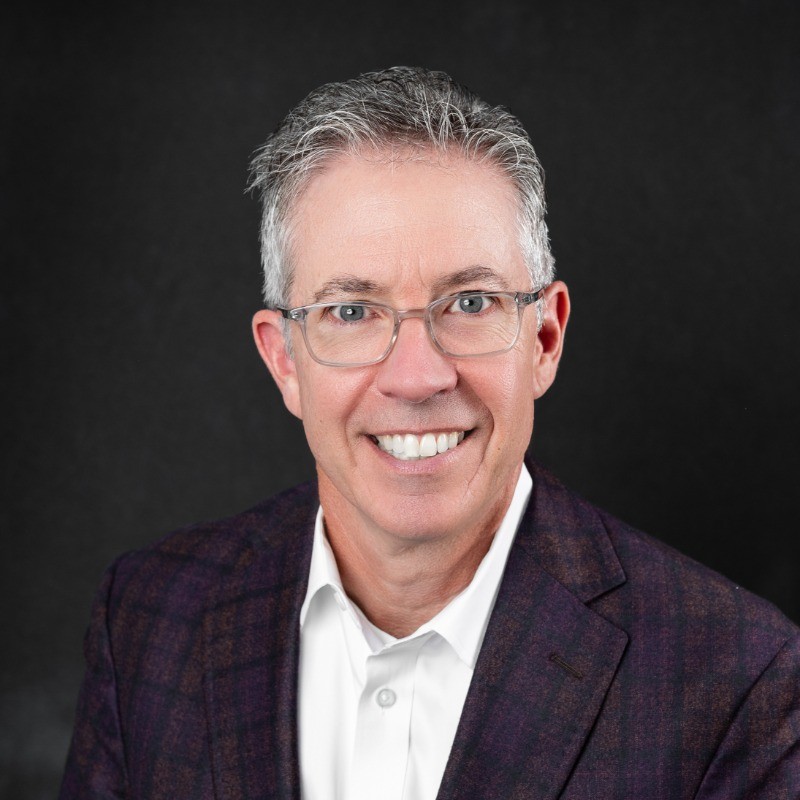

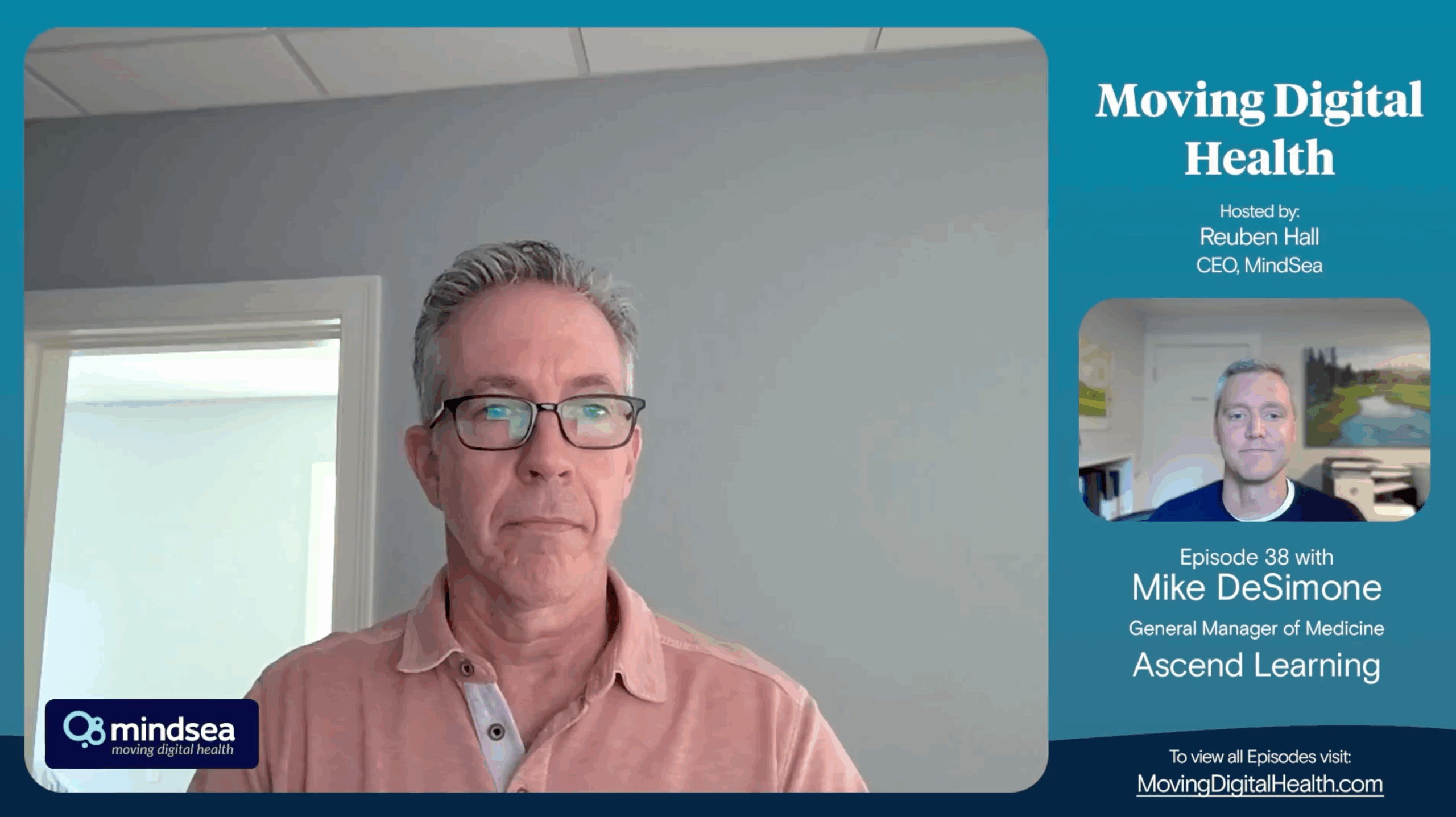
In this episode of the MindSea podcast, Mike Desimone, General Manager of Medicine at Ascend Learning, shares his extensive experience in healthcare tech and education. He discusses the importance of a diverse background in scaling healthcare companies, the challenges of health tech M&A (mergers & acquisitions), and the unique aspects of rapid growth in the healthcare industry. Mike emphasizes the need for effective leadership, the role of data in improving educational outcomes, and offers advice for health tech startup founders. He also highlights Ascend Learning’s goals in leveraging technology to enhance training for future healthcare professionals.
“If you have somebody who has a great idea, excellent. Let them drive the idea. That person who’s driving the idea does need to take a step back and say, okay, hey, this is what I’m good at. If I want to grow and scale though, I may need people that have different skill sets than I do.” — Mike DeSimone on the shift health tech founders need to make to enable their business to scale
Topics Covered in Episode 37 of Moving Digital Health (Mike Desimone of Ascend Learning):
- What Ascend Learning does in healthcare education and training (01:13)
- Why “utility players” accelerate health tech growth (02:13)
- How to make M&A work in health tech: integration that adds customer value (04:29)
- Navigating culture in M&A without derailing teams (06:05)
- What’s uniquely hard about healthcare M&A and operational efficiency (09:44)
- How a “listening tour” surfaces growth levers across sales, product, and ops (12:14)
- Upskilling vs. hiring: building the right health tech team (14:24)
- Bridging data, technology, and business to improve operations (18:54)
- Advice to early-stage health tech founders hoping to scale their business (23:28)
- Where AI fits next in medical education and competency tracking (28:10)
Find Moving Digital Health on Apple Podcasts and Spotify, and subscribe to the MindSea newsletter to be notified about future episodes.
Read Transcript:
Reuben Hall (00:01)
Welcome to the Mindsea podcast series, Moving Digital Health. Our guest today is Mike DeSimone, General Manager of Medicine at Ascend Learning. Thanks for joining us today, Mike.
Mike DeSimone (00:13)
Well, thank you. I appreciate it. Looking forward to the conversation.
Reuben Hall (00:16)
Yeah start by telling us a bit about your background.
Mike DeSimone (00:21)
So Reuben, I have an interesting background in the sense that I’ve done a lot of different things within healthcare. I have been, my main objective or my main goals is I work with small companies and help them grow. In healthcare technology, I have done everything from population health to data statistics and analysis to safety, harm, incident reporting and rounding, and now I’m on the educational side of the business. I think the value of learning everything within the health system is actually very helpful when you get to the education side to learn and understand how it is being applied in the actual settings. So it’s very diverse background in operations, commercial, product, and technology.
What Ascend Learning does in healthcare education and training
Reuben Hall (01:13)
Okay, and what type of education does Ascend Learning do?
Mike DeSimone (01:20)
So Ascend Learning is an organization that focuses on educating folks and preparing them for healthcare. So for example, nursing, one of our largest businesses is ATI. They do and they provide a lot of the contextual information that is associated with going through nursing school, learning and preparing for boards. We also have certification programs from National Health Association, NHA, which drive medical assistance, patient care technicians, phlebotomists, in which you can go through a certification program. And then the business I am part of provides technology, SaaS-based technology to undergraduate and graduate medical schools for us to, number one, track the students through their progress and really as a student management system.
Why “utility players” accelerate health tech growth
Reuben Hall (02:13)
Okay, excellent. So as you mentioned, you’ve had many different roles in healthcare throughout your career. And you’ve described yourself as a strong utility player. I’m curious what that means to you. Why do you believe that role is so crucial for scaling health tech companies?
Mike DeSimone (02:35)
So I’ve been lucky enough, is the way I like to look at it, to work with people who have provided me multiple opportunities. So from a commercial sales and marketing perspective, been able to learn how you approach a market, the value something provides within that market, and how you drive the value to the consumer of those goods. And I’ve been able to work through that process as well as you know, When you start to do that, you also start to understand product and technology.
So being on the commercial side, you start to hear from customers. You have to, you know, the good, the bad, and all of that. And then, so I started to take that into the product and technology side that says, hey, how do we start to develop better and more responsive tools and solutions for our customers? That’s what they’re needing. And then in all honesty, once you start to understand that, I got into the data side of the business, right?
So, okay, well, now our products have to collect data and information that’s useful for the customers. And then when the customer’s up and running in live, how are they using the data and information, but also how are we supporting them? So my career really started very, you know, at the front end of the customer, but then kind of, you kind of pull that string and go all the way back to ultimately, how are you selling? How are you building? How are you creating the value for the customer and then servicing them throughout the relationship with the customer.
So I’ve been lucky enough to have people who have given me that opportunity and allowed me to be able to grow and really help small companies, because that’s applicable, obviously, across all types of companies. But within a small company, to have somebody that has that kind of background is very beneficial.
How to make M&A work in health tech: integration that adds customer value
Reuben Hall (04:29)
Is there a specific story you could share around one of the companies that you worked with? What did it look like at the start? What was the high level journey in scaling up and growing?
Mike DeSimone (04:46)
I mean, yes, I have. As somebody who has been involved in lot of mergers and acquisitions, if you think of two companies coming together, sometimes it’s technology and service and being able to then bring together that technology and service. So how do you start wrapping the services around technology? So that the user, number one, gets the benefit of the tools and technology. Because you’re helping them use it from a best-in-class perspective. If you want to think of that way of a better best practice standpoint and that provides you know, that’s the value that that we can provide. And I’ve been through, I’ll say 10 plus significant number of mergers and acquisitions. And having the background to better be able to understand how these companies can integrate everywhere from basic operational HR, finance, legal to customer integration.
If the two companies both have the same customer selling different products, how do you integrate the service and process associated with that to the product integration? And it’s been a valuable process across my career.
Navigating culture in M&A without derailing teams
Reuben Hall (06:05)
Okay. And how do you work around like the culture of the M&A as well? Because you take these, you know, two separate companies that have developed their own culture over time. And now you have the challenge to, like you said, merge together not only the services and technology and processes, but also those people and teams as well.
Mike DeSimone (06:29)
Yeah, that’s a great question. My objective is always drive towards the common good and the common good of how you support the customer, but also how you support your employees as well. So how are you taking the best of both worlds and integrating those and then driving a collaborative culture. Sometimes, in all honesty for me personally, sometimes that means I gotta pick myself up and put myself on the outside because I could be reorganizing myself out of the job and or out of the situation because you know for the overall benefit of the organization or the company you don’t need two product heads or two technology heads or two folks working in M&A. So sometimes you do this type of work and you have to be able to separate what’s good for yourself versus what’s good for the overall company and all the employees involved.
The objective when I approach this is we’re building strength. We’re not, all right, we’re building strength through integration. So you try to limit, I’ll just say the adverse effects that can happen through M&A in the way you’d be able to do that. Right, you don’t wanna, the objective is not to take over a company and change, and you know, I’ll say this, go through multiple layoffs.
You then create a culture in which nobody’s collaborative and working together. You want people to work together to see the common good of the customer and make sure that goals and objectives are aligned in that.
Reuben Hall (08:06)
I see. And typically like where do you join in the process? Like are you part of kind of looking for potential, you know, acquisition partners and, know, determining fit or do you have you typically come in once the match has already been made to say, and then help with the integration side.
Mike DeSimone (08:28)
I’ve done a lot of both. As I advanced in my career, was the identification of where and how and who, right? And how we’re complementary to each other and the value that it can bring to a customer. At the beginning of the career, it started out as, hey, Mike, we’ve just acquired a company. We need you to help integrate this company based on your skill set.
So as you start to do that, you start to then recognize, okay, this is the value that they’re bringing and I’m able as I was going throughout my career to kind of move into different roles where now it is the identification of companies that are complementary to where we are and what we’re doing. At Ascend in the medicine business, just, you know, we had, we were looking for something to help measure competency of clinicians as they were going from, you know, from school into residency programs, we had, you know, we saw our company that we thought was very complimentary to us. We identified that company and acquired them and brought them into the fold of the organization so that we can then strengthen our product but also strengthen the ability of students within the marketplace.
What’s uniquely hard about healthcare M&A and operational efficiency
Reuben Hall (09:44)
Right, right. That’s great. And I’m wondering if, you know, what are the specific challenges within healthcare, right? Because, you know, some of these principles, they’re just applied to any M&A situation. But you’ve really dialed in on healthcare specifically; what are the challenges that you’ve seen that are unique?
Mike DeSimone (10:10)
Well, I mean, our challenges have been in the news for the last 20 years, 30 years, while we’re in healthcare, right? How do we make it efficient? How do people practice at the top of their licenses? You know, we went through a big change in the early 2000s. I think, you know, the advent of a digital clinical record is extremely valuable and important, right? It’s important for a patient, it’s important for clinicians.
Reuben Hall (10:16)
Ha ha.
Mike DeSimone (10:40)
Our job now in my mind is how do we make the tools, so I come at it from a perspective of how do we make it easier for people to provide care? It’s a very different industry than the business world. In today’s environment, I could be a doctor providing surgery, now all of a sudden I’m the head of surgery. Well, what does that mean? What does it mean for a leadership perspective? What does that mean overall?
A nurse can go from taking care of patients to then being a unit manager or a nurse manager and they could have upwards of 75 to 100 direct reports to them. You don’t see some of that in the business world. So we need to come at healthcare to say, how do we make it efficient and effective for folks to be able to do their jobs and treat patients without inundating them with technology?
How do we streamline the process and make it more efficient? So that’s kind of the goal I have of trying to work for and work towards. then Ascend is a great company to be doing that on both the education side, but also within the work.
How a “listening tour” surfaces growth levers across sales, product, and ops
Reuben Hall (11:49)
Okay. And aside from the M&A aspect, you know, you’ve had many different roles in companies as well. And part of that is, you know, looking at the inner workings of the business. How do you identify the levers and the path to growth?
Mike DeSimone (12:14)
It’s a great question and I always say so when I start a new role, I call it a listening tour, right? You need to go and listen and understand. you almost, I start internally first. It’s always important to understand from a sales standpoint, sales and marketing, what’s the messaging, what’s the value prop, why are people acquiring your services or product or technology, right? What’s the value?
Then I kind of pull that thread and go, okay, for product and technology, how are you getting, like how is information fed to you to continue to enhance and develop and grow what you’re doing, what you’re selling? Is that coming right from the sales team? Is it coming from external sources? How do you get that to better support the sales team? And you keep pulling that along and this is, okay, now how are we supporting? Like who supports the product once it’s in front of the customer, right? In that technology, how does the support system work and how is that set up?
With AI being involved now, how do chats work versus talking to a real person. And you pull that all the way through. that’s, I say that’s the 30 days. You start to learn and understand. Then you go to customers and you start to talk to a customer. So whether I’m in a commercial role or a product technology role or an operations role, those functions all come together. And in my mind, it’s very valuable to just listen first and understand and learn and ask questions before you come in and really act, if that makes sense.
Right, because you need some sort of context before you can start to act and drive change and start the growth period. And you’re also identifying, where are the strengths and weaknesses? So if we are to grow, there a weakness or a need in the sales team? Is there a weakness and a need in the product or the technology in order to sell more?
Or is it operationally we’re just not meeting our customers needs and we need to really hone in on that. So you do this listening to it and it gives you a better idea of the strengths and weaknesses and then you can start to apply that to how are we going to grow and developing a growth strategy for the future.
Upskilling vs. hiring: building the right health tech team
Reuben Hall (14:24)
Right, right. And so if you, you know, identify a gap, do you tend to lean towardsupskilling or training the existing team, or then looking at hiring externally to like that bring that expertise in house?
Mike DeSimone (14:44)
It’s both, right, in essence. So first it’s does the skill set exist, yes or no? Because if it doesn’t exist, you wanna make sure you’re bringing in an expert to help assist with that. But, like I say, the but is you also though wanna afford or award the employees an employee growth opportunity, right? So it’s a combination of how are we upskilling our current employees
But also do we have the right people to upskill those employees? Is there a right growth plan? I call it a career path, right? Understanding somebody’s career path so we’re ensuring that employees are achieving the growth that they want to achieve, right? And where they want to go. And that’s part of the listening tour is listening and understanding employees. An example, I hired somebody right out of school who was a statistician.
Mike DeSimone (15:41)
In healthcare we doing data and analytics, but through the first few months of working with this person, their ultimate dream job was working in applying statistics to baseball. So he worked for us for about three years, and it was all driven around stats and modeling and analysis, but it was something that he was able to take and apply in another industry.
And I can honestly say he’s very successful executive in the major leagues. So he started out in health care, but it was really the data modeling and building on a skill set that he had and that he wanted to apply as he had his own goals. So part of a leader is you need to understand people’s goals and objectives. I can give you a reverse example. I had an employee who at work.
Mike DeSimone (16:38)
in a very, very stressful environment for 15 years, very, very stressful, was working for us and kind of ran our help desk. When I was meeting with him and listening to him, was like, wow, he could do a lot. In my mind, I was like, he could do a lot more than just help desk and whatnot. And he said, listen, right now, this is what I want to do. I’m happy doing it. It’s something I can do well and not be as stressed as I was for the past 15 years.
Mike DeSimone (17:05)
I will let you know when I’m ready to move on. And you have to respect that. And you also need people in the business that will help. That still helps grow that business.
Reuben Hall (17:18)
For sure, some very good points there. You mentioned, yeah, some of your former team members are now in the C-suite and high-level roles in other companies. What are some of the attributes you’ve spotted or looked for in leaders?
Mike DeSimone (17:37)
Part of it, a couple of things. I always say don’t worry about what somebody either majored in or was doing before, right? You need to look at how people communicate both verbally in writing. You need to understand how people interact with each other, especially for particular roles. And it’s a varied skill set and background. Don’t want, I also don’t look for people that are like me. You want people who are different, who ask questions, who have different perspectives, because then you learn from each other. And as they’re learning from me and I’m learning from them, it helps by providing different perspectives to employees, it helps them learn and understand where they can go and what they can do.
Right? You know, whether they want to be a COO and work in an operations role or whether they want to be a chief revenue officer and be on the sales side. Right? But you need to understand their strengths and their weaknesses and help them grow as you get to know and better understand them. But having a background that is not pinpointed, if that makes sense, is valuable to me and something that I look at and look for.
Bridging data, technology, and business to improve operations
Reuben Hall (18:54)
Yes, yeah. Switching over to the operation side, how have you bridged the gap between data, technology, and business to create some of those operational efficiencies? Can you give us a specific example where you were able to connect those dots?
Mike DeSimone (19:17)
Well, here at Ascend for our medicine business, we’re operating a strategy that’s called institutional effectiveness, where we’re bringing data and information together. So school has kind of a coursework and objective for the students as they go through their programs. So we need to know and understand that what I’ll call assessment tools that evaluate where a student is and how well a student’s doing.
And then we have what we call competencies, kind of skills and knowledge-based competency tools. So if you’re a surgeon, you’re evaluating somebody’s ability to provide that procedure. As you bring the data together, right, you start to create a more efficient environment for teaching the students. And as you bring this data together, the school ultimately knows how well the school is operating at a whole, potentially each specialty within that school is operating because you now have data at that level. The faculty now also have access to the same data and information, but as a faculty member, I know how my students are doing. I know how my students are progressing. I know, Reuben, you and I may be in the same program going through the same process.
But you may be learning certain skills at a different speed than I’m learning those skills. So as a faculty member, it allows me to develop a plan for you and for me individually. So the data and information coming together, instead of treating us all the same, it enables a faculty member to treat people slightly differently based on their needs, right? And then the student themselves, we have self-assessment tools where they can go in and test and understand how they are progressing themselves and provide a little bit of predictability for them that says, listen, based on how you’re doing, what you’re doing, you would pass the board, you wouldn’t pass the boards. So again, that student can go back to the faculty member and say, hey, here’s what I see. So you start to bring data and information together, sharing it across multiple levels, university, faculty, student, then they start working together to achieve the outcome that they ultimately.
Reuben Hall (21:39)
That makes total sense. And so from your point of view at Ascend Learning, what are some of the gaps or opportunities about training future physicians and clinicians in healthcare?
Mike DeSimone (21:57)
Listen, with everything you’re always trying to improve and what can you do better, right? If you look at, I’ll use myself as an example, you know, when I was learning, it was pure textbook, you’re reading, you’re highlighting, you’re taking a test or you’re writing a paper and that grade provides you your answer, right? In today’s world, with the technology that exists today, whether it be a phone, a pad or a computer, or a book, we’re finding out that students learn and consume information differently, right? Even kids the same age. So our goal here is as we’re providing tools to our students is ensuring that the faculty has the ability to have or has access to multiple types of tools that they can then provide to their students for learning, right?
That is going to help us narrow the gap that exists. You can’t keep teaching the same way that we’ve been teaching for 10, 20, 30 years in the past. We have to change the methods based on the tools, technology, but also how people function today. It’s very different. And that’s been a gap, but it’s a gap that Ascend is closing and closing quickly and helping the universities and students work together to be able to do that.
Advice to early-stage health tech founders hoping to scale their business
Reuben Hall (23:28)
Right. So if you were advising a health tech startup founder today who has a great idea but doesn’t have a whole lot of experience in running a company, what could you tell them about how to get off the ground?
Mike DeSimone (23:49)
So, it’s interesting, because I have been, I’ll just say a partner, whether that’s a COO or whatnot, to three, maybe potentially could say four companies that were founder-led. And what I have learned as you go through this is if you have somebody who has a great idea, excellent. Let them drive the idea. That person who’s driving the idea, does need to take a step back and say, okay, hey, this is what I’m good at. If I want to grow and scale though, I may need people that have different skill sets than I do, right? And you need to find that partner that respects what you’ve done, respects how you got to the point you’re at, but also gives you the runway to keep driving that, but is ensuring you have the infrastructure to scale, grow, operationalize your ideas so that they are beneficial for the full marketplace.
Right? Yeah, a lot of great folks come up with these ideas and these inventions and think, listen, I can drive this. And I, you know, some go on to be CEOs and they can do it all. A number do not. Right? A number of them kind of end up in the chief strategy or chief product roles because that’s what they were driving at. They’re still the founder. They’re still driving the business. You just need to help them manage the business and do it in a way that lets them know that, listen, we know that this is your idea and that you’re driving it. To me, that’s a successful kind founder-partner relationship.
Reuben Hall (25:23)
Yeah, people leaning into their strengths, but recognizing, you know, where their limits and where they can bring on partners to complement their those strengths, right?
Mike DeSimone (25:30)
Exactly. Exactly. And not doing it in a harsh way where somebody may feel you’re coming to take over what they’re doing. It’s no, we’re coming to partner and help you grow what you’re doing. It’s very different mindset culturally.
Reuben Hall (25:56)
Yeah. And so for yourself, you’ve been through multiple roles in some of those previous situations. How did you know when it was the time to move on? Kind of like, hey, I’ve come in, I’ve done what I need to do, and now I’m on to the next thing. That must be hard too, right?
Mike DeSimone (26:19)
So, it is, it is. And I go back to one of my very first jobs. I worked for a woman and when she brought me on, and you go through your review process, my first review, so I had been there a year, and she said, listen, my goal is to report to you in seven to 10 years. And I was taken back by that. I was like, well, what do you mean? She goes, you know, she identified skill sets and all that. She goes, I know what I want to do. I know what my role is. My role is to get you to a point where I’m reporting to you. That actually did happen. Right? And so, but that has stuck with me in the sense that, so, know, when do I know I can move on is when I know the team is going to succeed, whether I’m here or not, because you’ve, I’ve trained the team.
They’ve had the experience, they’ve been able to, you know, maybe it’s they’re presenting to boards or presenting to the CEO or going out to customers and they’re starting to, you know, I’m starting to allow them to do that. I don’t need to do that. I don’t need to follow them. For me now at this point in my career, it’s, is, it’s, it’s watching others become successful and it allows me to move on and I say to folks that I’ve kind of worked with throughout my career is that someday I’m hoping to report to you. And I still mean that.
Where AI fits next in medical education and competency tracking
Reuben Hall (27:50)
Yeah, excellent. And so what’s next for Ascend? Are there any big goals or challenges that you need to accomplish as a company to elevate your product or service?
Mike DeSimone (28:10)
The big goals we have are around data and information and how do you continue to provide that consistent information from a school all the way through the faculty and student and how they’re using that data. And then think of layering AI on top of that. Not in replace of teachers, like we’re not saying you’re gonna replace teachers or anything like that, but how do you make it more efficient?
How can you predict an outcome of the student based on what they’re learning and how they’re learning it? So you can then really start to tailor academic programs to individual students. So even though they’re part of, I’m going to be a GI doctor, I’m going to be a pediatric nurse, how do you start to drive the curriculum to their needs and how they learn efficiently and effectively?
And I think AI is a very capable tool of helping us do that and helping using data and information to help predict different pathways, which then helps us alter the direction somebody may go in order to improve that. right, that’s Ascend is, you know, my mind in the cutting edge of some of that. And we’re really looking forward to what’s come in the future.
Reuben Hall (29:27)
Excellent. Well, thank you so much for sharing your insights on the podcast today,
Mike DeSimone (29:34)
Well, thank you very much for having me. It was a pleasure and I appreciate your time.
Reuben Hall (29:40)
And thanks to everyone who joined us today. If you like the conversation, please go to movingdigitalhealth.com to subscribe to the Mindsea newsletter and be notified about future episodes.