
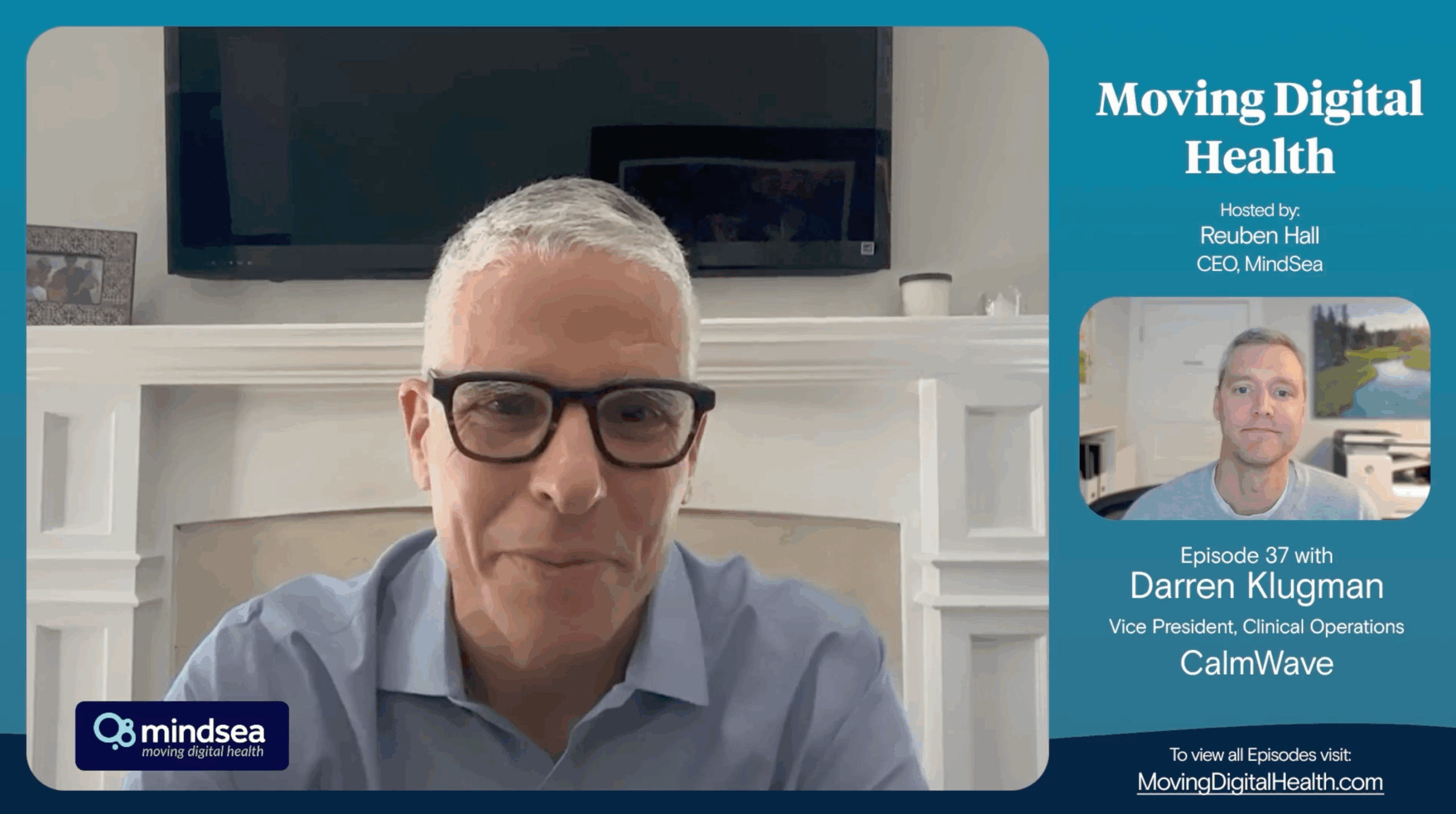
In this episode of the MindSea Podcast, Reuben Hall talks with Darren Klugman, Vice President of Clinical Operations at CalmWave. They discuss the critical issue of alarm management in ICUs. Klugman draws on his background in pediatric cardiac intensive care to explain the toll of constant noise on providers and patients. CalmWave uses data science and AI to cut alarm fatigue and strengthen patient safety by creating a calmer care environment. The discussion also covers integrating siloed data, engaging frontline staff, and the potential for CalmWave to reshape hospital operations.
“The patient is lying in the bed and no one’s looking at them. All the while, the nurse and physician are focused on silencing alarms. We have to do something about the noise.” – Darren shares on the issue of ICU alarm fatigue and need for increased patient focus.
Topics Covered in Episode 36 of Moving Digital Health (Darren Klugman of CalmWave):
- Why Alarm Fatigue Puts ICU Patients at Risk (00:51)
- How CalmWave Uses AI and Data Science to Reduce Alarm Noise (04:31)
- What Data-Driven Monitoring Means for Patient Safety (08:00)
- Post-Implementation Results: 50% Less Noise, Earlier Alerts (12:00)
- Balancing Alarm Sensitivity with Patient Safety (14:33)
- Why Listening to Frontline Staff Is Critical for Digital Health Adoption (18:16)
- How Integrating Siloed Hospital Data Improves ICU Operations (23:18)
- What Healthcare Leaders Can Learn About Tech Adoption from ICU Nurses (26:39)
- How AI Can Transform Hospital Operations and Improve Patient Safety (33:18)
Find Moving Digital Health on Apple Podcasts and Spotify, and subscribe to the MindSea newsletter.
Read Transcript:
Reuben Hall (00:01)
Welcome to the MindSea Podcast Series Moving Digital Health. Our guest today is Darren Klugman, Vice President, Clinical Operations at CalmWave. Thanks for joining us today, Darren.
Darren Klugman (00:13)
Great to be here. Thanks, Reuben.
Reuben Hall (00:16)
Can you start by telling us a bit about your background?
Darren Klugman (00:18)
Sure. I joined CalmWave earlier about six, eight months ago after a nearly 20 year career in pediatric cardiac intensive care. So my background is a pediatrician with board certifications in cardiology and critical care as well. And spent my career in my clinical time in running cardiac intensive care units for children.
And my non-clinical time was spent in quality and safety on hospital operations and in risk management.
Why Alarm Fatigue Puts ICU Patients at Risk
Reuben Hall (00:51)
Okay, and what was the personal or professional journey that led you to focus on a problem as specific and critical as alarm management? Was there a particular experience or observation that made you think, have to solve this problem?
Darren Klugman (01:06)
Well, it’s something that people don’t think about when you walk into a hospital until you’ve spent time in an ICU. And if you’ve spent time, anyone who’s spent time in an ICU, notice that as soon as you walk in there, one of the first things you recognize is how loud it is. It’s unbelievably loud.
And as a clinician who lived in that environment, I would come home post-call or come home from a day on service, and my wife and kids knew I just needed a quiet space. And it wasn’t because people were talking to me too much. It was because the place was loud.
The second thing that happened is I did a lot of work in risk management and quality improvement. ICUs are one of the places in the hospital where the most harm occurs because they’re the sickest patients, the most complex patients. And you’re dealing with life and death.
Then the final thing that really galvanized this for me is the number of times where I would be reviewing an event that occurred to a patient in an ICU in my role in the quality and safety and risk team. Or in my role as the medical director of an ICU, where we would hear a narrative that an alarm was going off and the nurse or the physician would walk in the room, and their knee-jerk reaction is to walk to the monitor and hit silence on the monitor.
Reuben Hall (02:18)
Hmm.
Darren Klugman (02:18)
And then they would go straight from that. They would go down to the device that was generating the alarm, whether it was the ventilator, an arterial line, some other device that was monitoring the patient or delivering life-supporting care, and they would focus on that. All the while, the patient is lying in the bed and no one’s looking at them. And those experiences really left a mark on me in the sense that we have to do something about the noise. About the means by which we monitor patients, which is very unprecise. And do something to ensure that the staff who goes in those rooms, when an alarm goes off, their knee jerk isn’t to silence it, but rather to say, means something important, let me look at the patient.
Reuben Hall (03:06)
Yeah, the alarm is almost, it’s screaming attention for itself for the alarm. And so the attention is going to the alarm rather than going to the patient that needs the help. You know, it’s very good point and something that, you know, you just wouldn’t think of unless you’ve lived through that as much as you have.
Darren Klugman (03:28)
Right, and then you, and having the countless times where alarms are going off in the room, and I’ve been in these rooms, and families are looking at you and they’re saying, Dr. Klugman, what does that mean? And you say, no, don’t worry about it. Right, I mean, what kind of faith does that give a family of a kid, an adult, a baby, whomever, when they’re staring at the physician or the nurse and their alarms are going off, and the person looks at them says, “don’t sweat it, it’s nothing”.
What makes that “don’t sweat it, it’s nothing” different from “my goodness, this patient has something really wrong that we need to do something about”.
Reuben Hall (04:07)
Yeah, and then the alarm loses its meaning. Yeah, it’s been it’s been overused, right? It’s like the boy who cried wolf almost, right?
Darren Klugman (04:10)
There’s no meaning anymore. No meaning.
Exactly, and yet these are the alerts that we are reliant upon to know when there’s an important change in the patient.
How CalmWave Uses AI and Data Science to Reduce Alarm Noise
Reuben Hall (04:31)
And so how does CalmWave improve that experience?
Darren Klugman (04:38)
What struck me and what really drew me to CalmWave is two things. One of the things is something that I fundamentally believed to be true over the last decade or so of my clinical career, which was that our patients are becoming more and more complex. The population is getting sicker and sicker, technology is allowing us to push the clinical envelope in ways that we never did before. And as a result, there’s more and more devices generating noise.
We’re using devices now that we never used before. And as patients have become more complicated and sicker, we also have a major problem with a staffing crisis that everybody has read about. In the nursing profession, there’s a crisis amongst physicians leaving the field in droves. We’re not training as many. We have residencies and fellowship spots going unfilled now.
That’s a really, really bad spot for the US, for the international healthcare system to be in. And so what CalmWave does is we fuse and integrate silo data streams in a way that allows data science and AI to really precisely set alarm parameters for patients so that we achieve two things.
Number one, we really focus on driving patient safety. So if you can precisely using data, set alarm parameters and then continually update those as the patient’s physiologic state changes, that patient is gonna be in a much safer environment. And secondarily, in doing so, we make the environment quieter because we reduce unnecessary alarms.
And we allow the staff to know that, my goodness, when there’s an alarm, it means something. I should go and actually check on the patient. And so one of the fundamental parts of CalmWave that I think is so powerful, and I’ve been asking for this from technology for years, the last thing our staff needs is more data to interpret. We’ve already crossed the threshold beyond which the human brain can process data quickly enough to make life and death decisions in a very dynamic life and death environment like an ICU.
And so what CalmWave does that I think is so brilliant and critically important for our patients, we don’t give anybody more data to process. We utilize data that has previously been siloed and inaccessible, and then use data science, math, and AI to de-burden the cognitive load of the providers so nobody has to think about what the right way is to monitor the patient.
We provide you vital sign parameters that are ideal for your patient population and then our algorithm monitors those parameters continually while the patient’s in the ICU and makes recommendations to adjust those parameters as the patient changes. So we achieve two things. We make data accessible that’s never been accessible before. We don’t ask the staff to process anything else.
We reduce cognitive burden, we make the environment much more safe, and we make it a quieter environment that allows people to think and is more therapeutic for the patients.
What Data-Driven Monitoring Means for Patient Safety
Reuben Hall (08:00)
So it’s not an extra step for clinicians to set parameters. The parameters are already being automatically set essentially based on the data that you have on the patient already.
Darren Klugman (08:13)
That’s exactly right. So we start by, we recognize one thing fundamentally about an ICU, which is that there’s a huge amount of data. And we also know a couple of other things that are very important to understand about an ICU environment. ICUs are often the single biggest bottleneck to patient movement through a hospital.
Everyone’s reading about all these ERs that are overflowing with patients. Many of those patients need ICU beds that are unavailable because we have a nursing crisis and we don’t have enough nurses to staff the beds. Or we have patients who can’t leave the ICU because they haven’t gotten better quickly enough or because there’s no bed downstream. The other thing we know about the ICU is that it’s the source of some of the most major, expensive, and harmful adverse events to patients in a hospital.
And we know it’s one of the biggest drivers of nurse attrition. I just read a recent study that showed that between 18 and 20% of nursing attrition is coming from ICU nursing. And so the ICU is a place that needs a lot of attention and it starts with monitoring. And so we begin by getting access to the actual patient data from the monitoring in the hospital.
We take the hospital middleware. We get the data that is generated from each ICU that we engage with, and we do a data analytics deep dive on specific patient data from those ICUs over at least a month and ideally longer, three to six month period. And we analyze vital sign trends, we analyze alarm behavior, we analyze staff behavior, how often alarms are being adjusted, if they’re being adjusted when the patient’s alarms are going off, if they’re being adjusted when the patient’s not alarming. We start there.
Once we have a real handle on what the physiologic data and the alarm behavior looks like in that unit, we then run models to understand the ideal alarm parameters for that unique patient population.
Reuben Hall (10:17)
Right, so it’s not just based on the patient’s data, it’s also based on that specific ICU, like you say, and the patient population that typically goes there, the types of cases they’re seeing, and also I guess the volume and demographics.
Darren Klugman (10:37)
100%, right? Because you can imagine that an ICU in Washington, DC might look very different from an ICU in Des Moines, Iowa, or an ICU in San Diego. And even if they take care of the same patients, the patient populations are different. Some ICUs might do certain procedures that others don’t do. And so we might as well tailor.
the monitoring and by the way the care obviously to the unique patient demographics and the patient populations. And that’s where we start. Once we do the deep dive in the data and we run models to understand what those ideal vital sign parameters would be for that patient population, we then provide that data back to the hospital in a lengthy analytics report that gives the hospital leadership all of that data to say, here is the ideal recommended vital sign parameters for each of your ICUs based on that patient demographic, based on historical data. And that’s the starting point.
So once you have all this silo data accessible, analyzed, and actionable, then we can start the CalmWave implementation, which will thereby drive patient safety, create quieter environments, increase efficiency of care, et cetera.
Post-Implementation Results: 50% Less Noise, Earlier Alerts
Reuben Hall (12:00)
What have you seen in terms of just the environment in the ICU, pre-implementation, post-implementation? Where are some of big changes you could expect?
Darren Klugman (12:12)
Yeah. So it’s been a really impressive journey. So in our charter customer, we noticed we published a recent case report with our customer that demonstrated greater than 50% reduction in alarm noise over the course of the first three months of implementation. And when you talk to staff now, they tell you, it’s quiet, but we want it quieter. So that’s the first thing. It’s good, but it’s not good enough. So they notice that notable reduction in the noise. And that’s tremendous.
There’s two other really important pieces of feedback that we’ve gotten. The first is we have a list of examples where the CalmWave platform has provided up to nine and sometimes 15 minutes of earlier alerting to physiologic changes in a patient that would have otherwise been missed if not for the CalmWave algorithm continually making recommendations for adjustments to alarm parameters.
So that the patients not only is there less noise, but when there is a noise, when the alarms do go off, it’s often up to 10 or 15 minutes earlier than it would have otherwise alerted the team to an important change in the patient. And then the final thing is that we’ve had the ability to utilize our platform with risk and safety teams to review events in the ICU. And we’ve received incredible feedback from those teams who have said utilizing this platform has saved us at least 10 and sometimes more hours per patient per review because of the way all of the data is integrated.
So to me, when you hear that, those are subjective data coupled with the objective data that we have on alarm reduction on earlier alerting of physiologic changes that becomes something incredibly powerful. We’re providing the staff a more manageable environment to work in. We’re reducing the cognitive load of the nurses and physicians at the bedside so they no longer have to think about alarm adjustments. And then most importantly, we’re making a much safer environment for patients.
Balancing Alarm Sensitivity with Patient Safety
Reuben Hall (14:33)
Is there a risk of reduced alarms that something gets missed? And how is that handled?
Darren Klugman (14:41)
Absolutely. That’s a, you know, this is something that is really important for people to understand. The goal here is not to have ICU silent. We can make ICUs really, really quiet, right? We can set alarm parameters that are so wide that alarms almost never go off. And we can also make them very, very loud and make the parameters so narrow that alerts are happening, alarms are going off all the time. And that is much closer to the reality than places that are incredibly quiet.
So what CommWave’s algorithm is able to do is both make the parameters tighter so that you alert teams to important changes earlier, right? And also make parameters, at times, wider so it doesn’t alarm as much when the alarms are going off and having no immediate actionable event associated with it.
The alarms are happening because they’re not set appropriately to the patient’s new vital sign baseline. And so in those scenarios, the vital sign parameters should be adjusted to make it more quiet.
Reuben Hall (15:52)
Yeah, it’s like hitting the snooze button on your alarm. It’s like, yeah, yeah, I know it’s there. I know it’s there. The nurse is like, yeah, I know I’m aware of the situation and they’re just constantly having to silence that alarm.
Darren Klugman (16:06)
Right, and not only that, it even goes sometimes a step further, Reuben, where you hear the alarm and you don’t even take the next step to make it quiet. You just walk right past the room because so many of them are going off and so infrequently does one actually intervene based on the alarm.
Reuben Hall (16:27)
So it’s about finding that right balance for each ICU. The right amount of alarm, the right parameters for every unique situation.
Darren Klugman (16:39)
And I would take it even a step further. It’s starting where you described, right? Using the data we have, which has historically been unused to make alarm parameter adjustments. Start there. Let’s get all of the data that we have that nobody’s been able to access. Let’s integrate it into a really, really usable interface so that people can understand it. So we start there.
Then let’s use the data to set precise parameters for that given ICU. And here’s the holy grail, Reuben. Now, let’s use math, data science, and AI to continually monitor those vital sign parameters for every patient so that ultimately when one patient’s vital signs change and their physiology changes, their vital sign parameters adjust accordingly. So that at the end of the day, every patient’s vital sign are being monitored according to their unique needs.
Not in a one size fits all manner, not because Dr. Klugman happens to be the physician at the bedside, or this nurse prefers this, or that surgeon prefers this. It’s based on data, it’s based on continuous monitoring and AI. And we empower the frontline staff to use our recommendation or not use it. We’re making no clinical decisions. We’re decluttering and reducing the cognitive burden of the teams and ultimately empowering them to make the decision.
Why Listening to Frontline Staff Is Critical for Digital Health Adoption
Reuben Hall (18:16)
Fantastic. How is your clinical background informed and shaped how you bridge the gap between technology and the actual real world environmental frontline clinicians using that tech?
Darren Klugman (18:33)
You know, it’s all about experience. So as I told you before, my experience is in running multiple ICUs and doing hospital operations and patient safety and quality work on the hospital and ICU level. And it’s a really powerful story that I tell often that I think will help you understand this. At the end of the day, this is about people. You have to show people the why. We hear people talk about this all the time. When people understand the why, they’re able to do a lot of things.
And in healthcare particularly, people love technology, people love innovation until they have to change. I learned this lesson in a really powerful way.
We were running a quality improvement initiative in one of the ICUs that I ran and trying to get an improvement in cardiac arrest rates. And I had read a bunch of work in industrial psychology and leadership and I decided that in this endeavor, one of the things that would be really unique and helpful was to use what is used on construction sites where they use a days-since counter for safety events so that all of the staff on the construction sites understands how safe that environment is.
And the nursing leadership and the staff I was working with kept telling me, “Darren, we can’t do that. It’s too raw. People are really upset about it. People don’t understand the problem. It’s not going to work”. And I said, “It works in the most high-risk environments. It works in aviation. It works in construction. It’s been proven. Let’s do it”. So we started.
We had a day since counter and we would post it in break rooms and in the bathrooms, which is where people disseminate information in the ICU. It started at zero and then the days would go by and it would go to one or two and then you’d have to cross it out and put zero again when a cardiac arrest happened. And the nurse would go to the break room for lunch or go to the bathroom and see this counter and he or she often, there were times when people started crying because it was their patient that had a cardiac arrest. And we had our next meeting a week later, and I looked at everybody and I said, I screwed this up. We’re done with the counters. We’re not using them anymore. And I apologize for not listening.
And that story is a low fidelity example of the same exact approach that needs to be taken with very high fidelity technology and new applications in healthcare. If you don’t engage and listen to the frontline staff and have them a part of the adoption, the implementation, the change management, all of it, and you don’t listen and you don’t actually hear from them what works and what doesn’t, you can have the most brilliant technology in the world, you won’t get uptake, you won’t get spread, and you certainly won’t make the impact that you could potentially make if you listen to the people that are engaging with the product.
Reuben Hall (21:27)
Yeah, one of the things that really struck me when you’re describing CalmWave at first was that the technology itself, like you said, you go in there and before just implementing anything, you’re listening, you’re recording data, you’re, you know, mapping out exactly how that ICU works. The whole first phase of the implementation is just listening from a data perspective, from a staff perspective, from a human perspective. Listen, listen, listen, and then start to integrate the technology.
Darren Klugman (21:59)
That’s exactly right, Reuben. And it starts with, I love how you said that, listening to the data, right? It is actually that because it tells a story. There’s a story there. And then engaging with the staff, what is it that’s going on here? How loud is it? Do you have examples where there was a patient who had a profound deterioration that was unrecognized because an alarm didn’t go off? Or even worse was alarming, alarming, alarming, and no one paid attention? “Oh yeah, let me tell you”. And everyone has stories. Patients and families, my gosh, I can’t tell you how “I can’t get any sleep in here”. “When my family members in this ICU, was the most stressful time of my life”.
Then the next part of it is then getting those stories from the data, the subjective narratives, to hospital leadership and saying, “Here’s what it is. What do you all think of this? Do these parameters, these data, that we’re demonstrating to you these scenarios that we’ve run. How do they look? How are they going to work? How are we going to implement this?”
As one of my mentors said to me, “I]If you’ve seen one hospital system, you’ve seen one hospital system”. Every one of them is a little bit different. Every hospital is different. An every ICU is different. You have to adapt and respond.
How Integrating Siloed Hospital Data Improves ICU Operations
Reuben Hall (23:18)
Yeah, there’s really no one size fits all approach. And you talked about how you integrate siloed hospital data streams. And I assume it’s the same too. Every ICU where you have different data streams, might be different technologies that you’re integrating with and different challenges to overcome. What does that mean in practical terms? What are the specific data sets that are the most important to integrate?
Darren Klugman (23:50)
Yeah, so basically what we do is we integrate through hospital middleware. So we can integrate with any EHR, we can integrate with any bedside monitor, and we take the data streams that are coordinated through the hospital middleware, and we integrate them from siloed streams, right, from the ventilators and the infusion pumps, and bedside monitors into what we call a common signal format that is de-identified patient-specific data.
That data then is used for data analytics. It’s also the data that’s the hospital’s data, patient data, completely de-identified in a HIPAA compliant manner and stored forever. So the other thing that most people don’t realize is that most ICUs dump data every 30 days.
So the data not only is it siloed, it isn’t stored for very long, and it’s inaccessible to the teams. As an example, we integrate data from the devices, and these data that are generating alarms in the ICUs are not just data that come from a patient. They’re also data that come from the devices. Those alarms are generated in the rooms as well.
So if a lamp is out on a monitor or the cable to the monitor is broken, it generates an alarm in the room or an alarm in the ICU. Up until CalmWave came along, clinical engineering teams didn’t even know about these alarms. And so we integrate all of those into what we call a CalmWave common signal format, completely de-identified, stored in the cloud and available to the hospital for forever.
Those data are the data that we use for analytics. They also are the data that we then provide back to the frontline teams through our platform. So we use those data to give visibility to the performance of the devices that even clinical engineering teams never had before. So now clinical engineering teams can know exactly which monitors are working and which ones aren’t. They know exactly where those monitors are and they know exactly when the alarms occurred. And so they can have proactive, real-time interventions so that patients are cared for with devices that actually work and are not generating alarms unnecessarily.
What Healthcare Leaders Can Learn About Tech Adoption from ICU Nurses
Reuben Hall (26:21)
So it sounds like CalmWave is a hub of data of source. Do you see other ways that in the future CalmWave can be providing value utilizing the integrated and combined data sets?
Darren Klugman (26:40)
No question about it. You know, CalmWave is, you we start with the ICU and we start with patient vital sign monitoring as a patient safety tool and as a tool to reduce alarm fatigue, alarm burnout, and hopefully making a meaningful impact on nurse attrition. And we start there because you have to start with the fundamental. You have to, if you’re going to build a house, you’ve got to have the foundation solid. To us, a solid foundation is built on airtight, rock solid data.
And once you can do that, CalmWave is ultimately, the power of CalmWave is a hospital operations platform. Because in utilizing CalmWave and making ICU patient care safer, more efficient, more integrated, more streamlined, we are able to reduce harm, increase efficiency in care, reduce ICU length of stay. Those are our goals. Those are our North Star.
And then the value of CalmWave as a clinical hospital operations platform is quite clear. It’s not something that is imaginary. And ultimately, to answer your question, what other uses are there for the data, we have an entire platform that we call Operations Health, where we utilize data to understand the work environment of the nurses and the health of those environments vis-a-vis staff well-being.
So there are nursing well-being scores that are used now that are largely subjective. And we believe that we should infuse the understanding of staff well-being with data to inform those decisions. We should be able to know when a nurse has had a really difficult assignment based on patient complexity, based on alarm data, based on data that is available and not utilized so that leadership can understand.
which units are under a lot of stress, which nurses are under a lot of stress, how the hospital is performing, how the system is performing, and be able to proactively provide a really, really excellent work environment that fosters individual unit hospital well-being in a tangible way for the staff.
Reuben Hall (28:56)
Yeah, and you mentioned before, everyone is talking about, everyone’s very aware of the burnout and retention issues with healthcare workers. What feedback are you hearing directly from the nurses on the floor who are working in a calm wave environment?
Darren Klugman (29:16)
Well, we know for sure that it’s making the place quieter, which we start there. A quieter ICU allows you to think, allows patients to heal. That’s really good. And we also are starting to hear from nurses, “Hey, this is really good”. You know, nurses can round with this tool and understand where the patients are that need the most attention. So we now are getting very clear data that CalmWave is improving the working environment.
We have data to understand and subjective narratives that describe the improved integration of care between clinical engineering and the frontline clinical teams that really improves the way nurses and clinical engineering are able to coordinate to optimize device management and care for the patient.
As an example, if a patient’s cable is broken right now, the workflow is generally that a nurse has to enter a ticket, has to call or email or text clinical engineering to let them know that there’s a problem. And then often the next step is to call his or her neighbour and say, “Hey, my cable for X is broken. Can you please go and grab me another one from the supply room?” You go into that room and it looks like everybody’s drawing your house that has a bunch of pens and stamps and charging cables and everything else. We all have that drawer. That’s what we have in ICUs.
The friend goes and hopes that he or she pulls a cable that works, brings it over, the nurse plugs it in and hopes that it works. And then clinical engineering shows up when they have the time between making sure that bypass circuits and other life-saving devices are working. But it’s highly inefficient. It’s a big pain point for everybody. And by the way, it’s not great for patients.
Now there’s complete integration of all of this and total visibility between the frontline staff and clinical engineering. No longer are nurses having to call clinical engineering because clinical engineering sees all of the devices themselves. And we break it down by responsibility. So this is generally an alarm that is responded to by clinical engineering because it’s an issue with device functioning, a hardware problem. This is something that is generated by patient and the nurse can just replace the lead on the patient and that technical alarm will go away.
So now clinical engineering can show up and say, looks like there’s a monitor issue. Let me make sure this is working properly for you.
So the nurses are seeing meaningful, tangible changes in their work environment. The environment is quieter and they are seeing the impact on patient safety, which the trifecta of those three things is exactly where we need to go to change the game for ICU nursing and patients.
Reuben Hall (31:59)
I liked how you said it lets the patients heal too because sleep is such an important factor in healing and recovering. And when an environment is so loud in an ICU, it’s almost impossible to get any sleep sometimes with all the constant alerts and alarms and interruptions that happen.
Darren Klugman (32:25)
It’s an amazing paradox, isn’t it? You go to a hospital to get healed and then we put people in an ICU where, as you said, it’s impossible to sleep. And it is impossible to sleep. You know, it’s the most non-therapeutic environment that one could ever imagine. And it’s not surprising. Part of it is that it’s an ICU. And so there’s dynamic things happening. There’s invasive things happening. And so part of it, one can’t avoid.
And we got to do a lot better about it. There’s emerging data that is undeniable, that is very clear that patients in loud environments are exposed to more narcotics. They heal less quickly. They have more delirium. These are real physiologic problems that delay healing, increase ICU length of stay, increase exposure to harm. We impact that directly at CalmWave.
How AI Can Transform Hospital Operations and Improve Patient Safety
Reuben Hall (33:18)
We often hear about AI and diagnostics in healthcare, but here you’re using it more for operations. How do you see the AI you’re working with continuing to transform the day-to-day running of hospital?
Darren Klugman (33:35)
Yeah, I think we’re setting the standard here that we need hospitals to run efficiently because of what we talked about at the beginning of this podcast. We don’t have enough staff. We have an aging, sicker population from birth through adulthood. And we have a more novice staff that’s burning out more quickly. And we have a growing data stream. That’s a really challenging environment.
And at CalmWave what we are demonstrating to people is we need to utilize the data we have. Let’s start there. Let’s utilize the data we have to really make meaningful impacts on patient care and operations. That’s where we need to be heading. We don’t need to layer our current environment with more data. We need to take the data we have, make it manageable, make it meaningful, make it actionable. First and foremost for the care of patients.
And when we do that, as we’re demonstrating, care improves, safety improves, work environment for the staff improves. That rolls up straight to hospital operations. Hospital operating decisions need to be made based on data. And we have that data. Now it’s time to use it, and that’s what we’re doing at Calmwave.
Reuben Hall (34:48)
As you mentioned, patient safety is the ultimate goal. And how can you measure the direct impact of a better alarm management on patient outcomes? Are you seeing reductions in adverse events or improvements in recovery times?
Darren Klugman (35:07)
Yeah, so that’s where we’re headed. And sometimes patient safety is very difficult, right? It’s really hard to prove the negative. It’s hard to sometimes prove that things don’t happen, right?
But what we are starting to develop is a series of data that demonstrates earlier intervention to important physiologic changes. The next phase here is to start measuring pre and post implementation adverse events, medication errors, length of stay, ventilator days, opiate exposure, and all of those things are measures for patient safety and quality of care and efficiency. We’re working in very high cost environment.
Every day in the ICU costs thousands of dollars, in excess of $10,000 quite commonly. And you couple that with the cost of nursing attrition. You couple that with the cost of a bloodstream infection or a cardiac arrest in an ICU patient. And now you don’t have additive impact. You have exponential impact. And so we measure patient safety both by hard data demonstrating our ability for our AI and data engines to lead to earlier intervention and earlier recognition of deterioration.
We also believe that we need to measure the impact based on the positive: A reduction in ICU length of stay, a reduction in ventilator days, accelerated throughput in the ICU.
Reuben Hall (36:41)
Well I’m certainly hoping that CalmWave continues to roll out and you see this in more ICUs in creating better environments for patients and clinicians. So really great to hear your story and your journey implementing that. I’m wondering for other innovators listening who are trying to make their own changes in digital health, what’s the most important lesson you’ve learned about taking new technology into a complex, high-stakes environment like the ICU?
Darren Klugman (37:21)
It’s about the people, as I said before, you have to listen, deeply listen to the user of your technology, to the user of your platform. And you have to respond to their needs in a way that it’s not good enough to have the most amazing UX in the world. It’s not good enough to have the most amazing data analytics. If those things don’t work for the people intended to utilize the product, you’ll never get where you need to go.
And for people trying to develop technology for implementation into health care environments, it’s critically important that you have people with the inside knowledge of how these places function, where the pressure points are, and what resonates. Those are physicians who can do that.
And having those people as a part of your team early in development, in implementation, in go-to-market strategies is critically important for the success of the product. So it ultimately is about the people. It’s about understanding the frontline staff, deeply understanding them, having the humility to be adaptable when you hear things that you may not have recognized or you may not have intended, and then having the right people on the team from the start to really optimize the impact of the technology solution that you’re offering.
Reuben Hall (38:53)
I couldn’t agree more. My background is in user experience and design. So I’m very much a believer of listening, listening to the end user, understanding their perspective, their context, their unique position, and making the technology fit them as opposed to the other way around. Thank you so much for joining me on the podcast, Darren. It’s been great to hear your journey and great conversation.
Darren Klugman (39:24)
It’s a pleasure to be here, Reuben. Thanks for having me.
Reuben Hall (39:27)
And thanks everyone for listening to the Moving Digital Health podcast. If you enjoyed the conversation, please go to movingdigitalhealth.com to subscribe to the Mindsea newsletter and be notified about future episodes.