
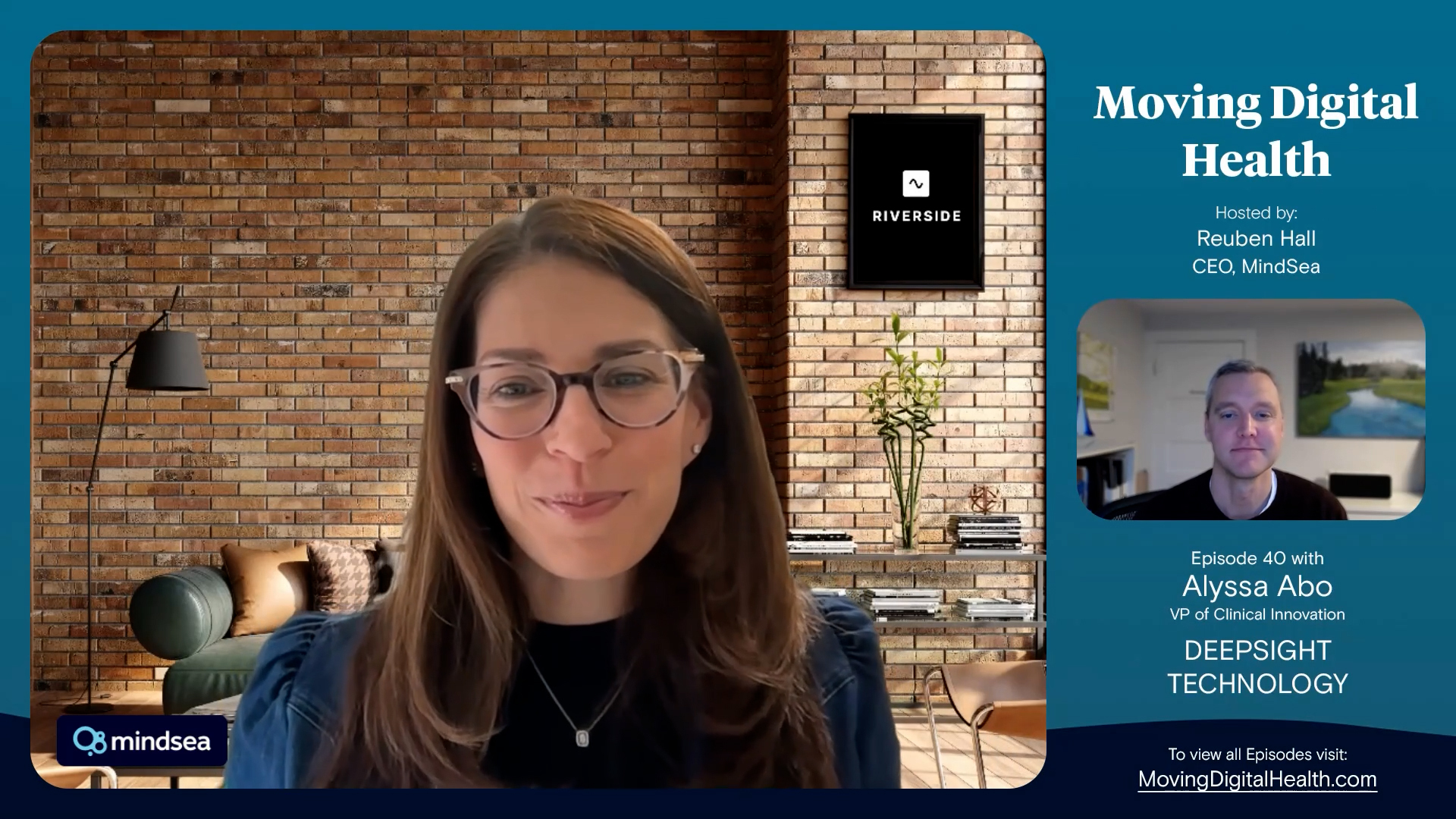
In this episode of Moving Digital Health, host Reuben Hall sits down with Alyssa Abo, Vice President of Clinical Innovation at DeepSight Technology and Adjunct Clinical Professor at Stanford University School of Medicine. Alyssa shares how her career across academia, clinical practice, and industry shapes the way she approaches being a health tech leader. Drawing from real-world pediatric care gaps and years on the clinical front lines, she explains why staying close to clinical reality leads to better problem selection, stronger technology adoption, and more meaningful impact. The conversation explores ultrasound innovation, AI-driven diagnostics, and what health tech leaders can learn from operating at the intersection of research, care delivery, and product development.
“It’s really important for me to have that clinical lens. It keeps me grounded and it reminds me why we’re doing what we’re doing. When you’re innovating in medicine and in healthcare, being as close to the front lines of medicine is very important.
– Alyssa Abo, Vice President of Clinical Innovation, DeepSight Technology
Topics Covered in Episode 40 of Moving Digital Health (Alyssa Abo of Deepsight Technology):
- Clinical curiosity as the starting point for healthcare innovation (0:48)
- Why academic and industry experience matters in health tech leadership (02:32)
- How pediatric care gaps inspire meaningful health tech innovation (06:05)
- Translating real clinician workflows into usable health technology (08:07)
- Applying clinical insight to next-generation ultrasound technology (10:33)
- Improving procedural accuracy through smart instruments and sensors (11:34)
- How AI strengthens diagnostics using real-time clinical data (15:03)
- Expanding access to care through advanced ultrasound technology (16:24)
- What health tech leaders should know about hospital procurement (18:02)
- Advice for clinicians applying academic insight to healthcare innovation (20:30)
Find Moving Digital Health on Apple Podcasts and Spotify, and subscribe to the MindSea newsletter to be notified about future episodes.
Read Transcript:
Reuben Hall (00:00)
Welcome to Moving Digital Health, a podcast series from MindSea Development. I’m your host, Reuben Hall, CEO of MindSea. Each episode, we sit down with leaders and innovators in healthcare to hear their personal stories and explore how they’re moving digital health forward. My guest today is Alyssa Abo, Vice President of Clinical Innovation at DeepSight Technology and Adjunct Clinical Professor at Stanford University School of Medicine. Welcome to the show, Alyssa.
Alyssa Abo (00:28)
Thanks so much for having me. I’m thrilled to be here.
Clinical curiosity as the starting point for healthcare innovation
Reuben Hall (00:30)
Excellent. So you have quite the background in academia, clinical practice at Stanford, and Children’s National.
What was the specific moment or frustration in the emergency room that made you realize, I can’t just use these tools anymore? I need to help build something better.
Alyssa Abo (00:48)
It’s a really great question. And when I think about it, I’m not sure it was a frustration as much as it was curiosity. So I’m in the emergency department. It was my first rotation as a resident in pediatrics at Yale. And I was asking a lot of questions. I remember one of the questions I was asking was related to lumbar punctures and neonates and trying to figure out why some people position neonates on their side and others sat them up. And when I asked, it was basically told to me it’s physician preference. Okay, that’s fine, but I really want to know if one position was better than the other.
And then my mentor actually took it a step further and said, wouldn’t it be really interesting if we could create a device to hold infants in place for the procedure? Because while the procedure has its challenges, really the most challenging part is trying to keep a neonate still.
And that really sent me down this path of, okay, let me find the engineers in residency. Let me see if we can build something together. But before doing that, answer the question, which position actually is better? And in an effort to do that, there was someone else in the emergency department who was starting to dabble in point-of-care ultrasound and took me under his wing. So with ultrasound, we determined that sitting up, the space was a little bit bigger. And then with that, tried to build a device to hold infants in place.
That really is more the theme of my career, of being curious and asking why we do things the way we do. And certainly over time, there are frustrations or I would see something in the adult world and think, wait, why do they have that and we don’t have that? But if I think back to the first memory of really being able to intersect the engineering background with clinical medicine, it was when I was a resident.
Why academic and industry experience matters in health tech leadership
Reuben Hall (02:32)
I love that approach of curiosity and just keep asking why, why, why until you get to the root cause. Now you still hold the faculty position at Stanford while leading innovation at DeepSight.
How does keeping one foot in clinical worlds influence the decisions you make in the boardroom?
Alyssa Abo (02:51)
So it’s very interesting. I grew up in the academic world and was there for over 20 years. I was practicing medicine in the emergency department, but all the meanwhile, working on a whole bunch of initiatives, a lot of them relating back to innovation. And the academic piece of my career was always really very important to me. So when I made the transition to spend more time in industry, I was really trying to figure out ways to hold on to that clinical piece and the academic piece.
And so it’s really important for me to have that clinical lens for a few reasons.
One, it keeps me grounded and it reminds me why we’re doing what we’re doing. And I think when you’re innovating in medicine and in healthcare, being as close to the front lines of medicine is very important. So I’m very grateful that while I work full-time in a med tech startup, I still have an opportunity to be connected back into academic and clinical medicine, where I can be reminded why we’re doing what we’re doing and then also continue to pay it forward in that space.
Part of my career early on was actually while in academics, bridging those gaps and building relationships on the industry side. And so now I just like to think of it in reverse, but the synergies between academics and industry are really very important to me and actually very important fundamentally to innovation on a much larger scale. And so I’m thrilled that I’m able to keep a foot in both worlds.
Reuben Hall (04:18)
It’s interesting. I think there’s this idea that there’s a certain type of people that excel in academia and it’s like a different type of person that excels in industry. But you’re showing there’s no reason we can’t still do both and have them complement each other, right?
Alyssa Abo (04:36)
Yeah, and you know, it’s funny. I think there’s a lot of overlap in what I did in the academic world and what I do now in industry. I think also it’s personality. So the emergency department of the clinical specialties is one of the place where you find a lot of adrenaline junkies. And now in the industry side of things, it’s similar. You know, I find a lot of adrenaline junkies in startups. And so I think just being able to work at that pace.
make decisions quickly, try to move the needle a little bit faster, definitely is a draw for me. And then the other piece of it, like you’re saying, is the team building and being set on trying to improve patient care or healthcare generally and make something a little bit better than how we found it. And so for me, the North Star is always the same, just how I approach it’s a little bit different, but I agree with you that there are skills that translate between the worlds that I don’t know at first glance that people really think would or see themselves outside of the position they’re in, especially when it comes to academics.
Reuben Hall (05:40)
Okay, so are you saying that you’re a little bit of an adrenaline junkie as well?
Alyssa Abo (05:44)
For sure. Yeah, no, and probably not a little. ⁓ Being a New Yorker also probably adds to the pace and the speaking quickly and all of that. But yes, I do. I do like high-paced environments.
How pediatric care gaps inspire meaningful health tech innovation
Reuben Hall (05:58)
Nice. So there are many areas of health tech that you could have focused on, AI, EMR, wearables.
Why was it ultrasound? What is it about that technology that you believe holds the key to diagnostics?
Alyssa Abo (06:15)
So early on ultrasound was the perfect example of what I saw happening in the adult emergency departments, and asked like, why not us? Like, why don’t we have this for kids? I got into ultrasound really out of that curiosity and trying to understand why oftentimes pediatric technology lags adult technology or they start something and then maybe it flows over into the pediatric space but I couldn’t really understand why something like this which was clearly even at the time so fundamental to their workflow and how they cared for patients, we didn’t have.
So early on my career was really focused on building out point of care ultrasound, not only in the hospitals, but really on a national, international level to really make the case that point of care ultrasound can help us at the bedside as clinicians taking care of patients. So that was really my first entry point into ultrasound.
What also ended up happening with that, though was I realized it was more than just ultrasound. I still love ultrasound. I’m very passionate about it. And I can say a few words about why I think ultrasound is so important in a minute, but it really became clear to me. It’s this idea of taking new technology, emerging technology, and figuring out how to leverage that into clinical medicine to help us do what we do better. And the goal is always either to help clinicians take better care of patients or do something directly for patients.
But either way, it was clear to me that ultrasound could do that, and so could other technologies. So over the past few years, I would say, I did spend time working in other technologies and still do in some capacity, either as an advisor to startups or sitting on boards or definitely other technologies that I’m involved with. Most of them do fall under medical devices. I’ve done a little bit of work with real-world data, but I always find myself coming back to medical devices and medical imaging.
Translating real clinician workflows into usable health technology
Reuben Hall (08:06)
Okay, and as VP of clinical innovation, essentially you’re a translator taking the chaotic, unstructured needs of the ER and then translating them into specs the software or hardware engineer can actually build.
Alyssa Abo (08:25)
So I love the translation piece. I love working with the engineers. It brings me great joy to be able to do that. The running joke is, you know, I trained in engineering, but I am not an engineer, but I can speak that language well enough, I would argue, to be able to effectively communicate with them. And I think that’s really what it’s all about. The engineering team’s hardware software are brilliant folks doing an excellent job and being able to bring that clinical piece in early just helps us ensure that we’re actually solving problems that need to be solved.
My experience generally in startups is there’s a lot of cool technology out there, but sometimes the technology is now looking for a problem to solve as opposed to finding out like what those problems are and then solving towards them. And so I think as a clinician, being able to see firsthand what the problems are and then also being able to pull in other clinicians. So part of my role, I am involved intimately with our KOLs and our advisor network and really making sure that I can bring the clinician voice that’s beyond just me, but really make sure that I can bring the voices of others who are maybe seeing different challenges or different problems and making sure that our technology is meeting the mark and helping them solve their problems as well.
I heard a lot of stories of people that have had orthopedic surgery, and coming out of the surgery they realize that their legs are a different length. They have a new hip or had knee surgery. Go back to their specialist and say, like, it feels like I’m limping more on this side and their expert, I’ve always heard something along the lines of “you were already kind of imbalanced before you came in, you’re just realizing it now that you had surgery because it’s different than what it was before”. And then we get used to it, we develop kind of these patterns to compensate for it.
For a lot of people, it’s not obvious enough to notice it in the short term, but there’s always kind of something that pops up long term.
Reuben Hall (09:42)
Yeah, I love that translation piece as well. So at MindSea, we have a team of software developers and user experience designers that are really experts in technology, but we are not the medical experts. And we’re always working with the clinicians who are the medical experts, but might not know anything about technology or actually implementing the solutions that they see the need for.
So that ability to take experts from different fields and find a common language and be the glue there to connect that is definitely essential. So for our listeners who aren’t radiologists, can you explain the problem DeepSight is solving and why traditional ultrasound has hit a wall?
Applying clinical insight to next-generation ultrasound technology
Alyssa Abo (10:32)
Sure, so ultrasound as a modality has so many uses and like we were talking about earlier, really is one of the technologies I believe can be the great equalizer, close healthcare gaps, be universal, be used globally. And so I’ve been very fortunate to work in the ultrasound space for my gosh, probably coming up on 20 years. So I have seen innovation in ultrasound over time, but nothing really transformative.
And what’s really unique about DeepSight is that we are focused on sensor technology, believe it or not, and sensors that go into instruments that then couple with ultrasound. And so it’s incredibly novel that now we are basically making instruments that haven’t changed in like 200 years. So if you think about a needle in the hospital now, it’s the same ones that they were using in the Civil War 200 years ago. Like there hasn’t been much change there. And so we are taking those instruments and we’re making them smart and we’re putting sensors in them. And that is allowing us to really change how ultrasound is being used for interventional procedures.
Improving procedural accuracy through smart instruments and sensors
Reuben Hall (11:34)
Could you give us an example maybe of a specific use case, how were the sensors combined with the ultrasound are improving the results and the data we’re getting out of it?
Alyssa Abo (11:48)
For sure. So we can take a use case of abdominal biopsies. So when you’re doing an ultrasound-guided abdominal biopsy, it’s really crucial to be able to see where your instruments are. Now, those instruments might be what we call an introducer. So the needle that goes in first to get you to your place. And then you take out the style, which is inside that introducer. And then you put down your device to actually collect the biopsy.
You can imagine that if you’re in the liver, some lesions are steep or DeepSight, and it’s really sometimes hard to see where your needle tip is with confidence. So the fact that DeepSight’s giving you an opportunity now, because that sensor is at the tip of the instrument, to say with confidence, okay, I know exactly where I am, then that translates. Our goal is once this is being used clinically, we will see that we are more effectively hitting the target and getting the biopsies and obviating the need for CT in some cases when maybe ultrasound was at a disadvantage because there were so many challenges around the visualization.
Really at the end of the day, any ultrasound-guided procedure could benefit from having a smart instrument. And again, that can be a needle, it can be a wire, it can be a catheter, but it’s really allowing the clinicians to have confidence in knowing exactly where they are at all times.
In addition, the sensor has other functionality. So the sensor can detect changes in pressure and temperature. And because the sensor is actually itself listening for sound, we can generate ultrasound images from within the body. And that really is an industry first, and that’s a game changer. Because sometimes something is DeepSight, now we can show you, okay, yes, your needle tip is there and you can see that. But maybe the image that you’re seeing on your screen is like not great for some of those deeper structures.
Now we’re giving you an opportunity to see from the vantage point of the instrument and that really starts to transform how we think about ultrasound guided procedures and that was a big draw for me when I joined the company.
Reuben Hall (13:53)
Okay, so yeah, we can see how sensors really improve the precision of the overall operation. And then how does the software overlay on top of the additional sensors and hardware innovations?
Alyssa Abo (14:10)
So another great question. So certainly the software and the hardware and the way they interact is incredibly complicated and sophisticated. And I would defer to my colleagues on those teams to give you more of the technical DeepSight dive.
But at a 30,000-foot view, obviously, the software is an integral part of making sure the hardware is being able to absorb the information and translate that to the clinician. I would say in addition to that, the software piece is how we’re also capturing a lot of that data to then understand even more so what’s happening during these procedures. So the software piece and the ability to capture data, whether it’s like I was mentioning pressure, temperature, or actually characteristics of the tissue itself, really is just adding another layer to why it’s so important that the software works in sync and seamlessly with the hardware.
How AI strengthens diagnostics using real-time clinical data
Reuben Hall (15:03)
Okay, and I have to ask this because AI is in every conversation about health technology. How does AI fit into DeepSight and what you’re doing?
Alyssa Abo (15:15)
Yeah, so another great question. It fits in a number of ways, but I’ll tell you the one that I’m most excited about. So imagine now because of the sensor, we can get information throughout the procedure. So whether it’s pressure changes, temperature changes, or tissue characteristics, AI will enable us to be able to use that in real time to better delineate where we are and what we’re looking at.
And the idea that earlier diagnosis or earlier diagnostics leads to better therapeutics is very exciting for me because it means that this notion of radiogenomics using ultrasound data with genomic data and really putting all the pieces of the puzzle together, the data that we would get, see fitting into that mold and adding to the mix and making what we do now even that much better. And then that starts to get into the whole precision medicine and things like that. To me, that’s really exciting, being able to use the data from ultrasound from within the body that I have not seen done before.
Expanding access to care through advanced ultrasound technology
Reuben Hall (16:15
Wow, yeah, there’s a lot of potential there for sure. And then how about, you know, how does DeepSight site and the increased depth and clarity of ultrasound affect the rural or global health?
Alyssa Abo (16:32)
Sure. So I think we started to touch on this a little bit, but the ability to see with confidence takes the guesswork out of it. And I think with that, we can help clinicians more confidently do procedures that might be at the fringe of what they’re doing right now. So there are times when procedures are just that much more complicated that people have to leave the rural areas that they live in and travel a few hours away to some of the larger centers.
And the idea would be if we can build out the technology that can really help serve the clinicians and patients in different areas, we can then bring a higher level of care to other parts of the country where historically maybe that procedure wouldn’t be able to be done.
Reuben Hall (17:19)
So you can take something that was previously required a specialist and maybe a more generalist clinician can do that same procedure now with the information that they’re getting from the sensors and accuracy of the technology.
Alyssa Abo (17:35)
Exactly right. And look, as a physician, the clinical training piece is obviously very important to me. And so we all have our scope of practices and we all operate within those scope of practices. But in my mind, sometimes people’s scope is broader than they’re able to do, limited by maybe the technology they have or the resources that they have. So if we can bring some of the technology and resources so people are really practicing medicine more broadly within their scope, I think then it serves everyone involved.
What health tech leaders should know about hospital procurement
Reuben Hall (18:02)
And introducing new hardware and technology into a hospital system is notoriously difficult. And what have you learned along the way about the business of getting hospitals on board with the new technology and the procurement process that goes along with that?
Alyssa Abo (18:21)
So my short answer to that is it’s not one person. I have spent enough time working in executive positions and startups and always trying to pinpoint who that person is or who the decision maker is in a hospital. Even if it’s a singular person in a hospital, that person is not usually replicated at another hospital. So even if it’s the CFO at one hospital, maybe it’s not the CFO at another. So I like the top-down, bottom-up approach.
in the sense that it’s really important to me that the people, and again, I don’t think the clinicians are at the bottom, but I think you appreciate what I’m saying in the hierarchy of the hospital. I think the people who are doing the work who are patient-facing should be intimately involved in this process so that they are the physicians or nurse practitioners, there may be other clinicians also who are adopting the technology. They have to believe that this will help them do what they do better.
It is also not lost on me that you mentioned hospitals being a business. They are a business, and the economics have to make sense. So I learned early on in my career, when I was advocating for point of care ultrasound and trying to get new equipment for the hospital, having to answer the question, well, what’s the ROI? Well, I have no idea. I’m a physician. They didn’t teach that to me in med school. So fear not, that was the impetus for going to get an MBA so that I could be a translator and speak that language as well.
But it is a business and it’s important that the startups understand the economics of it. In my mind, the other stakeholders are those who are managing the finances of the hospital. Being able to take the argument and explain to the CFOs of the hospital why in addition to making clinical sense, this makes financial sense, I think is very important. I’m a big advocate of making sure that the physicians are engaged and they are willing to adopt the technology because they see the value in the actual clinical part. And then simultaneously, I work with our commercial teams and other teams who are making that case to the administrators in the hospital because I think they’re both really important parts of the equation.
Advice for clinicians applying academic insight to healthcare innovation
Reuben Hall (20:30)
So there are a lot of doctors out there who are in your shoes in the early days. They have ideas for solutions, or they see a gap in care that needs to be solved, but don’t know where to start. So, do you have any advice for a clinician who sees a solution with technology and how to turn that into reality?
Alyssa Abo (20:55)
Sure, so a few ideas. I would say if someone is using something all the time that just fundamentally isn’t working as well as they want, reach out to the company who made that. See if they would be willing to have a conversation because chances are they get clinician input. And so being able to say, hey, the next time you are going to make the next iteration, I’d love to be a part of the conversation and if people want something more and they wanna be advisors for companies, that’s actually a nice way to just reach out and see if there’s an opportunity for engagement.
So definitely if people see a problem with what they’re using, for sure I would reach out to the companies, especially if it’s something small but meaningful, that would definitely be the way to go. I would also encourage people to reach out within their organization.
Some academic hospitals and other hospitals now have innovation centers, which, I will tell you embarrassingly, like I worked at hospitals and even with my engineering background, didn’t even know what innovation capabilities we had, what was really happening in that space until someone made the introduction. So I do think that it may just not be on people’s radar, but chances are it’s there in some capacity. So I would encourage people at their own institutions, like look to see what type of innovation you have.
Some hospitals are also connected to universities, where they may have some type of innovation arm as well. So I always like to tell people to check that out too. And then the other piece I’ll say is a lot of us are a part of our subspecialty organizations. So for me, that was always the American Academy of Pediatrics and the American College of Emergency Physicians. And so in that space, too, you can learn from other people who are innovating. Sometimes there’s opportunities to innovate or be a part of something new.
And so I would definitely encourage people to do that. And then if all else fails, people are welcome to reach out to me. They can find me on LinkedIn and I’m happy to help brainstorm how they can get involved in different innovation initiatives outside of the hospital.
Reuben Hall (20:03)
Well, that certainly is excellent advice and thank you so much for sharing your experience and your perspective on the podcast today.
Alyssa Abo (25:13)
My pleasure. Thanks for having me.
Reuben Hall (25:15)
And thanks to everyone for listening to the Moving Digital Health podcast. If you enjoyed this conversation, please go to movingdigitalhealth.com to subscribe to the MindSea newsletter and be notified about future episodes.