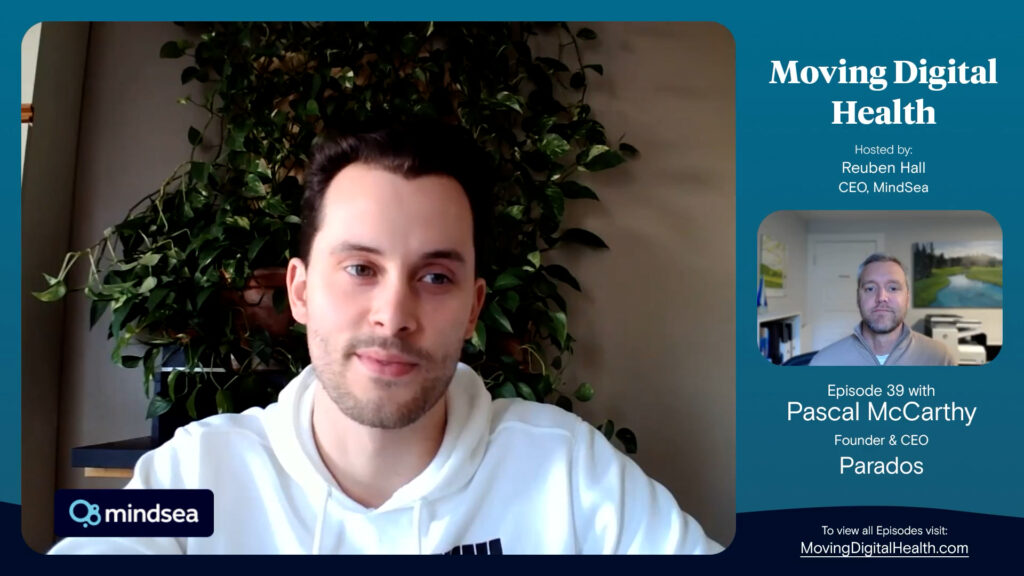

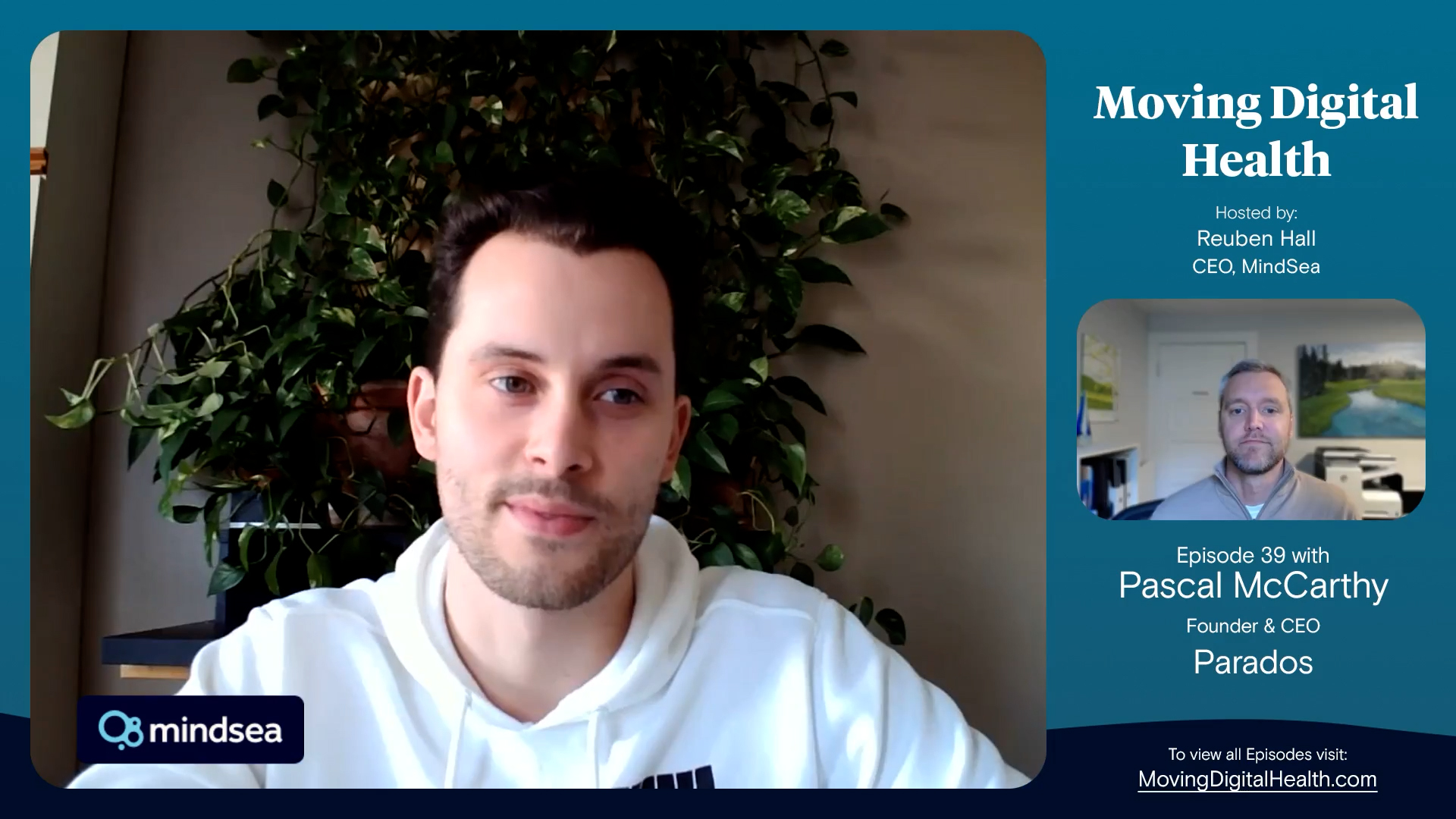
In this episode of the Moving Digital Health podcast from MindSea, Parados founder and CEO Pascal McCarthy shares how his experiences as an athlete led him to build a new kind of motion capture technology for healthcare to more frequently assess patient movement. Parados helps clinicians and athletes record and analyze movement using simple video capture, making it possible to identify gait imbalances, track recovery, and optimize performance without relying on a full motion lab. Pascal also discusses where this technology is headed next, including the potential for large-scale movement analysis to diagnose mental health issues earlier and improve long-term rehab and athletic outcomes.
“It’s always a trade off for clinicians to kind of ‘how accurate can I get data’ or ‘how fast can I make the decision’? You can get comprehensive data but it takes an hour and a half, a thousand or so dollars, and a full motion capture lab. … We’re really that ideal middle ground for screening and monitoring so you can do it anytime, anyplace and improve the frequency of testing.”
– Pascal McCarthy on how Parados is empowering more frequent movement analysis
Topics Covered in Episode 39 of Moving Digital Health (Pascal McCarthy of Parados):
- How Pascal’s athletic injuries led to the idea for Parados (00:35)
- What an NHL player’s injury reveals about traditional care in sports medicine (04:43)
- Why skeletal asymmetry matters for long-term health and performance (06:46)
- The problem Parados is solving by making motion capture technology accessible (09:06)
- How Parados measures and analyzes human movement (11:52)
- Making movement data meaningful for clinicians and rehab patients (13:52)
- Why faster, more frequent movement testing improves clinical efficiency(15:11)
- Helping athletes and patients stay engaged in their recovery (17:43)
- How ongoing movement assessments can unlock more personalized rehab plans (19:49)
- The future of motion capture technology in mental health and physical performance (22:36)
Find Moving Digital Health on Apple Podcasts and Spotify, and subscribe to the MindSea newsletter to be notified about future episodes.
Read Transcript:
Reuben Hall (00:00)
Welcome to Moving Digital Health, a podcast series from MindSea Development. I’m your host, Ruben Hall, CEO of MindSea. Each episode, we sit down with leaders and innovators in healthcare to hear their personal stories and explore how they’re moving digital health forward. Today, I’m thrilled to be joined by Pascal McCarthy, an innovator at the intersection of sports, health, and technology. He’s the founder and CEO of Parados, a company poised to change how we understand human movement. Pascal, welcome to the show.
Pascal McCarthy (00:33)
Thanks, nice to be here.
How Pascal’s athletic injuries led to the idea for Parados
Reuben Hall (00:35)
Now, you have a rare background as a former athlete in two different sports, neuromechanics researcher, and now a tech CEO.
Can you tell us how those experiences you faced as an athlete fed into what you’re doing at Parados?
Pascal McCarthy (00:52)
Yeah, I think most of them really gave me the itch that I want to scratch. Kind of saw behind the curtains in some situations and was on both sides of being an athlete, being a coach, being a trainer and saw the imperfections, I guess, in most of those things. And so, that motivated me to carry out my own, I guess, my own solution.
Reuben Hall (01:20)
Now, did you have any injuries specifically that kind of led you into that side of like the, you know, the diagnosis and rehab part of it as well?
Pascal McCarthy (01:31)
Absolutely, yeah, I can’t keep count of all of them, but it all started with my Achilles tendon when I was seven years old. Just talking to a lot of experts about that. Even when I think back, it’s hard to believe that I tore my Achilles that young.
Pascal McCarthy (01:49)
But it kind of started there, every couple of years it was either an ankle, knee, hip problem. Ended up having knee surgery before I turned 20. And then just constant, I guess constant like jumper’s knee, sprained ankle here and there. Then eventually cut short my professional volleyball career. And then that sent me back to school, which sent me on the path to Parados.
Reuben Hall (02:17)
And what did you do in school exactly?
Pascal McCarthy (02:20)
My bachelor’s was in mechanical engineering. So I did that while playing volleyball and baseball and then I went back to do a masters in technology management and entrepreneurship. It was basically taking students with a STEM background, with a STEM bachelor’s degree, and introducing them to the entrepreneurial side of things, finance, and a little bit to be able to build the technology solutions and then also manage the growth of them.
That’s really where I got kind of a bit by the bug of entrepreneurship. I got to see that I can really help solve some problems that are near and dear to me.
Reuben Hall (03:03)
Okay, and you say you lead with your love for learning and teaching. How does that passion shape the mission of your company, making those complex health science accessible to everyone?
Pascal McCarthy (03:18)
Yeah, from, I guess in sports and coaching is really where I learned that I like, I like teaching and then while I was playing volleyball was kind of bored in the middle of the days and, picked up a job teaching at the local college prep school in France. And then, yeah, kind of just realized that across the board, I like learning and teaching. I think I kind of fell into, being a founder didn’t really realize that it was all learning and teaching and constant learning and teaching. But yeah, that ended up really making it interesting to stay as a founder. I looked at kind of other jobs. Most of them, what I saw was a potential plateau, whereas you kind of never have to stop working on yourself as you know.
What an NHL player’s injury reveals about traditional care in sports medicine
Reuben Hall (04:08)
Yeah, definitely. I can relate a lot actually. I played sports university and do quite a bit of coaching in basketball with my kids. And certainly the reward of seeing that growth in the players throughout the season, individually and as a team, it’s almost addictive. You get a lot of reward back from that.
I was fascinated by the story you shared about the professional hockey player. Could you walk our listeners through that case from the beginning?
Pascal McCarthy (04:43)
Yeah, absolutely. Yeah, we worked with and NHL team. So they have at least three typical, like three teams of experts, the medical team, the therapy team, the skating team, shooting team. And so this one player and a team that took their skating very seriously and kind of have won a few Stanley Cups in the last decade, well, in the decade or so.
They had a player come in, the medical team said back pain, the therapy team said tight hips, the skating team said he could produce twice as much power in one leg as the other. They all came up with different diagnoses and different potential solutions. And then we ran them through a simple screening. So just posture, squat and, and gait. From that it was pretty clear to see there’s some kind of imbalance between his knees and his hips. Like every time he went down, he would hitch on one side, then come back up crooked.
And then through that they went back, looked, and decided to measure his bones and then figured out that one of his femurs is an inch longer than the other. Then they X-rayed his hip, turned out his hip bone was completely deformed from compensating for over 20 years playing at a high performance level, lifting weights every day. And then from that they came to the conclusion he was kind of a ticking time bomb. Like we know kind of something’s gonna break down. We just don’t know when.
And so that was a big issue for them. They kind of found out that even at the highest levels of care, even with the best experts in the world, it’s easy to miss something when you’re looking through your own lens and rather than maybe an objective, starting at an objective point and working through a process of elimination. So that was really interesting to see how some of those really common things can slip through the cracks when you’re not taking at least a combination of an objective and subjective approach.
Why skeletal asymmetry matters for long-term health and performance
Reuben Hall (06:46)
And how common are those kind of asymmetrical differences in the skeletal structure?
Pascal McCarthy (06:56)
Yeah, from the yeah, we looked in the research more. It seems like over 90% of people have at least half a centimeter difference that ends up causing a problem over the long term.
I heard a lot of stories of people that have had orthopedic surgery, and coming out of the surgery they realize that their legs are a different length. They have a new hip or had knee surgery. Go back to their specialist and say, like, it feels like I’m limping more on this side and their expert, I’ve always heard something along the lines of “you were already kind of imbalanced before you came in, you’re just realizing it now that you had surgery because it’s different than what it was before”. And then we get used to it, we develop kind of these patterns to compensate for it.
For a lot of people, it’s not obvious enough to notice it in the short term, but there’s always kind of something that pops up long term.
Reuben Hall (07:55)
It also kind of highlights like how the different experts can look at the same athlete and see completely different problems because they’re so focused on their specialty or their lens. How much of an issue is that type of siloed thinking in sports and general health care?
Pascal McCarthy (08:14)
Yeah, especially I think with the symptom based approach that pretty much every expert in North America is kind of motivated to do with the traditional healthcare system, the kind of “Sausage factory” or different people have different names for it, essentially getting someone in and out as fast as possible. It’s all too common. It’d be hard to put a number because I think we can’t even identify all the problems that it leads to. It has to be the huge majority of cases. And so that’s what I’m trying to kind of, that’s what we are doing is taking more of a root cause approach rather than the symptom based which leads to some oversight, I guess, in a huge amount of situations.
The problem Parados is solving by making motion capture technology accessible
Reuben Hall (09:06)
So can you break down Parados, the solution, how it works, like step by step, what does a clinician actually do when they use it, and where do the benefits or outcomes come out of that?
Pascal McCarthy (09:21)
So, we try to not, we don’t mess too much with the current workflow of things. The best way we found to adopt to, integrate a product, or to get widespread adoption, is really to change what happens around the typical workflow. So patients can upload, record themselves walking, squatting, basic functional movements to prepare that information for the expert. I often say similar to doctor or dentist, where they have someone that prepares all the information, helps kind of assist them in making the decision, but really getting the expert to come in, make the final decision, and decide next steps.
Because that’s where their time is best used. That’s really how we, what we’re designed for, is to make the most of their time by allowing the whole process to be kind of self-driven and by patients and to be engaging, educational. So you record the videos before and after the session. And then it’s really just a rapid test tool you can do from home, from anywhere really.
Reuben Hall (10:34)
So how many videos might a patient record of different movements or different angles?
Pascal McCarthy (10:42)
Yeah, typically the three main movements where you can spot the huge majority of problems are our posture, squat and walking like the building blocks of movement. And so from six videos, one from the front and the side that we’re able to kind of to really screen and monitor the 90 plus percent of situations and then.
If you have something specific, like if you have a knee problem that you specifically want to address, because that’s your, maybe that’s your biggest vulnerability at this point, or that’s your weak spot, it would only be two or three videos depending on what you’re trying to improve. So I could go through a ton of situations, whether it’s kind of preventing falls or recovering from a knee injury. We just help measure that kind of, what’s the one metric you want to measure to really improve to get the most out of your rehab, or the two – three exercises you can do, and what’s the one thing that we can measure to put you on that right path.
How Parados measures and analyzes human movement
Reuben Hall (11:52)
And from the technology perspective, what exactly is happening in the background? How are those videos being processed? What are the key data points you’re pulling out of that?
Pascal McCarthy (12:05)
Yeah, so similar to video call when we’re on zoom or whatever, when it picks out your silhouette, blurs the background, that’s the first step. And then we use a huge data set, collected in a motion capture lab that are in universities and hospitals, and we predict where your joints are based on that silhouette.
That part we’re constantly improving and working on. And then depending on the situation, we either measure how fast you walk, how much you limp, kind of what’s the difference in symmetry? Maybe how much lower is your right shoulder than your left shoulder? And it really breaks down to four main categories: mobility, symmetry, consistency, and stability across all kinds of movements. That’s always what we’re looking at.
Reuben Hall (12:59)
And so is that mapping all the joints in the body or are there just key like, you know, core movement joints that you’re looking at?
Pascal McCarthy (13:07)
Yeah, so different models, different approaches. We map pretty much all the joints other than, I guess, your hands. You’ve got most of your joints in your fingers and toes. So, but otherwise we map everything from the ankle to the neck. What’s not usually, or what’s not often looked at, I think, or often enough is the ankle because everything I guess starts at the ankle. If you have an ankle problem, it’s going to become a knee, a hip, a back, a shoulder, a neck problem, because everything starts from the ground up. So we really want to focus on most joints and especially the lower body.
Making movement data meaningful for clinicians and rehab patients
Reuben Hall (13:52)
And what does the clinician see, once you capture the videos, they’ve been analyzed, how is that data presented to them and distilled in an actionable way?
Pascal McCarthy (14:05)
Yeah, it comes out as both like a report, just an easy to understand report for patients and then for experts, they get a detailed breakdown of the key metrics they use to make decisions.
Again, if I’m trying to prevent falls or maybe help someone recover from a knee problem, I’d be looking at how fast are they walking? How many steps per minute? How much are they favoring one side when they’re walking? How big are their strides? How much time do they take in between every stride? And so it’s really the small, but important, details about someone’s walking patterns and range of motion.
I keep going back to gait because that is usually the most telling and the most widely used movement to be analyzed. But yeah, those are some of the main metrics that we focus on. I think we have quite a few dozen, so I won’t go through all of them.
Why faster, more frequent movement testing improves clinical efficiency
Reuben Hall (15:11)
And how does this save time or improve the efficiency for the clinician? How are we measuring how much better this is than the current standard?
Pascal McCarthy (15:26)
Yeah, yeah, good question. It’s always a trade off for clinicians to kind of “how accurate can I get data” or “how fast can I make the decision”? So we are focused on improving that trade off to get data that’s accurate enough to make a good decision rather than get no data and kind of it be a guessing game, or get the get comprehensive data but it take me an hour and a half, a thousand or so dollars, and I have to set up bring everyone together at the same time in the same place in a motion capture lab, plug them in with all this equipment.
We’re that really the ideal middle ground for screening and monitoring so that you can do it anytime, anyplace and really improve the frequency of testing. Because that’s usually the problem.
For example, my brother worked for the Blue Jays. What I saw even with them is that they would do a comprehensive analysis, but once a year. And I might get injured twice in between each analysis. So how can I really be sure that the steps I’m taking, the exercise program that I’m given is the best thing for me at the time. If it’s only getting revisited once a year with data to back it up. So yeah, improving that frequency of testing and the speed of testing really helps them correct the path more often and with something to back it up.
And really to get the buy-in from the patient as well. Because oftentimes, if I’m, as the patient, I kind of see it’s just a guessing game, or at least that I think it’s a guessing game, it’s not always as motivating or as convincing to me to follow the exercise program.
Reuben Hall (17:17)
So, Parados can be used remotely and the video is just uploaded and like you say, the higher level of frequency for more check-ins, more eyes on the issues. Yeah, certainly makes a lot of sense for that situation.
Helping athletes and patients stay engaged in their recovery
Reuben Hall (17:43)
How about just an individual? Like can they use Parados themselves just to get that information for, let’s say you’re like an amateur athlete, you know, does, you know, local marathons and that sort of thing. Is that a tool you can just use on your own or is it more, is it always in combination with, you know, a coach or a clinic that’s helping do that expert level analysis for you?
Pascal McCarthy (18:09)
Yeah, there are absolutely some people who are able to do it themselves. We’ve designed it really for experts because I think that’s the best way to get a system that gets buy-in credibility across the board. I think it’s a lot easier to start at a high level and kind of make it for the masses rather than start with a product that doesn’t really take the approach that the best highest end experts take and then try to change it from there. So it’s really for anyone.
And even if we’re going through an expert, what we are doing is giving immediate feedback to the person. So even if I don’t diagnose or recommend, at least I can know, as I’m uploading my video, that I’m walking 10 percent slower this week than last week. And so that might I might be able to kind of draw some conclusions or connect that. I know my Oura ring told me I didn’t sleep nearly as well this week. That might have played a part in it. And that might not be something that I would realize or maybe even communicate to the expert if I’m not aware of kind of the outcomes and the measurements.
So it’s really a tool to inform and educate everyone and to make everything more on demand, more personalized, and more documented, more measured.
How ongoing movement assessments can unlock more personalized rehab plans
Reuben Hall (19:49)
I’m curious what the typical treatment plan is for someone who has this skeletal asymmetry. Obviously you can’t just add or remove length to your femur or there’s certain things that that’s just the way it is, but then how do you compensate that in a healthy way as opposed to creating these imbalances?
Pascal McCarthy (20:19)
Yeah, that’s something that really interested me as well. And when it came to that player, I remember one of the coaches after he figured it out saying something along the lines of like he’d be perfect for track, because it’s a lot easier for him to turn left. And so if you were doing full sprint, it’s a lot, he’d he’d have a natural kind of tilt that you’re looking for in a
Reuben Hall (20:40)
Yeah, a natural lean to the left.
Pascal McCarthy (20:43)
Yeah, so it’s really, like it’s case by case. It’s 100 % case by case and if you’re an archer, maybe you want some kind of a balance, if you’re, you want to be able to kind of hold better with one arm and pull back with the other, if you’re a hockey player…
Some of these imbalances are you’re born with and then some of them are developed as well. For example, you look at soccer players, most of them after a decade or two will have bow legs. And it’s really from sport to sport, completely depends. You might just give them a strengthening or stabilizing program where they have to double up on one side or you just want to stretch them out. Make sure that they stretch out that hip or that side more. And so that’s really why I think the frequent assessment approach helps, because it’s all kind of trial and error. It’s all to some degree a guessing game. But the more you can check in, the more data you get, the more you can you can kind of narrow the possibilities and improve the outcomes.
The future of motion capture technology in mental health and physical performance
Reuben Hall (21:59)
Yeah, and I think that’s really the key that you hit on there is the more accurate data you have on any condition and especially over time as well, like frequent recaptures of that data, you just have more information to make better decisions for better outcomes for the patient.
So looking into the future, let’s say, five years, what’s the ultimate vision for how a Parados might impact how we assess health and movement?
Pascal McCarthy (22:36)
Yeah, the goal that we’re working towards, the North Star, is really to be what I call a large movement model. To be the first large movement model and to based on where you are, where you want to get and how you’re currently moving and what your goal is to be able to draw the path between the two and kind of constantly check in.
So, for example, if I want to run faster, if I want to jump higher, if I want to sprint faster, those are three different training programs. And depending on my starting point, then the kind of possible, the ideal training program, there’s a million different possibilities. So I want to be able to have that context and combine both where you are right now and and the objective data that we have to draw the best path forward that’s in any situation.
That’s why we’re in most universities and in most health and movement science departments and universities and continuous education programs. So for kinesiologists, physiotherapists, occupational therapists, physiatrists and so on to be sure that it can be used in any situation and that we have the tools to be able to help any kind of movement, imperfection, and improve the path forward.
Then as we’re doing that, I’ve come into a lot, and with my research and then also with some of our partners, our nonprofits, we’re looking at drawing the correlations between your mental state and your physical state. Because just for example, like the common sayings “hanging your head” or “dragging your feet”, where those are so, I guess, well recognized from the human eye, but they’re not necessarily measured yet through technology. And I think that we can do a lot better at identifying potential kind of problems, whether it’s from a physical perspective or mental perspective, whether it’s because you have concussions or maybe you have trauma that you’re working through to be able to identify any imperfections early and kind of set a path, a correction path for it.
That’s really where I want to get long term, whether it’s CTE, Alzheimer’s, Parkinson’s, any kind of movement disorder, neurodegenerative disorder. It’s kind of measuring how does the body affect the mind and vice versa and how can we do that through an objective measure like movement.
Reuben Hall (25:30)
Very interesting. Well, certainly a lot of potential and a lot of places you can kind of expand and explore into. So I really appreciate your time. Thank you for joining me on the podcast today, Pascal.
Pascal McCarthy (25:45)
My pleasure is great. Great to be here. Thanks for having me.
Reuben Hall (25:49)
And thanks to everyone for listening to the Moving Digital Health podcast. If you enjoyed this conversation, please go to movingdigitalhealth.com to subscribe to the MindSea newsletter and be notified about future episodes.